

5 Enabling Materials By Dimensionality: From 0D to 3D Carbon-Based. . .
149
5.2.1.1 Experimental Results
The experimental activity was focussed on synthesizing nanostructured carbonbased materials, such as silicon carbide (3C-SiC) [42–44] and graphene [46, 49, 50],
using C 60 fullerene supersonic beams impinging on metallic or semiconductor
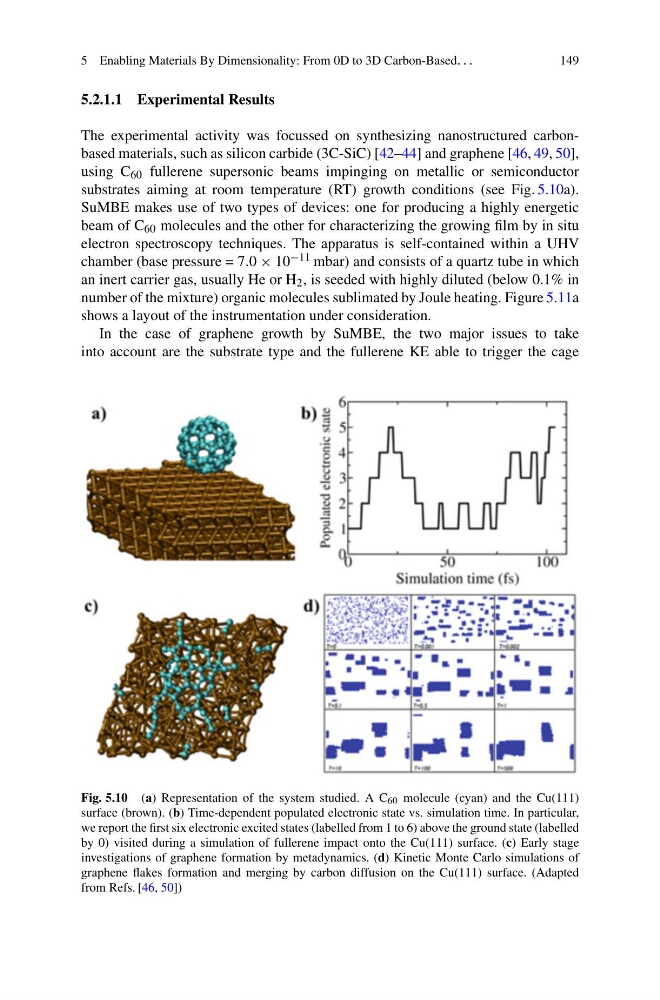
substrates aiming at room temperature (RT) growth conditions (see Fig. 5.10a).
SuMBE makes use of two types of devices: one for producing a highly energetic
beam of C 60 molecules and the other for characterizing the growing film by in situ
electron spectroscopy techniques. The apparatus is self-contained within a UHV
chamber (base pressure = 7.0 × 10 −11 mbar) and consists of a quartz tube in which
an inert carrier gas, usually He or H 2 , is seeded with highly diluted (below 0.1% in
number of the mixture) organic molecules sublimated by Joule heating. Figure 5.11a
shows a layout of the instrumentation under consideration.
In the case of graphene growth by SuMBE, the two major issues to take
into account are the substrate type and the fullerene KE able to trigger the cage
Fig. 5.10 (a) Representation of the system studied. A C 60 molecule (cyan) and the Cu(111)
surface (brown). (b) Time-dependent populated electronic state vs. simulation time. In particular,
we report the first six electronic excited states (labelled from 1 to 6) above the ground state (labelled
by 0) visited during a simulation of fullerene impact onto the Cu(111) surface. (c) Early stage
investigations of graphene formation by metadynamics. (d) Kinetic Monte Carlo simulations of
graphene flakes formation and merging by carbon diffusion on the Cu(111) surface. (Adapted
from Refs. [46, 50])
149
5.2.1.1 Experimental Results
The experimental activity was focussed on synthesizing nanostructured carbonbased materials, such as silicon carbide (3C-SiC) [42–44] and graphene [46, 49, 50],
using C 60 fullerene supersonic beams impinging on metallic or semiconductor
substrates aiming at room temperature (RT) growth conditions (see Fig. 5.10a).
SuMBE makes use of two types of devices: one for producing a highly energetic
beam of C 60 molecules and the other for characterizing the growing film by in situ
electron spectroscopy techniques. The apparatus is self-contained within a UHV
chamber (base pressure = 7.0 × 10 −11 mbar) and consists of a quartz tube in which
an inert carrier gas, usually He or H 2 , is seeded with highly diluted (below 0.1% in
number of the mixture) organic molecules sublimated by Joule heating. Figure 5.11a
shows a layout of the instrumentation under consideration.
In the case of graphene growth by SuMBE, the two major issues to take
into account are the substrate type and the fullerene KE able to trigger the cage
Fig. 5.10 (a) Representation of the system studied. A C 60 molecule (cyan) and the Cu(111)
surface (brown). (b) Time-dependent populated electronic state vs. simulation time. In particular,
we report the first six electronic excited states (labelled from 1 to 6) above the ground state (labelled
by 0) visited during a simulation of fullerene impact onto the Cu(111) surface. (c) Early stage
investigations of graphene formation by metadynamics. (d) Kinetic Monte Carlo simulations of
graphene flakes formation and merging by carbon diffusion on the Cu(111) surface. (Adapted
from Refs. [46, 50])