

148
S. Taioli
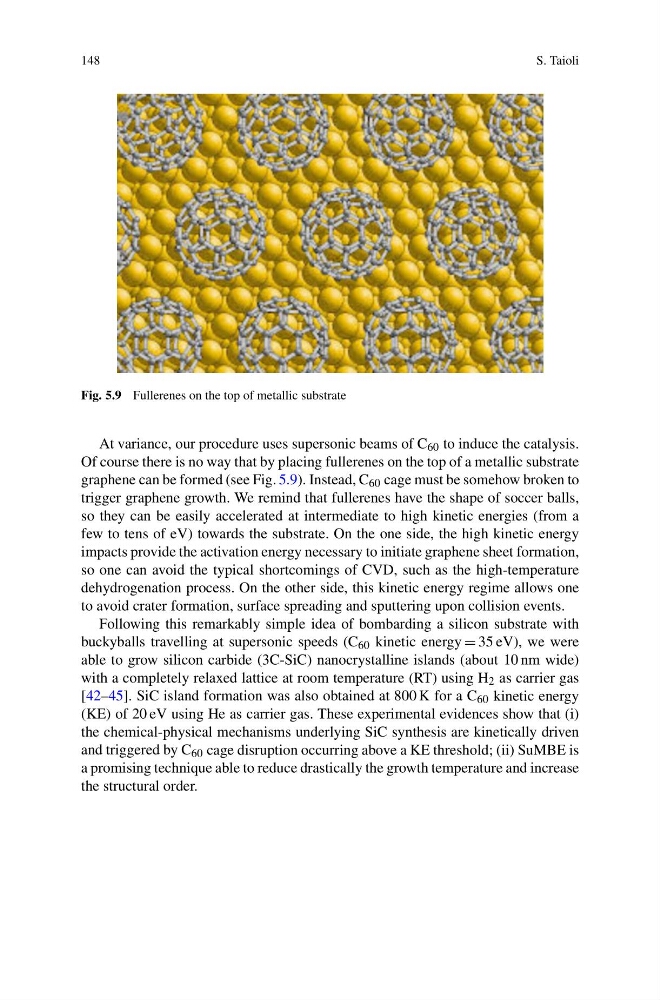
Fig. 5.9 Fullerenes on the top of metallic substrate
At variance, our procedure uses supersonic beams of C 60 to induce the catalysis.
Of course there is no way that by placing fullerenes on the top of a metallic substrate
graphene can be formed (see Fig. 5.9). Instead, C 60 cage must be somehow broken to
trigger graphene growth. We remind that fullerenes have the shape of soccer balls,
so they can be easily accelerated at intermediate to high kinetic energies (from a
few to tens of eV) towards the substrate. On the one side, the high kinetic energy
impacts provide the activation energy necessary to initiate graphene sheet formation,
so one can avoid the typical shortcomings of CVD, such as the high-temperature
dehydrogenation process. On the other side, this kinetic energy regime allows one
to avoid crater formation, surface spreading and sputtering upon collision events.
Following this remarkably simple idea of bombarding a silicon substrate with
buckyballs travelling at supersonic speeds (C 60 kinetic energy = 35 eV), we were
able to grow silicon carbide (3C-SiC) nanocrystalline islands (about 10 nm wide)
with a completely relaxed lattice at room temperature (RT) using H 2 as carrier gas
[42–45]. SiC island formation was also obtained at 800 K for a C 60 kinetic energy
(KE) of 20 eV using He as carrier gas. These experimental evidences show that (i)
the chemical-physical mechanisms underlying SiC synthesis are kinetically driven
and triggered by C 60 cage disruption occurring above a KE threshold; (ii) SuMBE is
a promising technique able to reduce drastically the growth temperature and increase
the structural order.
S. Taioli
Fig. 5.9 Fullerenes on the top of metallic substrate
At variance, our procedure uses supersonic beams of C 60 to induce the catalysis.
Of course there is no way that by placing fullerenes on the top of a metallic substrate
graphene can be formed (see Fig. 5.9). Instead, C 60 cage must be somehow broken to
trigger graphene growth. We remind that fullerenes have the shape of soccer balls,
so they can be easily accelerated at intermediate to high kinetic energies (from a
few to tens of eV) towards the substrate. On the one side, the high kinetic energy
impacts provide the activation energy necessary to initiate graphene sheet formation,
so one can avoid the typical shortcomings of CVD, such as the high-temperature
dehydrogenation process. On the other side, this kinetic energy regime allows one
to avoid crater formation, surface spreading and sputtering upon collision events.
Following this remarkably simple idea of bombarding a silicon substrate with
buckyballs travelling at supersonic speeds (C 60 kinetic energy = 35 eV), we were
able to grow silicon carbide (3C-SiC) nanocrystalline islands (about 10 nm wide)
with a completely relaxed lattice at room temperature (RT) using H 2 as carrier gas
[42–45]. SiC island formation was also obtained at 800 K for a C 60 kinetic energy
(KE) of 20 eV using He as carrier gas. These experimental evidences show that (i)
the chemical-physical mechanisms underlying SiC synthesis are kinetically driven
and triggered by C 60 cage disruption occurring above a KE threshold; (ii) SuMBE is
a promising technique able to reduce drastically the growth temperature and increase
the structural order.