

5 Enabling Materials By Dimensionality: From 0D to 3D Carbon-Based. . .
147
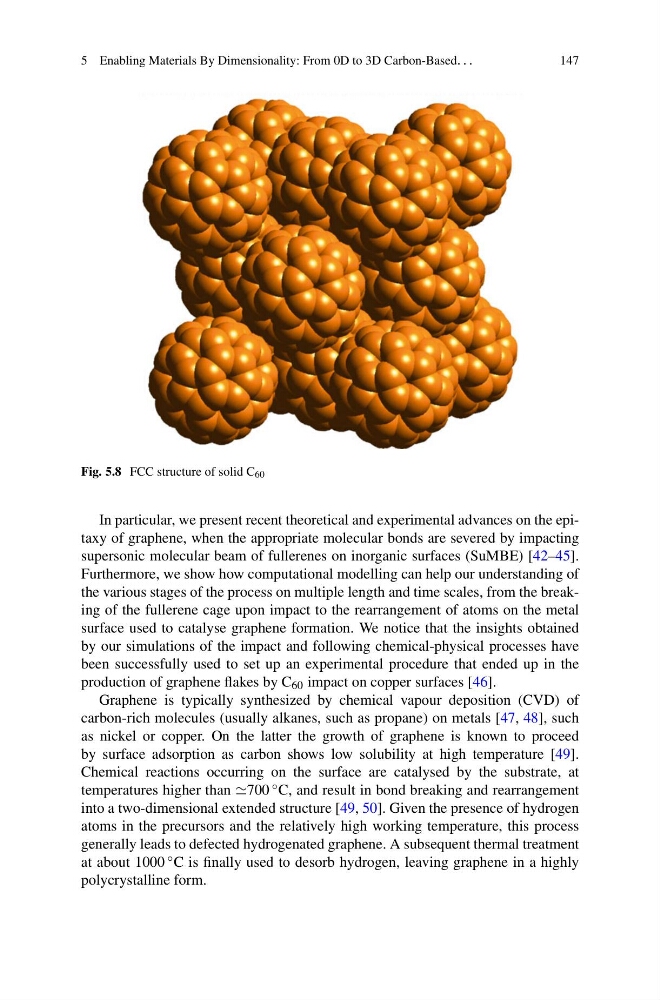
Fig. 5.8 FCC structure of solid C 60
In particular, we present recent theoretical and experimental advances on the epitaxy of graphene, when the appropriate molecular bonds are severed by impacting
supersonic molecular beam of fullerenes on inorganic surfaces (SuMBE) [42–45].
Furthermore, we show how computational modelling can help our understanding of
the various stages of the process on multiple length and time scales, from the breaking of the fullerene cage upon impact to the rearrangement of atoms on the metal
surface used to catalyse graphene formation. We notice that the insights obtained
by our simulations of the impact and following chemical-physical processes have
been successfully used to set up an experimental procedure that ended up in the
production of graphene flakes by C 60 impact on copper surfaces [46].
Graphene is typically synthesized by chemical vapour deposition (CVD) of
carbon-rich molecules (usually alkanes, such as propane) on metals [47, 48], such
as nickel or copper. On the latter the growth of graphene is known to proceed
by surface adsorption as carbon shows low solubility at high temperature [49].
Chemical reactions occurring on the surface are catalysed by the substrate, at
temperatures higher than 700 ◦ C, and result in bond breaking and rearrangement
into a two-dimensional extended structure [49, 50]. Given the presence of hydrogen
atoms in the precursors and the relatively high working temperature, this process
generally leads to defected hydrogenated graphene. A subsequent thermal treatment
at about 1000 ◦ C is finally used to desorb hydrogen, leaving graphene in a highly
polycrystalline form.
147
Fig. 5.8 FCC structure of solid C 60
In particular, we present recent theoretical and experimental advances on the epitaxy of graphene, when the appropriate molecular bonds are severed by impacting
supersonic molecular beam of fullerenes on inorganic surfaces (SuMBE) [42–45].
Furthermore, we show how computational modelling can help our understanding of
the various stages of the process on multiple length and time scales, from the breaking of the fullerene cage upon impact to the rearrangement of atoms on the metal
surface used to catalyse graphene formation. We notice that the insights obtained
by our simulations of the impact and following chemical-physical processes have
been successfully used to set up an experimental procedure that ended up in the
production of graphene flakes by C 60 impact on copper surfaces [46].
Graphene is typically synthesized by chemical vapour deposition (CVD) of
carbon-rich molecules (usually alkanes, such as propane) on metals [47, 48], such
as nickel or copper. On the latter the growth of graphene is known to proceed
by surface adsorption as carbon shows low solubility at high temperature [49].
Chemical reactions occurring on the surface are catalysed by the substrate, at
temperatures higher than 700 ◦ C, and result in bond breaking and rearrangement
into a two-dimensional extended structure [49, 50]. Given the presence of hydrogen
atoms in the precursors and the relatively high working temperature, this process
generally leads to defected hydrogenated graphene. A subsequent thermal treatment
at about 1000 ◦ C is finally used to desorb hydrogen, leaving graphene in a highly
polycrystalline form.