

146
S. Taioli
12 10 8 6 4 2 0 282 285 288 291 294
Binding energy (eV)
Energy (eV)
Intensity (arb.units)
PES
EELS Cls
w
L
Γ
x
w k
-4
-2
0
2
4
E F
E F
T 2u
1g
1u
u
u
g
g
T
T
H
H
G
G
-8.66 eV
-7.12 eV
-6.99 eV
-5.83 eV
-4.20 eV
-3.10 eV
-2.24 eV
LUMO
HOMO
Energy (eV)
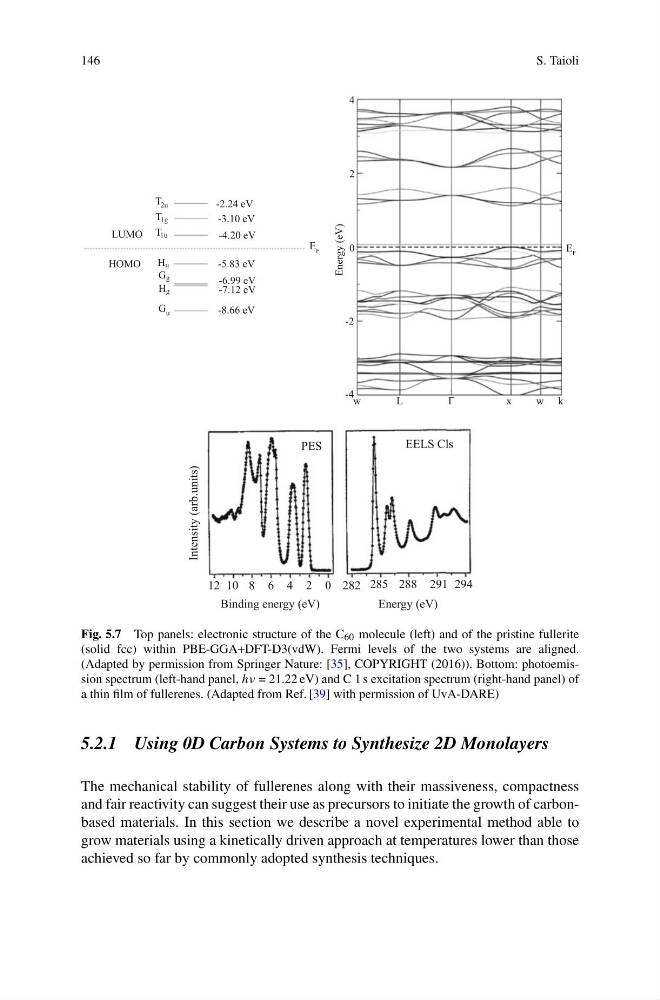
Fig. 5.7 Top panels: electronic structure of the C 60 molecule (left) and of the pristine fullerite
(solid fcc) within PBE-GGA+DFT-D3(vdW). Fermi levels of the two systems are aligned.
(Adapted by permission from Springer Nature: [35], COPYRIGHT (2016)). Bottom: photoemission spectrum (left-hand panel, hν = 21.22 eV) and C 1 s excitation spectrum (right-hand panel) of
a thin film of fullerenes. (Adapted from Ref. [39] with permission of UvA-DARE)
5.2.1 Using 0D Carbon Systems to Synthesize 2D Monolayers
The mechanical stability of fullerenes along with their massiveness, compactness
and fair reactivity can suggest their use as precursors to initiate the growth of carbonbased materials. In this section we describe a novel experimental method able to
grow materials using a kinetically driven approach at temperatures lower than those
achieved so far by commonly adopted synthesis techniques.
S. Taioli
12 10 8 6 4 2 0 282 285 288 291 294
Binding energy (eV)
Energy (eV)
Intensity (arb.units)
PES
EELS Cls
w
L
Γ
x
w k
-4
-2
0
2
4
E F
E F
T 2u
1g
1u
u
u
g
g
T
T
H
H
G
G
-8.66 eV
-7.12 eV
-6.99 eV
-5.83 eV
-4.20 eV
-3.10 eV
-2.24 eV
LUMO
HOMO
Energy (eV)
Fig. 5.7 Top panels: electronic structure of the C 60 molecule (left) and of the pristine fullerite
(solid fcc) within PBE-GGA+DFT-D3(vdW). Fermi levels of the two systems are aligned.
(Adapted by permission from Springer Nature: [35], COPYRIGHT (2016)). Bottom: photoemission spectrum (left-hand panel, hν = 21.22 eV) and C 1 s excitation spectrum (right-hand panel) of
a thin film of fullerenes. (Adapted from Ref. [39] with permission of UvA-DARE)
5.2.1 Using 0D Carbon Systems to Synthesize 2D Monolayers
The mechanical stability of fullerenes along with their massiveness, compactness
and fair reactivity can suggest their use as precursors to initiate the growth of carbonbased materials. In this section we describe a novel experimental method able to
grow materials using a kinetically driven approach at temperatures lower than those
achieved so far by commonly adopted synthesis techniques.