

5 Enabling Materials By Dimensionality: From 0D to 3D Carbon-Based. . .
141
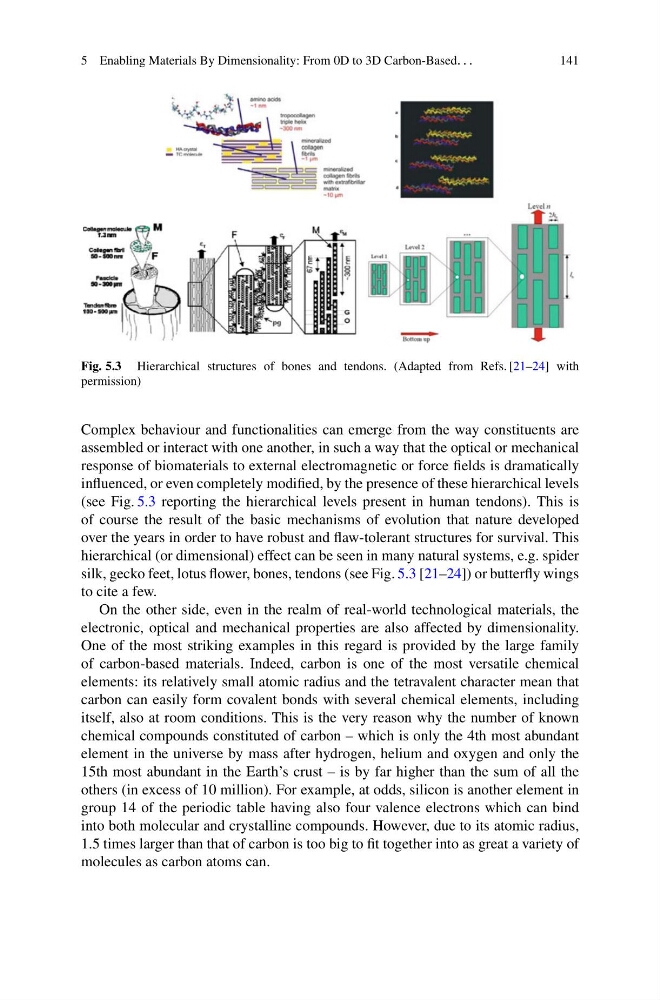
Fig. 5.3 Hierarchical structures of bones and tendons. (Adapted from Refs. [21–24] with
permission)
Complex behaviour and functionalities can emerge from the way constituents are
assembled or interact with one another, in such a way that the optical or mechanical
response of biomaterials to external electromagnetic or force fields is dramatically
influenced, or even completely modified, by the presence of these hierarchical levels
(see Fig. 5.3 reporting the hierarchical levels present in human tendons). This is
of course the result of the basic mechanisms of evolution that nature developed
over the years in order to have robust and flaw-tolerant structures for survival. This
hierarchical (or dimensional) effect can be seen in many natural systems, e.g. spider
silk, gecko feet, lotus flower, bones, tendons (see Fig. 5.3 [21–24]) or butterfly wings
to cite a few.
On the other side, even in the realm of real-world technological materials, the
electronic, optical and mechanical properties are also affected by dimensionality.
One of the most striking examples in this regard is provided by the large family
of carbon-based materials. Indeed, carbon is one of the most versatile chemical
elements: its relatively small atomic radius and the tetravalent character mean that
carbon can easily form covalent bonds with several chemical elements, including
itself, also at room conditions. This is the very reason why the number of known
chemical compounds constituted of carbon – which is only the 4th most abundant
element in the universe by mass after hydrogen, helium and oxygen and only the
15th most abundant in the Earth’s crust – is by far higher than the sum of all the
others (in excess of 10 million). For example, at odds, silicon is another element in
group 14 of the periodic table having also four valence electrons which can bind
into both molecular and crystalline compounds. However, due to its atomic radius,
1.5 times larger than that of carbon is too big to fit together into as great a variety of
molecules as carbon atoms can.
141
Fig. 5.3 Hierarchical structures of bones and tendons. (Adapted from Refs. [21–24] with
permission)
Complex behaviour and functionalities can emerge from the way constituents are
assembled or interact with one another, in such a way that the optical or mechanical
response of biomaterials to external electromagnetic or force fields is dramatically
influenced, or even completely modified, by the presence of these hierarchical levels
(see Fig. 5.3 reporting the hierarchical levels present in human tendons). This is
of course the result of the basic mechanisms of evolution that nature developed
over the years in order to have robust and flaw-tolerant structures for survival. This
hierarchical (or dimensional) effect can be seen in many natural systems, e.g. spider
silk, gecko feet, lotus flower, bones, tendons (see Fig. 5.3 [21–24]) or butterfly wings
to cite a few.
On the other side, even in the realm of real-world technological materials, the
electronic, optical and mechanical properties are also affected by dimensionality.
One of the most striking examples in this regard is provided by the large family
of carbon-based materials. Indeed, carbon is one of the most versatile chemical
elements: its relatively small atomic radius and the tetravalent character mean that
carbon can easily form covalent bonds with several chemical elements, including
itself, also at room conditions. This is the very reason why the number of known
chemical compounds constituted of carbon – which is only the 4th most abundant
element in the universe by mass after hydrogen, helium and oxygen and only the
15th most abundant in the Earth’s crust – is by far higher than the sum of all the
others (in excess of 10 million). For example, at odds, silicon is another element in
group 14 of the periodic table having also four valence electrons which can bind
into both molecular and crystalline compounds. However, due to its atomic radius,
1.5 times larger than that of carbon is too big to fit together into as great a variety of
molecules as carbon atoms can.