

140
S. Taioli
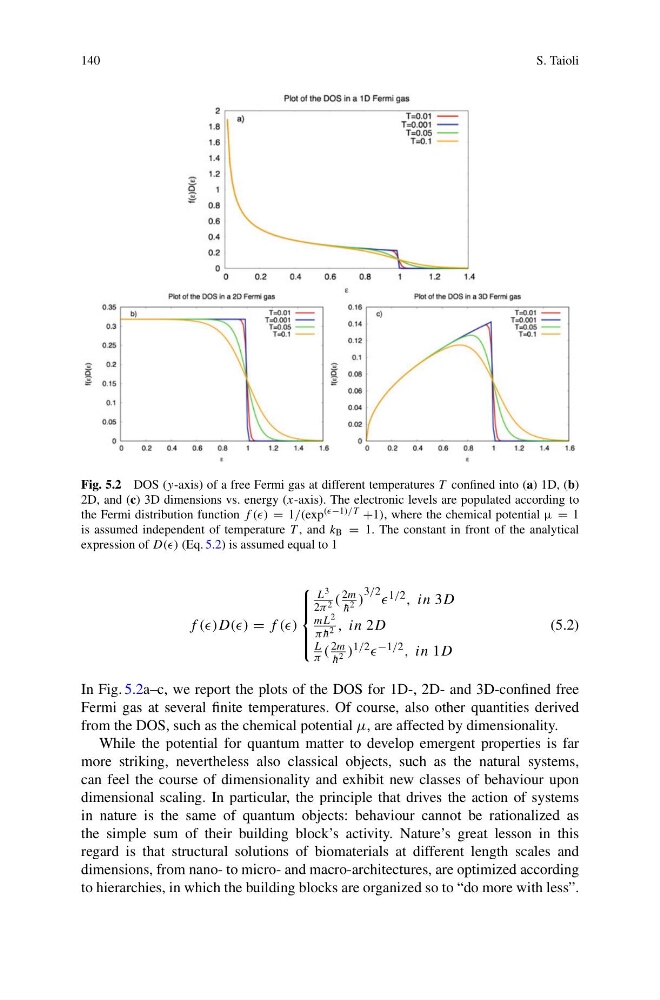
Fig. 5.2 DOS (y-axis) of a free Fermi gas at different temperatures T confined into (a) 1D, (b)
2D, and (c) 3D dimensions vs. energy (x-axis). The electronic levels are populated according to
the Fermi distribution function f (() = 1/(exp ((−1)/T +1), where the chemical potential μ = 1
is assumed independent of temperature T , and k B = 1. The constant in front of the analytical
expression of D(() (Eq. 5.2) is assumed equal to 1
f (()D(() = f (()
⎧
⎪ ⎪ ⎨
⎪ ⎪ ⎩
L 3
2π 2 (
2m
¯
h 2 )
3/2 1/2 , in 3D
mL 2
π ¯
h 2 , in 2D
L
π (
2m
¯
h 2 ) 1/2 −1/2 , in 1D
(5.2)
In Fig. 5.2a–c, we report the plots of the DOS for 1D-, 2D- and 3D-confined free
Fermi gas at several finite temperatures. Of course, also other quantities derived
from the DOS, such as the chemical potential μ, are affected by dimensionality.
While the potential for quantum matter to develop emergent properties is far
more striking, nevertheless also classical objects, such as the natural systems,
can feel the course of dimensionality and exhibit new classes of behaviour upon
dimensional scaling. In particular, the principle that drives the action of systems
in nature is the same of quantum objects: behaviour cannot be rationalized as
the simple sum of their building block’s activity. Nature’s great lesson in this
regard is that structural solutions of biomaterials at different length scales and
dimensions, from nano- to micro- and macro-architectures, are optimized according
to hierarchies, in which the building blocks are organized so to “do more with less”.
S. Taioli
Fig. 5.2 DOS (y-axis) of a free Fermi gas at different temperatures T confined into (a) 1D, (b)
2D, and (c) 3D dimensions vs. energy (x-axis). The electronic levels are populated according to
the Fermi distribution function f (() = 1/(exp ((−1)/T +1), where the chemical potential μ = 1
is assumed independent of temperature T , and k B = 1. The constant in front of the analytical
expression of D(() (Eq. 5.2) is assumed equal to 1
f (()D(() = f (()
⎧
⎪ ⎪ ⎨
⎪ ⎪ ⎩
L 3
2π 2 (
2m
¯
h 2 )
3/2 1/2 , in 3D
mL 2
π ¯
h 2 , in 2D
L
π (
2m
¯
h 2 ) 1/2 −1/2 , in 1D
(5.2)
In Fig. 5.2a–c, we report the plots of the DOS for 1D-, 2D- and 3D-confined free
Fermi gas at several finite temperatures. Of course, also other quantities derived
from the DOS, such as the chemical potential μ, are affected by dimensionality.
While the potential for quantum matter to develop emergent properties is far
more striking, nevertheless also classical objects, such as the natural systems,
can feel the course of dimensionality and exhibit new classes of behaviour upon
dimensional scaling. In particular, the principle that drives the action of systems
in nature is the same of quantum objects: behaviour cannot be rationalized as
the simple sum of their building block’s activity. Nature’s great lesson in this
regard is that structural solutions of biomaterials at different length scales and
dimensions, from nano- to micro- and macro-architectures, are optimized according
to hierarchies, in which the building blocks are organized so to “do more with less”.