

142
S. Taioli
This remarkable ability of carbon to bind in different ways by sharing from one
single to four electrons may lead to the formation of single to triple bonds. This
makes for an enormous number of possible bond combinations forming straight
chains, such as polymers; rings, such as aromatic hydrocarbons; crystals, such as
silicon carbide; and also amorphous phases. The all-carbon materials that carbon can
form by binding in different ways are called allotropes of carbon, be those naturally
available or man-made. The most common are graphite, diamond, fullerene and
amorphous carbon. In this chapter, we will focus on the description of the physical
properties of carbon allotropes with the aim to show how the dimensionality leaves
its signature on the electronic, optical and mechanical properties of these carbonbased materials. For example, on the one side, graphite is a quasi-two-dimensional
material whose distinctive treats are to be opaque, black and sufficiently soft to be
used in pencils. Furthermore, graphite is a good electrical conductor. On the other
side, diamond is a 3D transparent, hard solid showing low electrical conductivity.
Nevertheless, at room conditions, 3D diamond, 1D carbon nanotubes, and 2D
graphene have all large thermal conductivities.
In the discussion of these topics, we have made the disputable choice of focussing
on the description of structures which grown out of our research activity over the
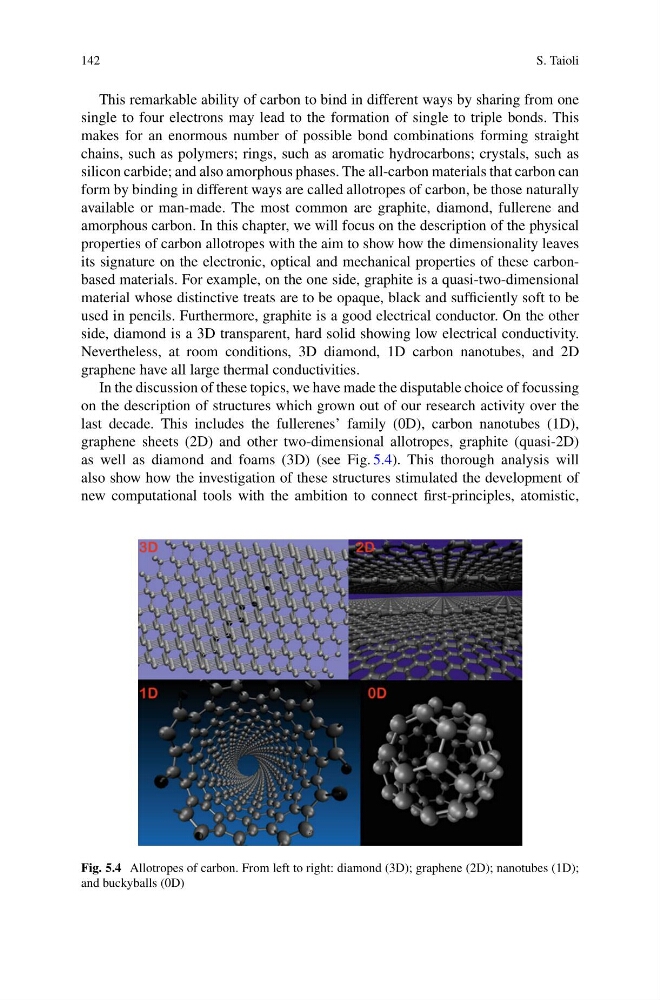
last decade. This includes the fullerenes’ family (0D), carbon nanotubes (1D),
graphene sheets (2D) and other two-dimensional allotropes, graphite (quasi-2D)
as well as diamond and foams (3D) (see Fig. 5.4). This thorough analysis will
also show how the investigation of these structures stimulated the development of
new computational tools with the ambition to connect first-principles, atomistic,
Fig. 5.4 Allotropes of carbon. From left to right: diamond (3D); graphene (2D); nanotubes (1D);
and buckyballs (0D)
S. Taioli
This remarkable ability of carbon to bind in different ways by sharing from one
single to four electrons may lead to the formation of single to triple bonds. This
makes for an enormous number of possible bond combinations forming straight
chains, such as polymers; rings, such as aromatic hydrocarbons; crystals, such as
silicon carbide; and also amorphous phases. The all-carbon materials that carbon can
form by binding in different ways are called allotropes of carbon, be those naturally
available or man-made. The most common are graphite, diamond, fullerene and
amorphous carbon. In this chapter, we will focus on the description of the physical
properties of carbon allotropes with the aim to show how the dimensionality leaves
its signature on the electronic, optical and mechanical properties of these carbonbased materials. For example, on the one side, graphite is a quasi-two-dimensional
material whose distinctive treats are to be opaque, black and sufficiently soft to be
used in pencils. Furthermore, graphite is a good electrical conductor. On the other
side, diamond is a 3D transparent, hard solid showing low electrical conductivity.
Nevertheless, at room conditions, 3D diamond, 1D carbon nanotubes, and 2D
graphene have all large thermal conductivities.
In the discussion of these topics, we have made the disputable choice of focussing
on the description of structures which grown out of our research activity over the
last decade. This includes the fullerenes’ family (0D), carbon nanotubes (1D),
graphene sheets (2D) and other two-dimensional allotropes, graphite (quasi-2D)
as well as diamond and foams (3D) (see Fig. 5.4). This thorough analysis will
also show how the investigation of these structures stimulated the development of
new computational tools with the ambition to connect first-principles, atomistic,
Fig. 5.4 Allotropes of carbon. From left to right: diamond (3D); graphene (2D); nanotubes (1D);
and buckyballs (0D)