

116
S. Yanagisawa and I. Hamada
with that obtained with optPBE-vdW [135]. These results indicate that the nonlocal
correlation also affects the electronic structure, although its effect has been thought
to be minor [136]. This is in line with the recent work by Ferri et al. [137] using the
fully self-consistent Tkatchenko-Scheffler vdW correction [138].
IPSs of metal surfaces functionalized with molecular overlayers have also been
investigated [132, 139–142]. Naphthalene on highly oriented pyrolytic graphite
(HOPG) is one of prototypical systems for aromatic hydrocarbons physisorbed on
a metal surface, and there have been several studies investigating its electronic
properties [20, 143–146]. The scanning tunneling microscopy (STM) measurement
revealed that the naphthalene overlayer on HOPG forms a superstructure with a
tilted adsorption configuration [145]. Furthermore, based on the angle-resolved
two-photon photoemission spectroscopy measurement, the authors of Ref. [145]
suggested that the lowest IPS behaves almost like a free electron, despite the
presence of the molecular overlayer [20].
To gain insights into the nature on the IPS at organic-metal interfaces, DFT
calculations were conducted for naphthalene adsorbed on graphene [19]. The revvdW-DF2 functional [10] was used to correctly describe the molecule-substrate and
the intermolecular interactions, which are typically of the vdW interaction nature. It
was found that the naphthalene molecules are stabilized as a superstructure with
a periodicity of (2
√
3 × 2
√
3) with a tilted molecular adsorption geometry, in
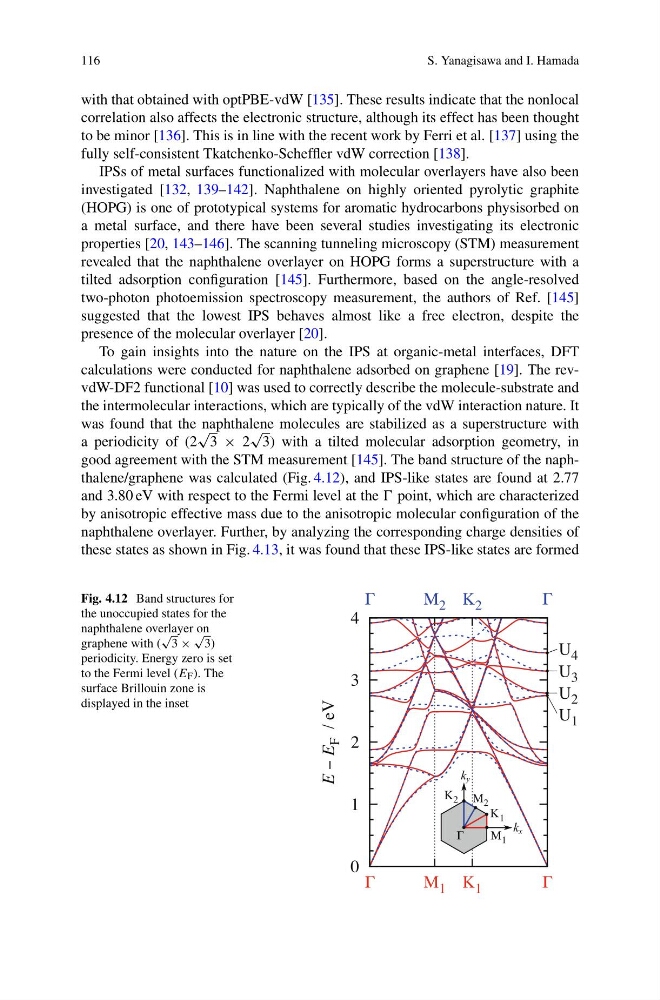
good agreement with the STM measurement [145]. The band structure of the naphthalene/graphene was calculated (Fig. 4.12), and IPS-like states are found at 2.77
and 3.80 eV with respect to the Fermi level at the point, which are characterized
by anisotropic effective mass due to the anisotropic molecular configuration of the
naphthalene overlayer. Further, by analyzing the corresponding charge densities of
these states as shown in Fig. 4.13, it was found that these IPS-like states are formed
Fig. 4.12 Band structures for
the unoccupied states for the
naphthalene overlayer on
graphene with (
√
3 ×
√
3)
periodicity. Energy zero is set
to the Fermi level (E F ). The
surface Brillouin zone is
displayed in the inset
S. Yanagisawa and I. Hamada
with that obtained with optPBE-vdW [135]. These results indicate that the nonlocal
correlation also affects the electronic structure, although its effect has been thought
to be minor [136]. This is in line with the recent work by Ferri et al. [137] using the
fully self-consistent Tkatchenko-Scheffler vdW correction [138].
IPSs of metal surfaces functionalized with molecular overlayers have also been
investigated [132, 139–142]. Naphthalene on highly oriented pyrolytic graphite
(HOPG) is one of prototypical systems for aromatic hydrocarbons physisorbed on
a metal surface, and there have been several studies investigating its electronic
properties [20, 143–146]. The scanning tunneling microscopy (STM) measurement
revealed that the naphthalene overlayer on HOPG forms a superstructure with a
tilted adsorption configuration [145]. Furthermore, based on the angle-resolved
two-photon photoemission spectroscopy measurement, the authors of Ref. [145]
suggested that the lowest IPS behaves almost like a free electron, despite the
presence of the molecular overlayer [20].
To gain insights into the nature on the IPS at organic-metal interfaces, DFT
calculations were conducted for naphthalene adsorbed on graphene [19]. The revvdW-DF2 functional [10] was used to correctly describe the molecule-substrate and
the intermolecular interactions, which are typically of the vdW interaction nature. It
was found that the naphthalene molecules are stabilized as a superstructure with
a periodicity of (2
√
3 × 2
√
3) with a tilted molecular adsorption geometry, in
good agreement with the STM measurement [145]. The band structure of the naphthalene/graphene was calculated (Fig. 4.12), and IPS-like states are found at 2.77
and 3.80 eV with respect to the Fermi level at the point, which are characterized
by anisotropic effective mass due to the anisotropic molecular configuration of the
naphthalene overlayer. Further, by analyzing the corresponding charge densities of
these states as shown in Fig. 4.13, it was found that these IPS-like states are formed
Fig. 4.12 Band structures for
the unoccupied states for the
naphthalene overlayer on
graphene with (
√
3 ×
√
3)
periodicity. Energy zero is set
to the Fermi level (E F ). The
surface Brillouin zone is
displayed in the inset