

4 Nanoscale First-Principles Electronic Structure Simulations of Materials. . .
115
-20
-15
-10
-5
0
5
10
E-E
F
(eV)
M
K
E vac
Γ
Γ
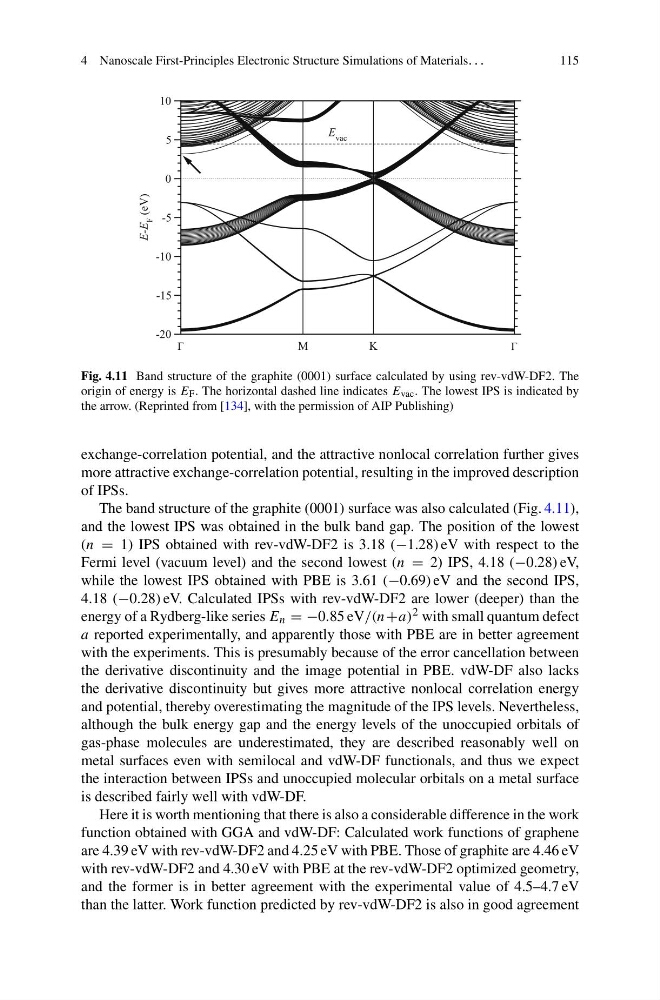
Fig. 4.11 Band structure of the graphite (0001) surface calculated by using rev-vdW-DF2. The
origin of energy is E F . The horizontal dashed line indicates E vac . The lowest IPS is indicated by
the arrow. (Reprinted from [134], with the permission of AIP Publishing)
exchange-correlation potential, and the attractive nonlocal correlation further gives
more attractive exchange-correlation potential, resulting in the improved description
of IPSs.
The band structure of the graphite (0001) surface was also calculated (Fig. 4.11),
and the lowest IPS was obtained in the bulk band gap. The position of the lowest
(n = 1) IPS obtained with rev-vdW-DF2 is 3.18 (−1.28) eV with respect to the
Fermi level (vacuum level) and the second lowest (n = 2) IPS, 4.18 (−0.28) eV,
while the lowest IPS obtained with PBE is 3.61 (−0.69) eV and the second IPS,
4.18 (−0.28) eV. Calculated IPSs with rev-vdW-DF2 are lower (deeper) than the
energy of a Rydberg-like series E n = −0.85 eV/(n+a) 2 with small quantum defect
a reported experimentally, and apparently those with PBE are in better agreement
with the experiments. This is presumably because of the error cancellation between
the derivative discontinuity and the image potential in PBE. vdW-DF also lacks
the derivative discontinuity but gives more attractive nonlocal correlation energy
and potential, thereby overestimating the magnitude of the IPS levels. Nevertheless,
although the bulk energy gap and the energy levels of the unoccupied orbitals of
gas-phase molecules are underestimated, they are described reasonably well on
metal surfaces even with semilocal and vdW-DF functionals, and thus we expect
the interaction between IPSs and unoccupied molecular orbitals on a metal surface
is described fairly well with vdW-DF.
Here it is worth mentioning that there is also a considerable difference in the work
function obtained with GGA and vdW-DF: Calculated work functions of graphene
are 4.39 eV with rev-vdW-DF2 and 4.25 eV with PBE. Those of graphite are 4.46 eV
with rev-vdW-DF2 and 4.30 eV with PBE at the rev-vdW-DF2 optimized geometry,
and the former is in better agreement with the experimental value of 4.5–4.7 eV
than the latter. Work function predicted by rev-vdW-DF2 is also in good agreement
115
-20
-15
-10
-5
0
5
10
E-E
F
(eV)
M
K
E vac
Γ
Γ
Fig. 4.11 Band structure of the graphite (0001) surface calculated by using rev-vdW-DF2. The
origin of energy is E F . The horizontal dashed line indicates E vac . The lowest IPS is indicated by
the arrow. (Reprinted from [134], with the permission of AIP Publishing)
exchange-correlation potential, and the attractive nonlocal correlation further gives
more attractive exchange-correlation potential, resulting in the improved description
of IPSs.
The band structure of the graphite (0001) surface was also calculated (Fig. 4.11),
and the lowest IPS was obtained in the bulk band gap. The position of the lowest
(n = 1) IPS obtained with rev-vdW-DF2 is 3.18 (−1.28) eV with respect to the
Fermi level (vacuum level) and the second lowest (n = 2) IPS, 4.18 (−0.28) eV,
while the lowest IPS obtained with PBE is 3.61 (−0.69) eV and the second IPS,
4.18 (−0.28) eV. Calculated IPSs with rev-vdW-DF2 are lower (deeper) than the
energy of a Rydberg-like series E n = −0.85 eV/(n+a) 2 with small quantum defect
a reported experimentally, and apparently those with PBE are in better agreement
with the experiments. This is presumably because of the error cancellation between
the derivative discontinuity and the image potential in PBE. vdW-DF also lacks
the derivative discontinuity but gives more attractive nonlocal correlation energy
and potential, thereby overestimating the magnitude of the IPS levels. Nevertheless,
although the bulk energy gap and the energy levels of the unoccupied orbitals of
gas-phase molecules are underestimated, they are described reasonably well on
metal surfaces even with semilocal and vdW-DF functionals, and thus we expect
the interaction between IPSs and unoccupied molecular orbitals on a metal surface
is described fairly well with vdW-DF.
Here it is worth mentioning that there is also a considerable difference in the work
function obtained with GGA and vdW-DF: Calculated work functions of graphene
are 4.39 eV with rev-vdW-DF2 and 4.25 eV with PBE. Those of graphite are 4.46 eV
with rev-vdW-DF2 and 4.30 eV with PBE at the rev-vdW-DF2 optimized geometry,
and the former is in better agreement with the experimental value of 4.5–4.7 eV
than the latter. Work function predicted by rev-vdW-DF2 is also in good agreement