

108
S. Yanagisawa and I. Hamada
Table 4.4 Calculated band gap (E g ) and the band width for the HOMO-derived band (W H ) and
that for the LUMO-derived band (W L ) of the tetracene crystal obtained with G 0 W 0 and evGW
for different structures. I and II denote the structures obtained by the X-ray diffraction experiment
in Refs. [45] and [50], respectively, and their internal atomic coordinates were relaxed with their
lattice constants fixed. Structure III denotes the one obtained by fully optimizing the cell and
internal degrees of freedom, corresponding to the crystal geometry displayed in Table 4.1. E
g is the
molecular fundamental gap plus the polarization effect (see the main text). Unit is eV. (Reprinted
from [13], with the permission of AIP Publishing)
Structure
I
II
III
E g (G 0 W 0 )
2.63
2.50
2.40
E g (evGW )
3.31
3.19
3.09
W H (G 0 W 0 )
0.39
0.45
0.49
W H (evGW )
0.44
0.48
0.54
W L (G 0 W 0 )
0.60
0.66
0.73
W L (evGW )
0.64
0.71
0.75
E
g (G 0 W 0 )
3.12
3.06
3.01
E
g (evGW )
3.85
3.79
3.74
lattice constants displayed in Table 4.3. We denote their structures by Structures I
and II, for the former and the latter, respectively, and the structure fully optimized
with rev-vdW-DF2 is denoted by Structure III.
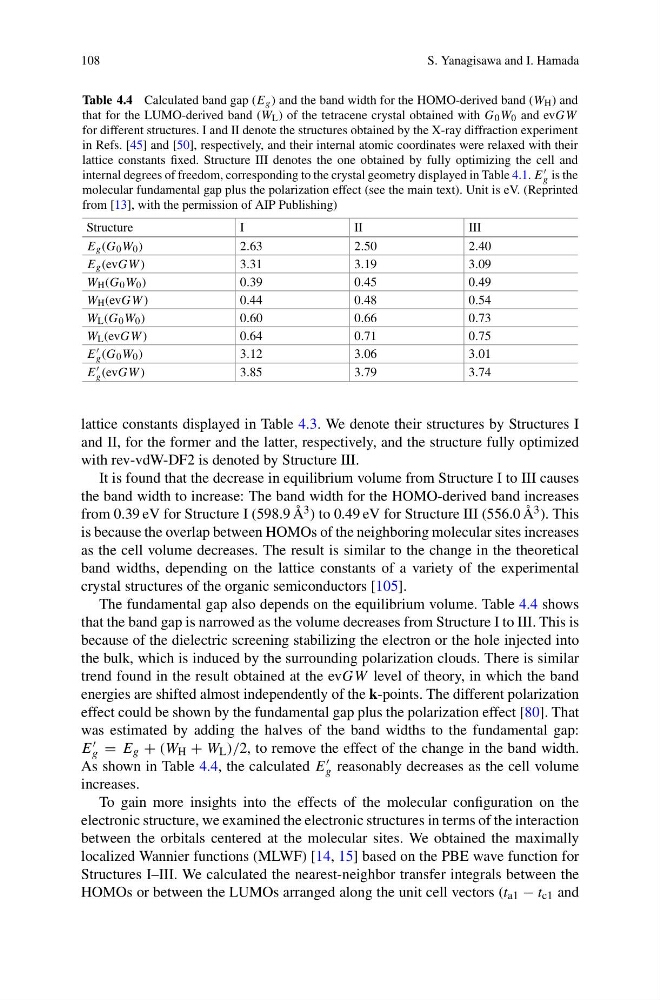
It is found that the decrease in equilibrium volume from Structure I to III causes
the band width to increase: The band width for the HOMO-derived band increases
from 0.39 eV for Structure I (598.9 Å 3 ) to 0.49 eV for Structure III (556.0 Å 3 ). This
is because the overlap between HOMOs of the neighboring molecular sites increases
as the cell volume decreases. The result is similar to the change in the theoretical
band widths, depending on the lattice constants of a variety of the experimental
crystal structures of the organic semiconductors [105].
The fundamental gap also depends on the equilibrium volume. Table 4.4 shows
that the band gap is narrowed as the volume decreases from Structure I to III. This is
because of the dielectric screening stabilizing the electron or the hole injected into
the bulk, which is induced by the surrounding polarization clouds. There is similar
trend found in the result obtained at the evGW level of theory, in which the band
energies are shifted almost independently of the k-points. The different polarization
effect could be shown by the fundamental gap plus the polarization effect [80]. That
was estimated by adding the halves of the band widths to the fundamental gap:
E
g = E g + (W H + W L )/2, to remove the effect of the change in the band width.
As shown in Table 4.4, the calculated E
g reasonably decreases as the cell volume
increases.
To gain more insights into the effects of the molecular configuration on the
electronic structure, we examined the electronic structures in terms of the interaction
between the orbitals centered at the molecular sites. We obtained the maximally
localized Wannier functions (MLWF) [14, 15] based on the PBE wave function for
Structures I–III. We calculated the nearest-neighbor transfer integrals between the
HOMOs or between the LUMOs arranged along the unit cell vectors (t a1 − t c1 and
S. Yanagisawa and I. Hamada
Table 4.4 Calculated band gap (E g ) and the band width for the HOMO-derived band (W H ) and
that for the LUMO-derived band (W L ) of the tetracene crystal obtained with G 0 W 0 and evGW
for different structures. I and II denote the structures obtained by the X-ray diffraction experiment
in Refs. [45] and [50], respectively, and their internal atomic coordinates were relaxed with their
lattice constants fixed. Structure III denotes the one obtained by fully optimizing the cell and
internal degrees of freedom, corresponding to the crystal geometry displayed in Table 4.1. E
g is the
molecular fundamental gap plus the polarization effect (see the main text). Unit is eV. (Reprinted
from [13], with the permission of AIP Publishing)
Structure
I
II
III
E g (G 0 W 0 )
2.63
2.50
2.40
E g (evGW )
3.31
3.19
3.09
W H (G 0 W 0 )
0.39
0.45
0.49
W H (evGW )
0.44
0.48
0.54
W L (G 0 W 0 )
0.60
0.66
0.73
W L (evGW )
0.64
0.71
0.75
E
g (G 0 W 0 )
3.12
3.06
3.01
E
g (evGW )
3.85
3.79
3.74
lattice constants displayed in Table 4.3. We denote their structures by Structures I
and II, for the former and the latter, respectively, and the structure fully optimized
with rev-vdW-DF2 is denoted by Structure III.
It is found that the decrease in equilibrium volume from Structure I to III causes
the band width to increase: The band width for the HOMO-derived band increases
from 0.39 eV for Structure I (598.9 Å 3 ) to 0.49 eV for Structure III (556.0 Å 3 ). This
is because the overlap between HOMOs of the neighboring molecular sites increases
as the cell volume decreases. The result is similar to the change in the theoretical
band widths, depending on the lattice constants of a variety of the experimental
crystal structures of the organic semiconductors [105].
The fundamental gap also depends on the equilibrium volume. Table 4.4 shows
that the band gap is narrowed as the volume decreases from Structure I to III. This is
because of the dielectric screening stabilizing the electron or the hole injected into
the bulk, which is induced by the surrounding polarization clouds. There is similar
trend found in the result obtained at the evGW level of theory, in which the band
energies are shifted almost independently of the k-points. The different polarization
effect could be shown by the fundamental gap plus the polarization effect [80]. That
was estimated by adding the halves of the band widths to the fundamental gap:
E
g = E g + (W H + W L )/2, to remove the effect of the change in the band width.
As shown in Table 4.4, the calculated E
g reasonably decreases as the cell volume
increases.
To gain more insights into the effects of the molecular configuration on the
electronic structure, we examined the electronic structures in terms of the interaction
between the orbitals centered at the molecular sites. We obtained the maximally
localized Wannier functions (MLWF) [14, 15] based on the PBE wave function for
Structures I–III. We calculated the nearest-neighbor transfer integrals between the
HOMOs or between the LUMOs arranged along the unit cell vectors (t a1 − t c1 and