

12
2 Results and Discussion
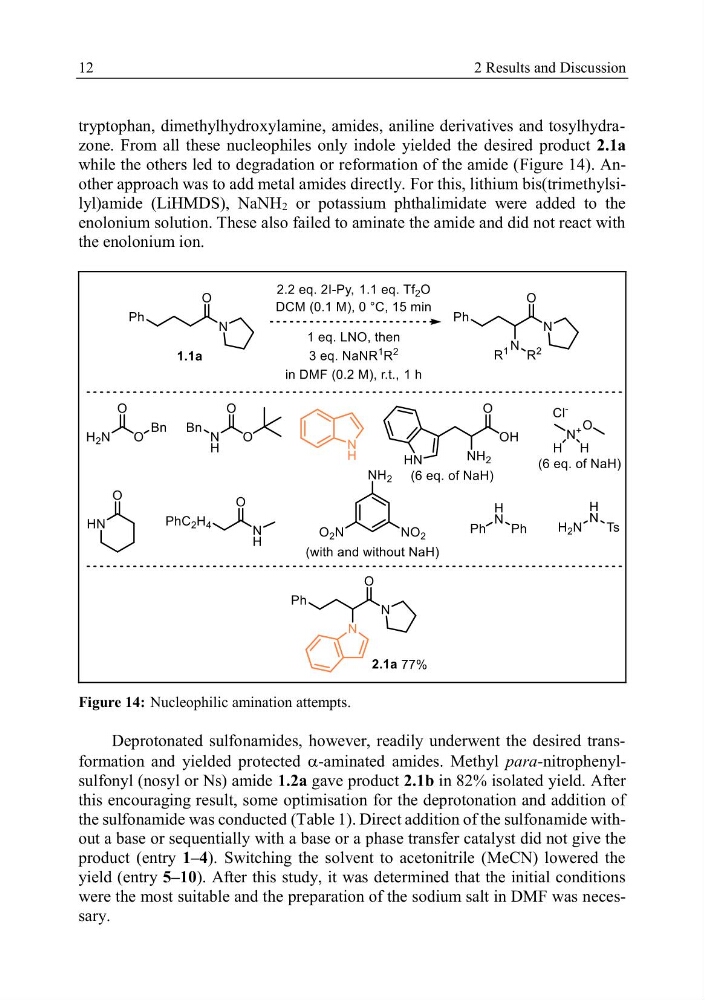
tryptophan, dimethylhydroxylamine, amides, aniline derivatives and tosylhydrazone. From all these nucleophiles only indole yielded the desired product 2.1a
while the others led to degradation or reformation of the amide (Figure 14). Another approach was to add metal amides directly. For this, lithium bis(trimethylsilyl)amide (LiHMDS), NaNH2 or potassium phthalimidate were added to the
enolonium solution. These also failed to aminate the amide and did not react with
the enolonium ion.
Figure 14: Nucleophilic amination attempts.
Deprotonated sulfonamides, however, readily underwent the desired transformation and yielded protected -aminated amides. Methyl para-nitrophenylsulfonyl (nosyl or Ns) amide 1.2a gave product 2.1b in 82% isolated yield. After
this encouraging result, some optimisation for the deprotonation and addition of
the sulfonamide was conducted (Table 1). Direct addition of the sulfonamide without a base or sequentially with a base or a phase transfer catalyst did not give the
product (entry 1–4). Switching the solvent to acetonitrile (MeCN) lowered the
yield (entry 5–10). After this study, it was determined that the initial conditions
were the most suitable and the preparation of the sodium salt in DMF was necessary.
2 Results and Discussion
tryptophan, dimethylhydroxylamine, amides, aniline derivatives and tosylhydrazone. From all these nucleophiles only indole yielded the desired product 2.1a
while the others led to degradation or reformation of the amide (Figure 14). Another approach was to add metal amides directly. For this, lithium bis(trimethylsilyl)amide (LiHMDS), NaNH2 or potassium phthalimidate were added to the
enolonium solution. These also failed to aminate the amide and did not react with
the enolonium ion.
Figure 14: Nucleophilic amination attempts.
Deprotonated sulfonamides, however, readily underwent the desired transformation and yielded protected -aminated amides. Methyl para-nitrophenylsulfonyl (nosyl or Ns) amide 1.2a gave product 2.1b in 82% isolated yield. After
this encouraging result, some optimisation for the deprotonation and addition of
the sulfonamide was conducted (Table 1). Direct addition of the sulfonamide without a base or sequentially with a base or a phase transfer catalyst did not give the
product (entry 1–4). Switching the solvent to acetonitrile (MeCN) lowered the
yield (entry 5–10). After this study, it was determined that the initial conditions
were the most suitable and the preparation of the sodium salt in DMF was necessary.