

2 Results and Discussion
2.1 Nucleophilic α-Functionalisation of Amides
We envisioned a chemoselective nucleophilic functionalisation of amides through
Umpolung. A challenge that could arise are the different electrophilic centres on
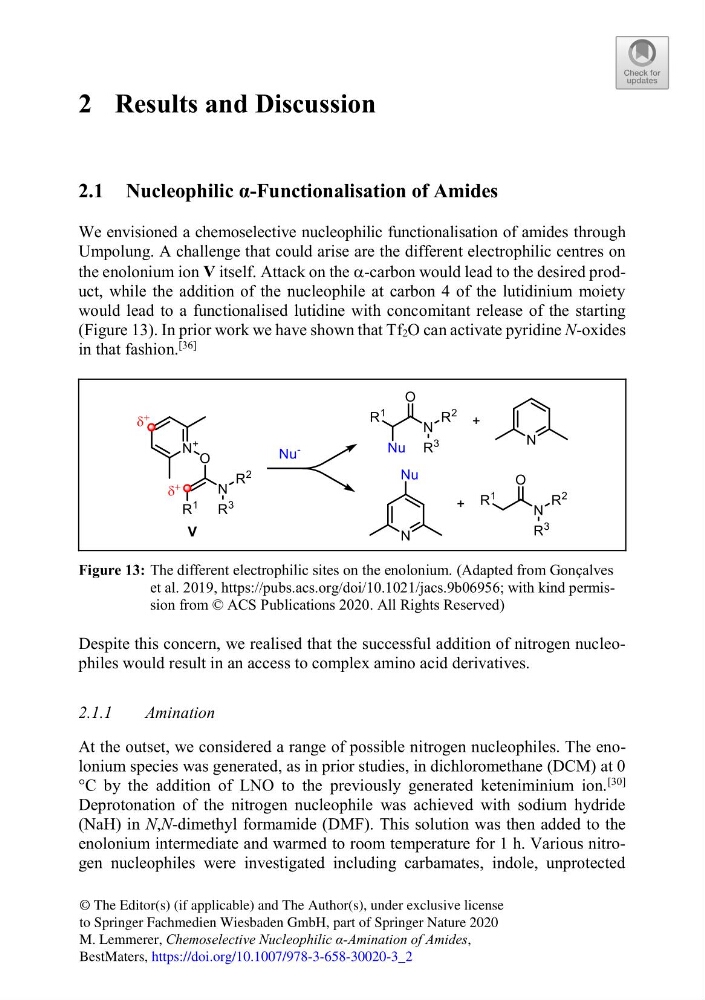
the enolonium ion V itself. Attack on the -carbon would lead to the desired product, while the addition of the nucleophile at carbon 4 of the lutidinium moiety
would lead to a functionalised lutidine with concomitant release of the starting
(Figure 13). In prior work we have shown that Tf2O can activate pyridine N-oxides
in that fashion.
[36]
Figure 13: The different electrophilic sites on the enolonium. (Adapted from Gonçalves
et al. 2019, https://pubs.acs.org/doi/10.1021/jacs.9b06956; with kind permission from © ACS Publications 2020. All Rights Reserved)
Despite this concern, we realised that the successful addition of nitrogen nucleophiles would result in an access to complex amino acid derivatives.
2.1.1
Amination
At the outset, we considered a range of possible nitrogen nucleophiles. The enolonium species was generated, as in prior studies, in dichloromethane (DCM) at 0
°C by the addition of LNO to the previously generated keteniminium ion.
[30]
Deprotonation of the nitrogen nucleophile was achieved with sodium hydride
(NaH) in N,N-dimethyl formamide (DMF). This solution was then added to the
enolonium intermediate and warmed to room temperature for 1 h. Various nitrogen nucleophiles were investigated including carbamates, indole, unprotected
© The Editor(s) (if applicable) and The Author(s), under exclusive license
to Springer Fachmedien Wiesbaden GmbH, part of Springer Nature 2020
M. Lemmerer, Chemoselective Nucleophilic α-Amination of Amides,
BestMaters, https://doi.org/10.1007/978-3-658-30020-3_2
2.1 Nucleophilic α-Functionalisation of Amides
We envisioned a chemoselective nucleophilic functionalisation of amides through
Umpolung. A challenge that could arise are the different electrophilic centres on
the enolonium ion V itself. Attack on the -carbon would lead to the desired product, while the addition of the nucleophile at carbon 4 of the lutidinium moiety
would lead to a functionalised lutidine with concomitant release of the starting
(Figure 13). In prior work we have shown that Tf2O can activate pyridine N-oxides
in that fashion.
[36]
Figure 13: The different electrophilic sites on the enolonium. (Adapted from Gonçalves
et al. 2019, https://pubs.acs.org/doi/10.1021/jacs.9b06956; with kind permission from © ACS Publications 2020. All Rights Reserved)
Despite this concern, we realised that the successful addition of nitrogen nucleophiles would result in an access to complex amino acid derivatives.
2.1.1
Amination
At the outset, we considered a range of possible nitrogen nucleophiles. The enolonium species was generated, as in prior studies, in dichloromethane (DCM) at 0
°C by the addition of LNO to the previously generated keteniminium ion.
[30]
Deprotonation of the nitrogen nucleophile was achieved with sodium hydride
(NaH) in N,N-dimethyl formamide (DMF). This solution was then added to the
enolonium intermediate and warmed to room temperature for 1 h. Various nitrogen nucleophiles were investigated including carbamates, indole, unprotected
© The Editor(s) (if applicable) and The Author(s), under exclusive license
to Springer Fachmedien Wiesbaden GmbH, part of Springer Nature 2020
M. Lemmerer, Chemoselective Nucleophilic α-Amination of Amides,
BestMaters, https://doi.org/10.1007/978-3-658-30020-3_2