

1.3 Smiles Rearrangement
9
1.3 Smiles Rearrangement
The Smiles rearrangement is a powerful tool in the construction of arene-bearing
molecular structures.
[31]
Its reaction mechanism proceeds through a nucleophilic
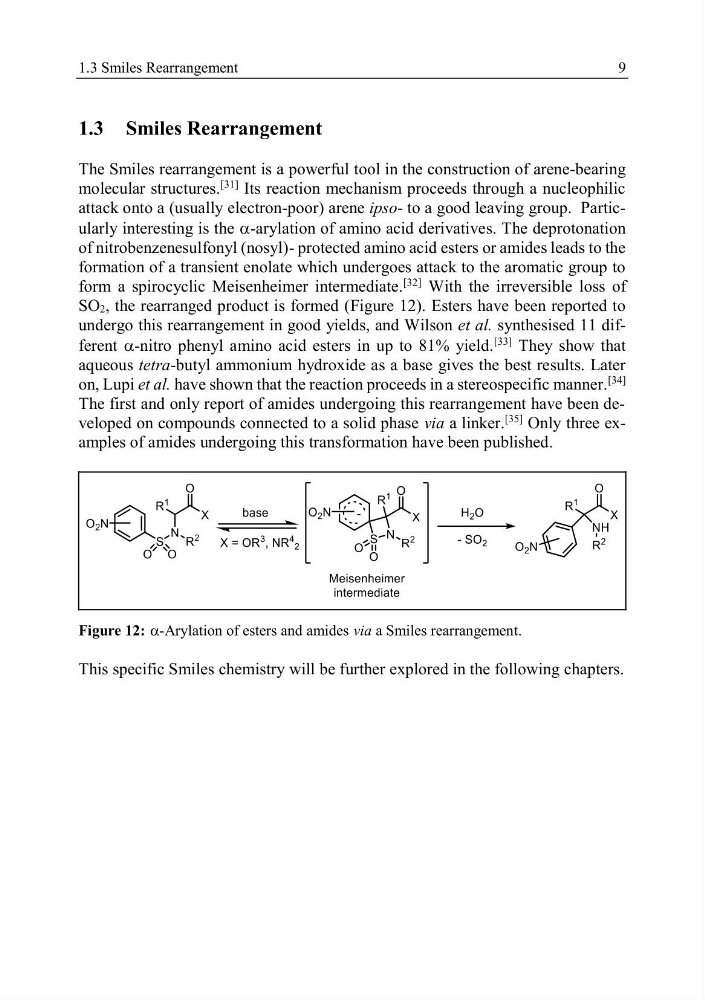
attack onto a (usually electron-poor) arene ipso- to a good leaving group. Particularly interesting is the -arylation of amino acid derivatives. The deprotonation
of nitrobenzenesulfonyl (nosyl)- protected amino acid esters or amides leads to the
formation of a transient enolate which undergoes attack to the aromatic group to
form a spirocyclic Meisenheimer intermediate.
[32]
With the irreversible loss of
SO2, the rearranged product is formed (Figure 12). Esters have been reported to
undergo this rearrangement in good yields, and Wilson et al. synthesised 11 different -nitro phenyl amino acid esters in up to 81% yield.
[33]
They show that
aqueous tetra-butyl ammonium hydroxide as a base gives the best results. Later
on, Lupi et al. have shown that the reaction proceeds in a stereospecific manner.
[34]
The first and only report of amides undergoing this rearrangement have been developed on compounds connected to a solid phase via a linker.
[35]
Only three examples of amides undergoing this transformation have been published.
Figure 12: -Arylation of esters and amides via a Smiles rearrangement.
This specific Smiles chemistry will be further explored in the following chapters.
9
1.3 Smiles Rearrangement
The Smiles rearrangement is a powerful tool in the construction of arene-bearing
molecular structures.
[31]
Its reaction mechanism proceeds through a nucleophilic
attack onto a (usually electron-poor) arene ipso- to a good leaving group. Particularly interesting is the -arylation of amino acid derivatives. The deprotonation
of nitrobenzenesulfonyl (nosyl)- protected amino acid esters or amides leads to the
formation of a transient enolate which undergoes attack to the aromatic group to
form a spirocyclic Meisenheimer intermediate.
[32]
With the irreversible loss of
SO2, the rearranged product is formed (Figure 12). Esters have been reported to
undergo this rearrangement in good yields, and Wilson et al. synthesised 11 different -nitro phenyl amino acid esters in up to 81% yield.
[33]
They show that
aqueous tetra-butyl ammonium hydroxide as a base gives the best results. Later
on, Lupi et al. have shown that the reaction proceeds in a stereospecific manner.
[34]
The first and only report of amides undergoing this rearrangement have been developed on compounds connected to a solid phase via a linker.
[35]
Only three examples of amides undergoing this transformation have been published.
Figure 12: -Arylation of esters and amides via a Smiles rearrangement.
This specific Smiles chemistry will be further explored in the following chapters.