

2.1 Nucleophilic α-Functionalisation of Amides
13
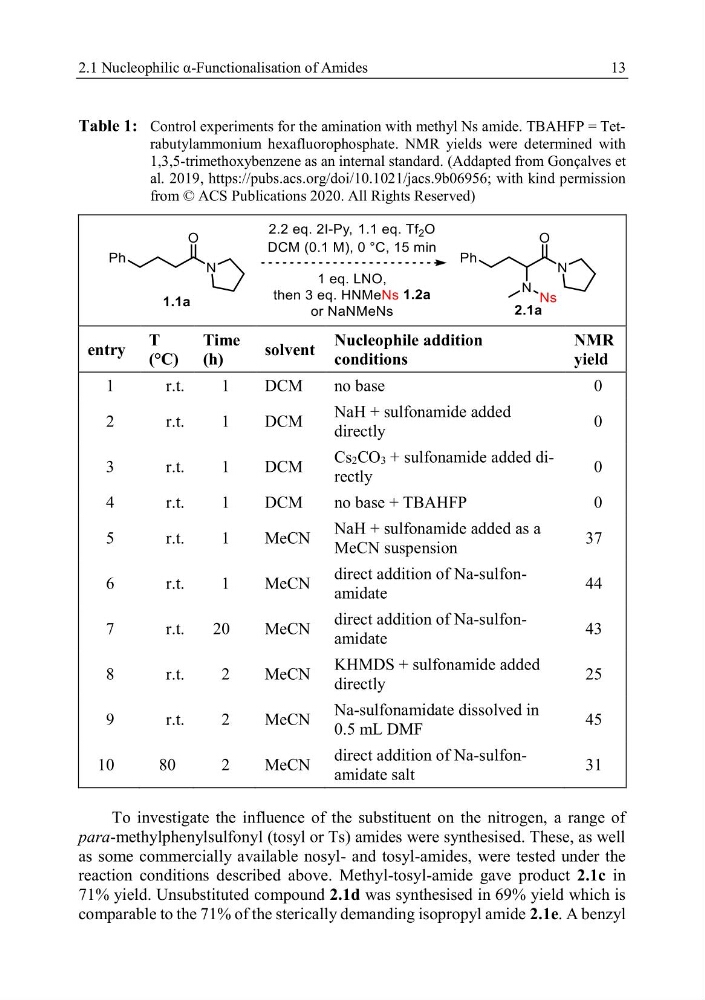
Table 1: Control experiments for the amination with methyl Ns amide. TBAHFP = Tetrabutylammonium hexafluorophosphate. NMR yields were determined with
1,3,5-trimethoxybenzene as an internal standard. (Addapted from Gonçalves et
al. 2019, https://pubs.acs.org/doi/10.1021/jacs.9b06956; with kind permission
from © ACS Publications 2020. All Rights Reserved)
entry
T
(°C)
Time
(h)
solvent
Nucleophile addition
conditions
NMR
yield
1
r.t.
1
DCM
no base
0
2
r.t.
1
DCM
NaH + sulfonamide added
directly
0
3
r.t.
1
DCM
Cs2CO3 + sulfonamide added directly
0
4
r.t.
1
DCM
no base + TBAHFP
0
5
r.t.
1
MeCN
NaH + sulfonamide added as a
MeCN suspension
37
6
r.t.
1
MeCN
direct addition of Na-sulfonamidate
44
7
r.t.
20
MeCN
direct addition of Na-sulfonamidate
43
8
r.t.
2
MeCN
KHMDS + sulfonamide added
directly
25
9
r.t.
2
MeCN
Na-sulfonamidate dissolved in
0.5 mL DMF
45
10
80
2
MeCN
direct addition of Na-sulfonamidate salt
31
To investigate the influence of the substituent on the nitrogen, a range of
para-methylphenylsulfonyl (tosyl or Ts) amides were synthesised. These, as well
as some commercially available nosyl- and tosyl-amides, were tested under the
reaction conditions described above. Methyl-tosyl-amide gave product 2.1c in
71% yield. Unsubstituted compound 2.1d was synthesised in 69% yield which is
comparable to the 71% of the sterically demanding isopropyl amide 2.1e. A benzyl
13
Table 1: Control experiments for the amination with methyl Ns amide. TBAHFP = Tetrabutylammonium hexafluorophosphate. NMR yields were determined with
1,3,5-trimethoxybenzene as an internal standard. (Addapted from Gonçalves et
al. 2019, https://pubs.acs.org/doi/10.1021/jacs.9b06956; with kind permission
from © ACS Publications 2020. All Rights Reserved)
entry
T
(°C)
Time
(h)
solvent
Nucleophile addition
conditions
NMR
yield
1
r.t.
1
DCM
no base
0
2
r.t.
1
DCM
NaH + sulfonamide added
directly
0
3
r.t.
1
DCM
Cs2CO3 + sulfonamide added directly
0
4
r.t.
1
DCM
no base + TBAHFP
0
5
r.t.
1
MeCN
NaH + sulfonamide added as a
MeCN suspension
37
6
r.t.
1
MeCN
direct addition of Na-sulfonamidate
44
7
r.t.
20
MeCN
direct addition of Na-sulfonamidate
43
8
r.t.
2
MeCN
KHMDS + sulfonamide added
directly
25
9
r.t.
2
MeCN
Na-sulfonamidate dissolved in
0.5 mL DMF
45
10
80
2
MeCN
direct addition of Na-sulfonamidate salt
31
To investigate the influence of the substituent on the nitrogen, a range of
para-methylphenylsulfonyl (tosyl or Ts) amides were synthesised. These, as well
as some commercially available nosyl- and tosyl-amides, were tested under the
reaction conditions described above. Methyl-tosyl-amide gave product 2.1c in
71% yield. Unsubstituted compound 2.1d was synthesised in 69% yield which is
comparable to the 71% of the sterically demanding isopropyl amide 2.1e. A benzyl