

4
1 Introduction
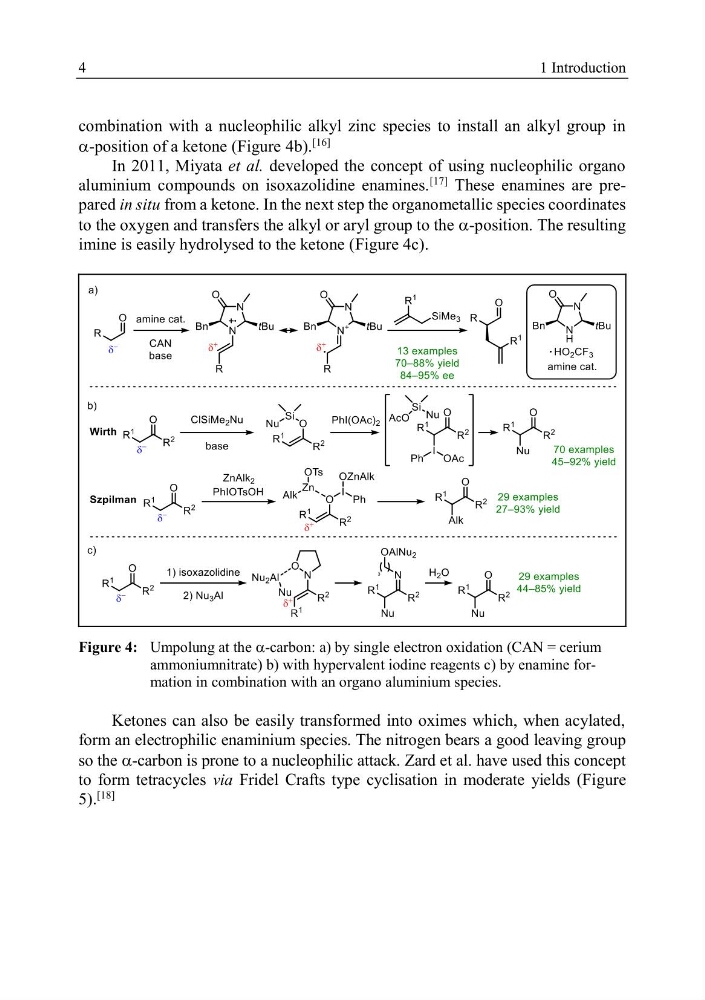
combination with a nucleophilic alkyl zinc species to install an alkyl group in
-position of a ketone (Figure 4b).
[16]
In 2011, Miyata et al. developed the concept of using nucleophilic organo
aluminium compounds on isoxazolidine enamines.
[17]
These enamines are prepared in situ from a ketone. In the next step the organometallic species coordinates
to the oxygen and transfers the alkyl or aryl group to the -position. The resulting
imine is easily hydrolysed to the ketone (Figure 4c).
Figure 4: Umpolung at the -carbon: a) by single electron oxidation (CAN = cerium
ammoniumnitrate) b) with hypervalent iodine reagents c) by enamine formation in combination with an organo aluminium species.
Ketones can also be easily transformed into oximes which, when acylated,
form an electrophilic enaminium species. The nitrogen bears a good leaving group
so the -carbon is prone to a nucleophilic attack. Zard et al. have used this concept
to form tetracycles via Fridel Crafts type cyclisation in moderate yields (Figure
5).
[18]
1 Introduction
combination with a nucleophilic alkyl zinc species to install an alkyl group in
-position of a ketone (Figure 4b).
[16]
In 2011, Miyata et al. developed the concept of using nucleophilic organo
aluminium compounds on isoxazolidine enamines.
[17]
These enamines are prepared in situ from a ketone. In the next step the organometallic species coordinates
to the oxygen and transfers the alkyl or aryl group to the -position. The resulting
imine is easily hydrolysed to the ketone (Figure 4c).
Figure 4: Umpolung at the -carbon: a) by single electron oxidation (CAN = cerium
ammoniumnitrate) b) with hypervalent iodine reagents c) by enamine formation in combination with an organo aluminium species.
Ketones can also be easily transformed into oximes which, when acylated,
form an electrophilic enaminium species. The nitrogen bears a good leaving group
so the -carbon is prone to a nucleophilic attack. Zard et al. have used this concept
to form tetracycles via Fridel Crafts type cyclisation in moderate yields (Figure
5).
[18]