

1.1 Umpolung
3
extensions of the Stetter reaction have been published including asymmetric variants.
[10,11]
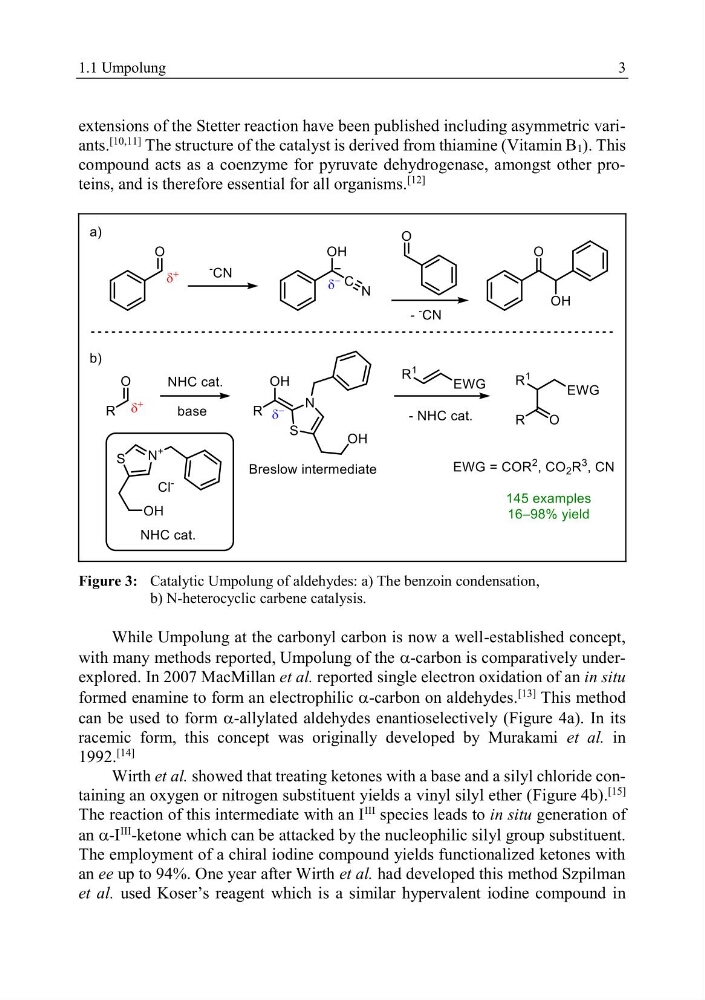
The structure of the catalyst is derived from thiamine (Vitamin B1). This
compound acts as a coenzyme for pyruvate dehydrogenase, amongst other proteins, and is therefore essential for all organisms.
[12]
Figure 3: Catalytic Umpolung of aldehydes: a) The benzoin condensation,
b) N-heterocyclic carbene catalysis.
While Umpolung at the carbonyl carbon is now a well-established concept,
with many methods reported, Umpolung of the -carbon is comparatively underexplored. In 2007 MacMillan et al. reported single electron oxidation of an in situ
formed enamine to form an electrophilic -carbon on aldehydes.
[13]
This method
can be used to form -allylated aldehydes enantioselectively (Figure 4a). In its
racemic form, this concept was originally developed by Murakami et al. in
1992.
[14]
Wirth et al. showed that treating ketones with a base and a silyl chloride containing an oxygen or nitrogen substituent yields a vinyl silyl ether (Figure 4b).
[15]
The reaction of this intermediate with an I
III
species leads to in situ generation of
an -I
III
-ketone which can be attacked by the nucleophilic silyl group substituent.
The employment of a chiral iodine compound yields functionalized ketones with
an ee up to 94%. One year after Wirth et al. had developed this method Szpilman
et al. used Koser’s reagent which is a similar hypervalent iodine compound in
3
extensions of the Stetter reaction have been published including asymmetric variants.
[10,11]
The structure of the catalyst is derived from thiamine (Vitamin B1). This
compound acts as a coenzyme for pyruvate dehydrogenase, amongst other proteins, and is therefore essential for all organisms.
[12]
Figure 3: Catalytic Umpolung of aldehydes: a) The benzoin condensation,
b) N-heterocyclic carbene catalysis.
While Umpolung at the carbonyl carbon is now a well-established concept,
with many methods reported, Umpolung of the -carbon is comparatively underexplored. In 2007 MacMillan et al. reported single electron oxidation of an in situ
formed enamine to form an electrophilic -carbon on aldehydes.
[13]
This method
can be used to form -allylated aldehydes enantioselectively (Figure 4a). In its
racemic form, this concept was originally developed by Murakami et al. in
1992.
[14]
Wirth et al. showed that treating ketones with a base and a silyl chloride containing an oxygen or nitrogen substituent yields a vinyl silyl ether (Figure 4b).
[15]
The reaction of this intermediate with an I
III
species leads to in situ generation of
an -I
III
-ketone which can be attacked by the nucleophilic silyl group substituent.
The employment of a chiral iodine compound yields functionalized ketones with
an ee up to 94%. One year after Wirth et al. had developed this method Szpilman
et al. used Koser’s reagent which is a similar hypervalent iodine compound in