

2
1 Introduction
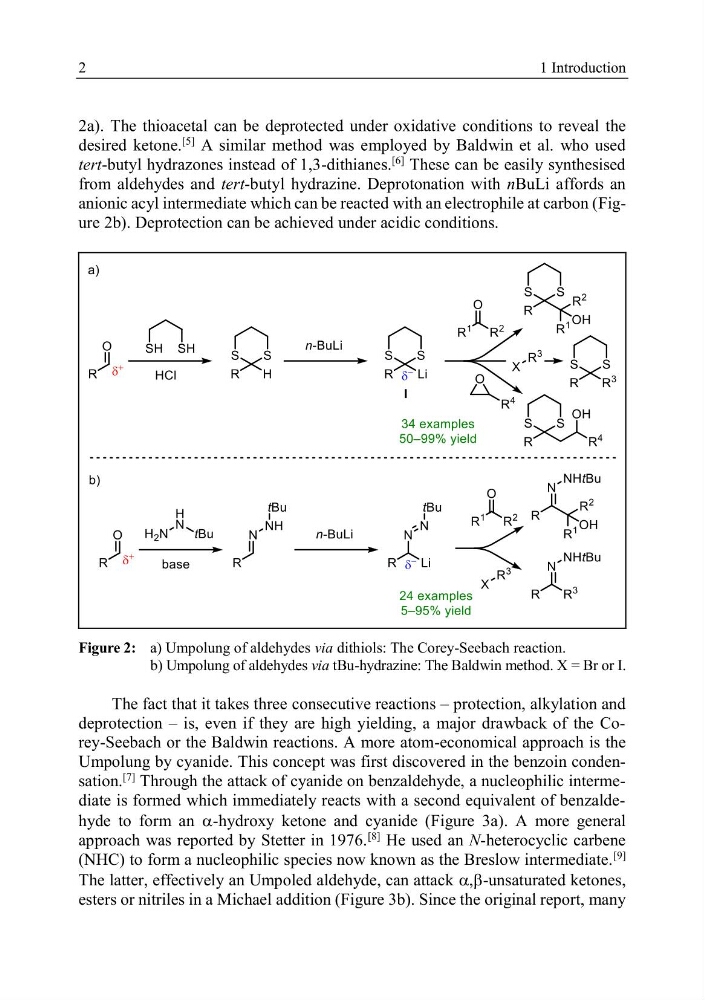
2a). The thioacetal can be deprotected under oxidative conditions to reveal the
desired ketone.
[5]
A similar method was employed by Baldwin et al. who used
tert-butyl hydrazones instead of 1,3-dithianes.
[6]
These can be easily synthesised
from aldehydes and tert-butyl hydrazine. Deprotonation with nBuLi affords an
anionic acyl intermediate which can be reacted with an electrophile at carbon (Figure 2b). Deprotection can be achieved under acidic conditions.
Figure 2: a) Umpolung of aldehydes via dithiols: The Corey-Seebach reaction.
b) Umpolung of aldehydes via tBu-hydrazine: The Baldwin method. X = Br or I.
The fact that it takes three consecutive reactions – protection, alkylation and
deprotection – is, even if they are high yielding, a major drawback of the Corey-Seebach or the Baldwin reactions. A more atom-economical approach is the
Umpolung by cyanide. This concept was first discovered in the benzoin condensation.
[7]
Through the attack of cyanide on benzaldehyde, a nucleophilic intermediate is formed which immediately reacts with a second equivalent of benzaldehyde to form an -hydroxy ketone and cyanide (Figure 3a). A more general
approach was reported by Stetter in 1976.
[8]
He used an N-heterocyclic carbene
(NHC) to form a nucleophilic species now known as the Breslow intermediate.
[9]
The latter, effectively an Umpoled aldehyde, can attack ,-unsaturated ketones,
esters or nitriles in a Michael addition (Figure 3b). Since the original report, many
1 Introduction
2a). The thioacetal can be deprotected under oxidative conditions to reveal the
desired ketone.
[5]
A similar method was employed by Baldwin et al. who used
tert-butyl hydrazones instead of 1,3-dithianes.
[6]
These can be easily synthesised
from aldehydes and tert-butyl hydrazine. Deprotonation with nBuLi affords an
anionic acyl intermediate which can be reacted with an electrophile at carbon (Figure 2b). Deprotection can be achieved under acidic conditions.
Figure 2: a) Umpolung of aldehydes via dithiols: The Corey-Seebach reaction.
b) Umpolung of aldehydes via tBu-hydrazine: The Baldwin method. X = Br or I.
The fact that it takes three consecutive reactions – protection, alkylation and
deprotection – is, even if they are high yielding, a major drawback of the Corey-Seebach or the Baldwin reactions. A more atom-economical approach is the
Umpolung by cyanide. This concept was first discovered in the benzoin condensation.
[7]
Through the attack of cyanide on benzaldehyde, a nucleophilic intermediate is formed which immediately reacts with a second equivalent of benzaldehyde to form an -hydroxy ketone and cyanide (Figure 3a). A more general
approach was reported by Stetter in 1976.
[8]
He used an N-heterocyclic carbene
(NHC) to form a nucleophilic species now known as the Breslow intermediate.
[9]
The latter, effectively an Umpoled aldehyde, can attack ,-unsaturated ketones,
esters or nitriles in a Michael addition (Figure 3b). Since the original report, many