

1 Introduction
1.1 Umpolung
By definition carbonyl moieties display electrophilic character at the carbonyl carbon and nucleophilic character at the -position. Through deprotonation aldehydes, ketones, esters, amides and nitriles form enolates which react with electrophiles to yield -functionalized products. Examples of such electrophiles include
aldehydes, ketones or esters themselves. These aldol
[1]
or Claisen
[2]
coupling reactions showcase the electrophilic character of the carbonyl carbon as well as the
nucleophilic character of the -position.
To expand the number of possible transformations of carbonyl compounds,
chemists have conceived creative strategies to reverse their polarity and therefore
their reactivity. The term Umpolung (“polarity inversion”) was popularized by the
German chemist D. Seebach and the American Nobel laureate E. J. Corey and
describes a reversal in partial charge.
[3]
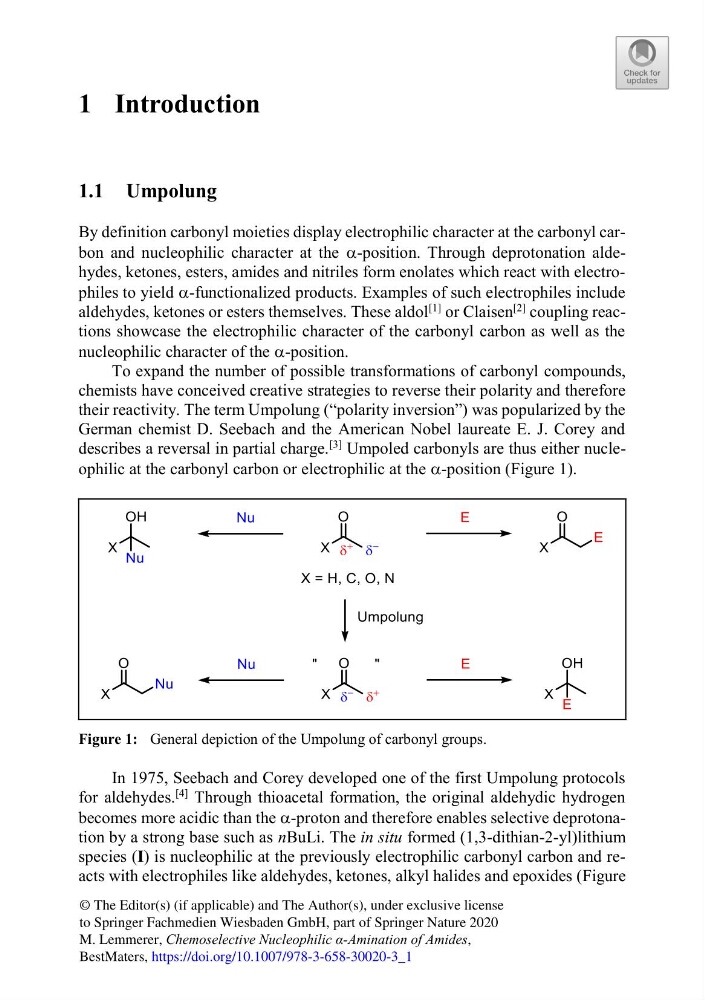
Umpoled carbonyls are thus either nucleophilic at the carbonyl carbon or electrophilic at the -position (Figure 1).
Figure 1: General depiction of the Umpolung of carbonyl groups.
In 1975, Seebach and Corey developed one of the first Umpolung protocols
for aldehydes.
[4]
Through thioacetal formation, the original aldehydic hydrogen
becomes more acidic than the -proton and therefore enables selective deprotonation by a strong base such as nBuLi. The in situ formed (1,3-dithian-2-yl)lithium
species (I) is nucleophilic at the previously electrophilic carbonyl carbon and reacts with electrophiles like aldehydes, ketones, alkyl halides and epoxides (Figure
© The Editor(s) (if applicable) and The Author(s), under exclusive license
to Springer Fachmedien Wiesbaden GmbH, part of Springer Nature 2020
M. Lemmerer, Chemoselective Nucleophilic α-Amination of Amides,
BestMaters, https://doi.org/10.1007/978-3-658-30020-3_1
1.1 Umpolung
By definition carbonyl moieties display electrophilic character at the carbonyl carbon and nucleophilic character at the -position. Through deprotonation aldehydes, ketones, esters, amides and nitriles form enolates which react with electrophiles to yield -functionalized products. Examples of such electrophiles include
aldehydes, ketones or esters themselves. These aldol
[1]
or Claisen
[2]
coupling reactions showcase the electrophilic character of the carbonyl carbon as well as the
nucleophilic character of the -position.
To expand the number of possible transformations of carbonyl compounds,
chemists have conceived creative strategies to reverse their polarity and therefore
their reactivity. The term Umpolung (“polarity inversion”) was popularized by the
German chemist D. Seebach and the American Nobel laureate E. J. Corey and
describes a reversal in partial charge.
[3]
Umpoled carbonyls are thus either nucleophilic at the carbonyl carbon or electrophilic at the -position (Figure 1).
Figure 1: General depiction of the Umpolung of carbonyl groups.
In 1975, Seebach and Corey developed one of the first Umpolung protocols
for aldehydes.
[4]
Through thioacetal formation, the original aldehydic hydrogen
becomes more acidic than the -proton and therefore enables selective deprotonation by a strong base such as nBuLi. The in situ formed (1,3-dithian-2-yl)lithium
species (I) is nucleophilic at the previously electrophilic carbonyl carbon and reacts with electrophiles like aldehydes, ketones, alkyl halides and epoxides (Figure
© The Editor(s) (if applicable) and The Author(s), under exclusive license
to Springer Fachmedien Wiesbaden GmbH, part of Springer Nature 2020
M. Lemmerer, Chemoselective Nucleophilic α-Amination of Amides,
BestMaters, https://doi.org/10.1007/978-3-658-30020-3_1