

Processes 2018, 6, 134
The incorporated mechanisms of VLDL and LDL endocytosis and their respective dynamics
at the cellular level are as follows. LDL particles in the medium surrounding the cell (denoted
l E ) bind to free receptors (r F ) in clathrin pits on the cell surface at rate ¯
α L and unbind at rate ¯
α −L .
In binding, LDL particles effectively bind to one receptor, but can occlude up to m l surrounding
receptors. The bound receptor and LDL (l RB ) and the free and occluded receptors in the pit are then
internalised (at rate ¯
β L ) to become internalised vesicles (l I ).
Internalised vesicles and their contents subsequently break down whereby the cholesterol c
contained within the LDL particles is added to the internal cholesterol pool of the cell ( ¯
γ L ), where it is
esterified for other cellular processes at a rate proportional to it’s concentration ( ¯
δ c ). A proportion f of
the free receptors in the vesicle are placed in the cells internal cell store, ready for recycling back to the
cell surface ( ¯
γ r ). The rest are degraded.
VLDL particle binding, internalisation and subsequent breakdown are governed by a similar series
of processes represented by variables denoted with v instead of l, for example v E for the concentration
of extracellular VLDL and ¯
α v for binding of VLDL to receptors. Pits consisting of P empty receptors
(no LDL or VLDL bound) may also be internalised ¯
β 0 .
Further to these processes, VLDL supply to the serum and VLDL to LDL delipidation is
described by
¯
ω −−−−→ V E
¯
χv
−−−−→ L E ,
(2)
where ¯
ω is a constant supply of VLDL to the serum and ¯
χ v is the respective reaction rate constant
of delipidation.
2. Materials and Methods
2.1. Mathematical Formulation
Applying the Law of Mass Action to those mechanisms described in Section 1.1 coupled with
the models of [10,15] leads to the system of Equations (3)–(20), that integrate cholesterol and receptor
biosynthesis with lipoprotein metabolism metabolism.
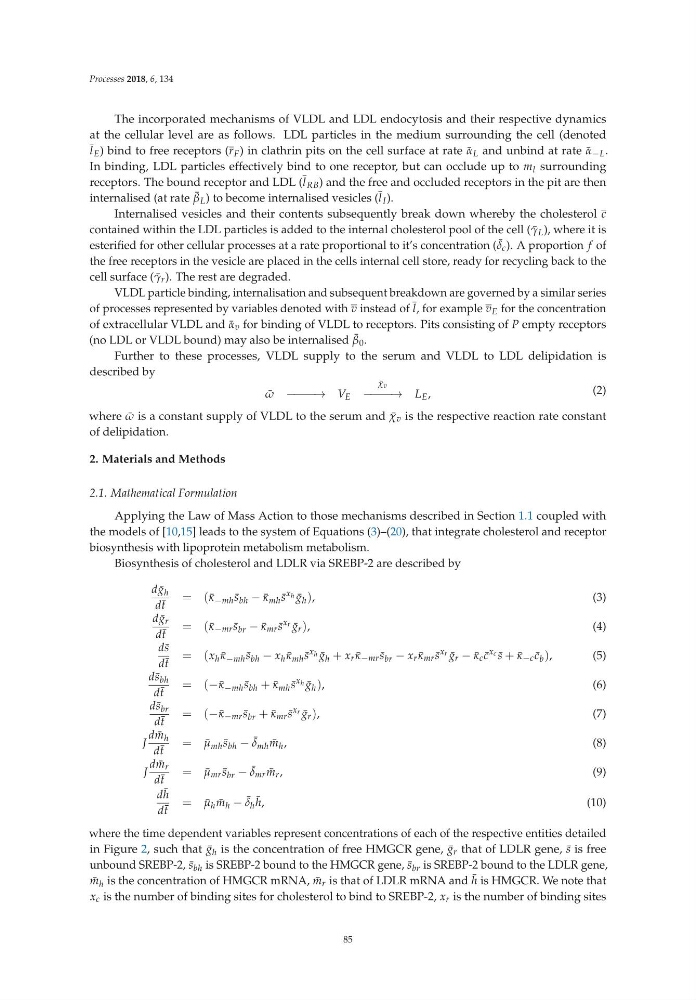
Biosynthesis of cholesterol and LDLR via SREBP-2 are described by
d ¯
g h
d ¯
t
=( ¯
κ −mh ¯
s bh − ¯
κ mh ¯
s
x h ¯
g h ),
(3)
d ¯
g r
d ¯
t
=( ¯
κ −mr ¯
s br − ¯
κ mr ¯
s
xr ¯
g r ),
(4)
d ¯
s
d ¯
t
=( x h ¯
κ −mh ¯
s bh − x h ¯
κ mh ¯
s
x h ¯
g h + x r ¯
κ −mr ¯
s br − x r ¯
κ mr ¯
s
xr ¯
g r − ¯
κ c ¯
c
xc ¯
s + ¯
κ −c ¯
c b ),
(5)
d ¯
s bh
d ¯
t
=( − ¯
κ −mh ¯
s bh + ¯
κ mh ¯
s
x h ¯
g h ),
(6)
d ¯
s br
d ¯
t
=( − ¯
κ −mr ¯
s br + ¯
κ mr ¯
s
xr ¯
g r ),
(7)
J
d ¯
m h
d ¯
t
= ¯
μ mh ¯
s bh − ¯
δ mh ¯
m h ,
(8)
J
d ¯
m r
d ¯
t
= ¯
μ mr ¯
s br − ¯
δ mr ¯
m r ,
(9)
d ¯
h
d ¯
t
= ¯
μ h ¯
m h − ¯
δ h ¯
h,
(10)
where the time dependent variables represent concentrations of each of the respective entities detailed
in Figure 2, such that ¯
g h is the concentration of free HMGCR gene, ¯
g r that of LDLR gene, ¯
s is free
unbound SREBP-2, ¯
s bh is SREBP-2 bound to the HMGCR gene, ¯
s br is SREBP-2 bound to the LDLR gene,
¯
m h is the concentration of HMGCR mRNA, ¯
m r is that of LDLR mRNA and ¯
h is HMGCR. We note that
x c is the number of binding sites for cholesterol to bind to SREBP-2, x r is the number of binding sites
85
The incorporated mechanisms of VLDL and LDL endocytosis and their respective dynamics
at the cellular level are as follows. LDL particles in the medium surrounding the cell (denoted
l E ) bind to free receptors (r F ) in clathrin pits on the cell surface at rate ¯
α L and unbind at rate ¯
α −L .
In binding, LDL particles effectively bind to one receptor, but can occlude up to m l surrounding
receptors. The bound receptor and LDL (l RB ) and the free and occluded receptors in the pit are then
internalised (at rate ¯
β L ) to become internalised vesicles (l I ).
Internalised vesicles and their contents subsequently break down whereby the cholesterol c
contained within the LDL particles is added to the internal cholesterol pool of the cell ( ¯
γ L ), where it is
esterified for other cellular processes at a rate proportional to it’s concentration ( ¯
δ c ). A proportion f of
the free receptors in the vesicle are placed in the cells internal cell store, ready for recycling back to the
cell surface ( ¯
γ r ). The rest are degraded.
VLDL particle binding, internalisation and subsequent breakdown are governed by a similar series
of processes represented by variables denoted with v instead of l, for example v E for the concentration
of extracellular VLDL and ¯
α v for binding of VLDL to receptors. Pits consisting of P empty receptors
(no LDL or VLDL bound) may also be internalised ¯
β 0 .
Further to these processes, VLDL supply to the serum and VLDL to LDL delipidation is
described by
¯
ω −−−−→ V E
¯
χv
−−−−→ L E ,
(2)
where ¯
ω is a constant supply of VLDL to the serum and ¯
χ v is the respective reaction rate constant
of delipidation.
2. Materials and Methods
2.1. Mathematical Formulation
Applying the Law of Mass Action to those mechanisms described in Section 1.1 coupled with
the models of [10,15] leads to the system of Equations (3)–(20), that integrate cholesterol and receptor
biosynthesis with lipoprotein metabolism metabolism.
Biosynthesis of cholesterol and LDLR via SREBP-2 are described by
d ¯
g h
d ¯
t
=( ¯
κ −mh ¯
s bh − ¯
κ mh ¯
s
x h ¯
g h ),
(3)
d ¯
g r
d ¯
t
=( ¯
κ −mr ¯
s br − ¯
κ mr ¯
s
xr ¯
g r ),
(4)
d ¯
s
d ¯
t
=( x h ¯
κ −mh ¯
s bh − x h ¯
κ mh ¯
s
x h ¯
g h + x r ¯
κ −mr ¯
s br − x r ¯
κ mr ¯
s
xr ¯
g r − ¯
κ c ¯
c
xc ¯
s + ¯
κ −c ¯
c b ),
(5)
d ¯
s bh
d ¯
t
=( − ¯
κ −mh ¯
s bh + ¯
κ mh ¯
s
x h ¯
g h ),
(6)
d ¯
s br
d ¯
t
=( − ¯
κ −mr ¯
s br + ¯
κ mr ¯
s
xr ¯
g r ),
(7)
J
d ¯
m h
d ¯
t
= ¯
μ mh ¯
s bh − ¯
δ mh ¯
m h ,
(8)
J
d ¯
m r
d ¯
t
= ¯
μ mr ¯
s br − ¯
δ mr ¯
m r ,
(9)
d ¯
h
d ¯
t
= ¯
μ h ¯
m h − ¯
δ h ¯
h,
(10)
where the time dependent variables represent concentrations of each of the respective entities detailed
in Figure 2, such that ¯
g h is the concentration of free HMGCR gene, ¯
g r that of LDLR gene, ¯
s is free
unbound SREBP-2, ¯
s bh is SREBP-2 bound to the HMGCR gene, ¯
s br is SREBP-2 bound to the LDLR gene,
¯
m h is the concentration of HMGCR mRNA, ¯
m r is that of LDLR mRNA and ¯
h is HMGCR. We note that
x c is the number of binding sites for cholesterol to bind to SREBP-2, x r is the number of binding sites
85