

Processes 2018, 6, 134
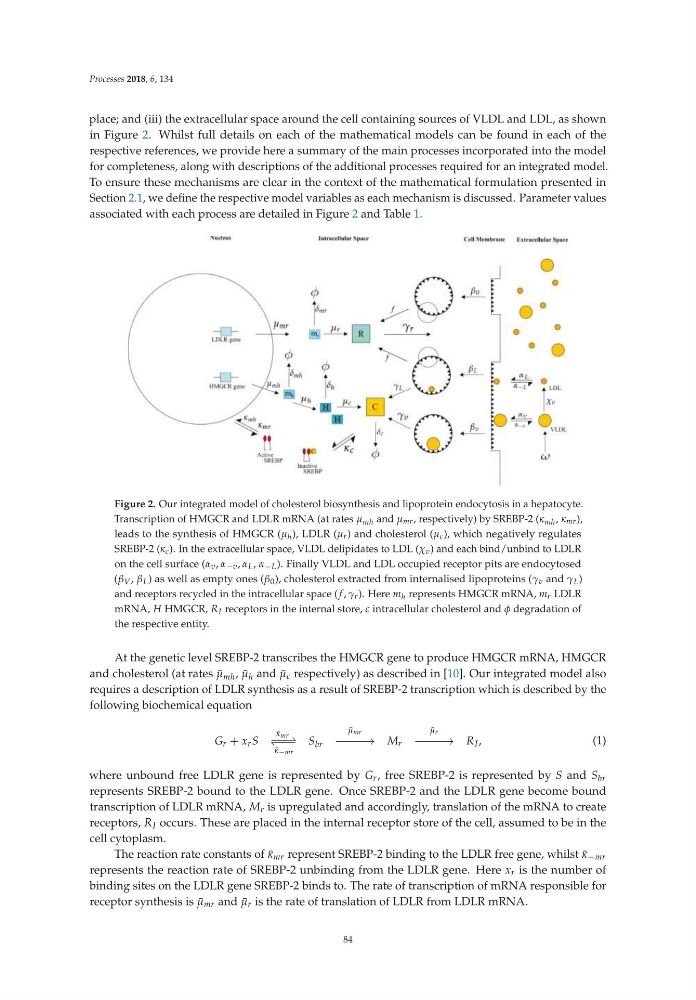
place; and (iii) the extracellular space around the cell containing sources of VLDL and LDL, as shown
in Figure 2. Whilst full details on each of the mathematical models can be found in each of the
respective references, we provide here a summary of the main processes incorporated into the model
for completeness, along with descriptions of the additional processes required for an integrated model.
To ensure these mechanisms are clear in the context of the mathematical formulation presented in
Section 2.1, we define the respective model variables as each mechanism is discussed. Parameter values
associated with each process are detailed in Figure 2 and Table 1.
Figure 2. Our integrated model of cholesterol biosynthesis and lipoprotein endocytosis in a hepatocyte.
Transcription of HMGCR and LDLR mRNA (at rates μ mh and μ mr , respectively) by SREBP-2 (κ mh , κ mr ),
leads to the synthesis of HMGCR (μ h ), LDLR (μ r ) and cholesterol (μ c ), which negatively regulates
SREBP-2 (κ c ). In the extracellular space, VLDL delipidates to LDL (χ v ) and each bind/unbind to LDLR
on the cell surface (α v , α −v , α L , α −L ). Finally VLDL and LDL occupied receptor pits are endocytosed
(β V , β L ) as well as empty ones (β 0 ), cholesterol extracted from internalised lipoproteins (γ v and γ L )
and receptors recycled in the intracellular space ( f , γ r ). Here m h represents HMGCR mRNA, m r LDLR
mRNA, H HMGCR, R I receptors in the internal store, c intracellular cholesterol and φ degradation of
the respective entity.
At the genetic level SREBP-2 transcribes the HMGCR gene to produce HMGCR mRNA, HMGCR
and cholesterol (at rates ¯
μ mh , ¯
μ h and ¯
μ c respectively) as described in [10]. Our integrated model also
requires a description of LDLR synthesis as a result of SREBP-2 transcription which is described by the
following biochemical equation
G r + x r S
¯
κmr
−−⇀ ↽−−
¯
κ−mr
S br
¯
μmr
−−−−→ M r
¯
μr
−−−−→ R I ,
(1)
where unbound free LDLR gene is represented by G r , free SREBP-2 is represented by S and S br
represents SREBP-2 bound to the LDLR gene. Once SREBP-2 and the LDLR gene become bound
transcription of LDLR mRNA, M r is upregulated and accordingly, translation of the mRNA to create
receptors, R I occurs. These are placed in the internal receptor store of the cell, assumed to be in the
cell cytoplasm.
The reaction rate constants of ¯
κ mr represent SREBP-2 binding to the LDLR free gene, whilst ¯
κ −mr
represents the reaction rate of SREBP-2 unbinding from the LDLR gene. Here x r is the number of
binding sites on the LDLR gene SREBP-2 binds to. The rate of transcription of mRNA responsible for
receptor synthesis is ¯
μ mr and ¯
μ r is the rate of translation of LDLR from LDLR mRNA.
84
place; and (iii) the extracellular space around the cell containing sources of VLDL and LDL, as shown
in Figure 2. Whilst full details on each of the mathematical models can be found in each of the
respective references, we provide here a summary of the main processes incorporated into the model
for completeness, along with descriptions of the additional processes required for an integrated model.
To ensure these mechanisms are clear in the context of the mathematical formulation presented in
Section 2.1, we define the respective model variables as each mechanism is discussed. Parameter values
associated with each process are detailed in Figure 2 and Table 1.
Figure 2. Our integrated model of cholesterol biosynthesis and lipoprotein endocytosis in a hepatocyte.
Transcription of HMGCR and LDLR mRNA (at rates μ mh and μ mr , respectively) by SREBP-2 (κ mh , κ mr ),
leads to the synthesis of HMGCR (μ h ), LDLR (μ r ) and cholesterol (μ c ), which negatively regulates
SREBP-2 (κ c ). In the extracellular space, VLDL delipidates to LDL (χ v ) and each bind/unbind to LDLR
on the cell surface (α v , α −v , α L , α −L ). Finally VLDL and LDL occupied receptor pits are endocytosed
(β V , β L ) as well as empty ones (β 0 ), cholesterol extracted from internalised lipoproteins (γ v and γ L )
and receptors recycled in the intracellular space ( f , γ r ). Here m h represents HMGCR mRNA, m r LDLR
mRNA, H HMGCR, R I receptors in the internal store, c intracellular cholesterol and φ degradation of
the respective entity.
At the genetic level SREBP-2 transcribes the HMGCR gene to produce HMGCR mRNA, HMGCR
and cholesterol (at rates ¯
μ mh , ¯
μ h and ¯
μ c respectively) as described in [10]. Our integrated model also
requires a description of LDLR synthesis as a result of SREBP-2 transcription which is described by the
following biochemical equation
G r + x r S
¯
κmr
−−⇀ ↽−−
¯
κ−mr
S br
¯
μmr
−−−−→ M r
¯
μr
−−−−→ R I ,
(1)
where unbound free LDLR gene is represented by G r , free SREBP-2 is represented by S and S br
represents SREBP-2 bound to the LDLR gene. Once SREBP-2 and the LDLR gene become bound
transcription of LDLR mRNA, M r is upregulated and accordingly, translation of the mRNA to create
receptors, R I occurs. These are placed in the internal receptor store of the cell, assumed to be in the
cell cytoplasm.
The reaction rate constants of ¯
κ mr represent SREBP-2 binding to the LDLR free gene, whilst ¯
κ −mr
represents the reaction rate of SREBP-2 unbinding from the LDLR gene. Here x r is the number of
binding sites on the LDLR gene SREBP-2 binds to. The rate of transcription of mRNA responsible for
receptor synthesis is ¯
μ mr and ¯
μ r is the rate of translation of LDLR from LDLR mRNA.
84