

Processes 2018, 6, 134
Our paper is organised as follows. In Section 1.1 we discuss the main biological features included
in our integrated mathematical model before presenting an ODE model of the system in Section 2.1.
Details of the model parameterisation are discussed in Section 2.4, which is followed by numerical
simulations of the governing system of equations in Section 3.1. Results of computational and
mathematical model analysis are presented in Section 3.2, before we investigate the effect of different
classes of FH on extracellular levels of LDL and intracellular cholesterol levels. The effect of varying
levels of statin therapy are investigated in Section 3.4 before we summarise and discuss our findings in
Section 4.
Whilst our model has been formulated and parameterised in an in vitro context, the extrapolation
to an in vivo setting is not considerably different given hepatocytes will be surrounded by lipoproteins
within the liver. We thus wish to test how well this extrapolation works by testing the model against
known in vivo outcomes in respect of Familial Hypercholesterolaemia and response to statin therapy.
1.1. Cholesterol Biosynthesis and Lipoprotein Metabolism
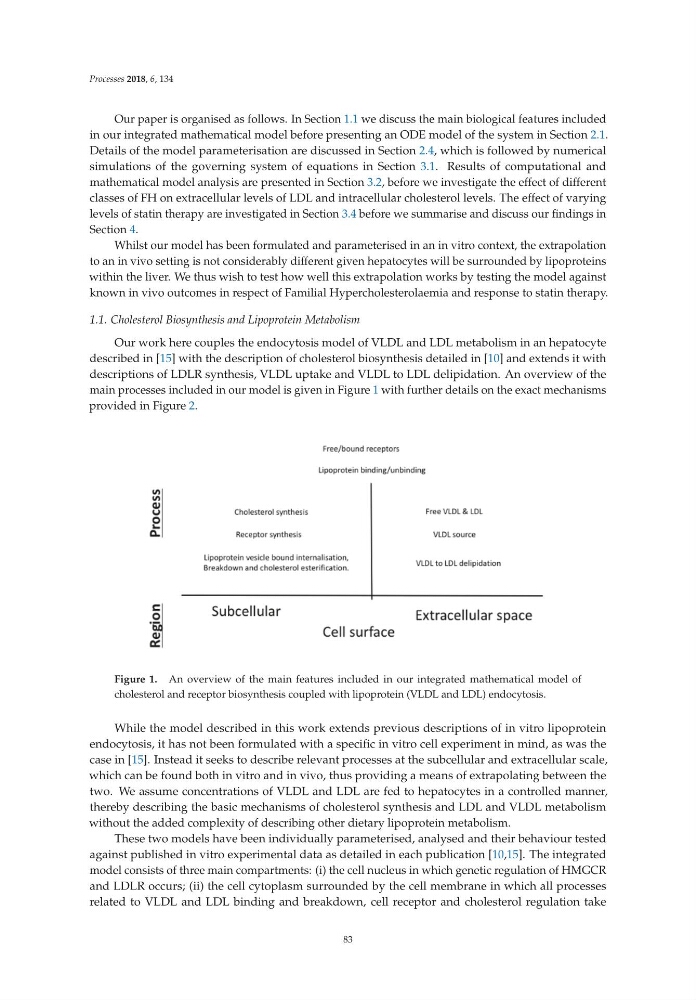
Our work here couples the endocytosis model of VLDL and LDL metabolism in an hepatocyte
described in [15] with the description of cholesterol biosynthesis detailed in [10] and extends it with
descriptions of LDLR synthesis, VLDL uptake and VLDL to LDL delipidation. An overview of the
main processes included in our model is given in Figure 1 with further details on the exact mechanisms
provided in Figure 2.
Figure 1. An overview of the main features included in our integrated mathematical model of
cholesterol and receptor biosynthesis coupled with lipoprotein (VLDL and LDL) endocytosis.
While the model described in this work extends previous descriptions of in vitro lipoprotein
endocytosis, it has not been formulated with a specific in vitro cell experiment in mind, as was the
case in [15]. Instead it seeks to describe relevant processes at the subcellular and extracellular scale,
which can be found both in vitro and in vivo, thus providing a means of extrapolating between the
two. We assume concentrations of VLDL and LDL are fed to hepatocytes in a controlled manner,
thereby describing the basic mechanisms of cholesterol synthesis and LDL and VLDL metabolism
without the added complexity of describing other dietary lipoprotein metabolism.
These two models have been individually parameterised, analysed and their behaviour tested
against published in vitro experimental data as detailed in each publication [10,15]. The integrated
model consists of three main compartments: (i) the cell nucleus in which genetic regulation of HMGCR
and LDLR occurs; (ii) the cell cytoplasm surrounded by the cell membrane in which all processes
related to VLDL and LDL binding and breakdown, cell receptor and cholesterol regulation take
83
Our paper is organised as follows. In Section 1.1 we discuss the main biological features included
in our integrated mathematical model before presenting an ODE model of the system in Section 2.1.
Details of the model parameterisation are discussed in Section 2.4, which is followed by numerical
simulations of the governing system of equations in Section 3.1. Results of computational and
mathematical model analysis are presented in Section 3.2, before we investigate the effect of different
classes of FH on extracellular levels of LDL and intracellular cholesterol levels. The effect of varying
levels of statin therapy are investigated in Section 3.4 before we summarise and discuss our findings in
Section 4.
Whilst our model has been formulated and parameterised in an in vitro context, the extrapolation
to an in vivo setting is not considerably different given hepatocytes will be surrounded by lipoproteins
within the liver. We thus wish to test how well this extrapolation works by testing the model against
known in vivo outcomes in respect of Familial Hypercholesterolaemia and response to statin therapy.
1.1. Cholesterol Biosynthesis and Lipoprotein Metabolism
Our work here couples the endocytosis model of VLDL and LDL metabolism in an hepatocyte
described in [15] with the description of cholesterol biosynthesis detailed in [10] and extends it with
descriptions of LDLR synthesis, VLDL uptake and VLDL to LDL delipidation. An overview of the
main processes included in our model is given in Figure 1 with further details on the exact mechanisms
provided in Figure 2.
Figure 1. An overview of the main features included in our integrated mathematical model of
cholesterol and receptor biosynthesis coupled with lipoprotein (VLDL and LDL) endocytosis.
While the model described in this work extends previous descriptions of in vitro lipoprotein
endocytosis, it has not been formulated with a specific in vitro cell experiment in mind, as was the
case in [15]. Instead it seeks to describe relevant processes at the subcellular and extracellular scale,
which can be found both in vitro and in vivo, thus providing a means of extrapolating between the
two. We assume concentrations of VLDL and LDL are fed to hepatocytes in a controlled manner,
thereby describing the basic mechanisms of cholesterol synthesis and LDL and VLDL metabolism
without the added complexity of describing other dietary lipoprotein metabolism.
These two models have been individually parameterised, analysed and their behaviour tested
against published in vitro experimental data as detailed in each publication [10,15]. The integrated
model consists of three main compartments: (i) the cell nucleus in which genetic regulation of HMGCR
and LDLR occurs; (ii) the cell cytoplasm surrounded by the cell membrane in which all processes
related to VLDL and LDL binding and breakdown, cell receptor and cholesterol regulation take
83