

Processes 2019, 7,20
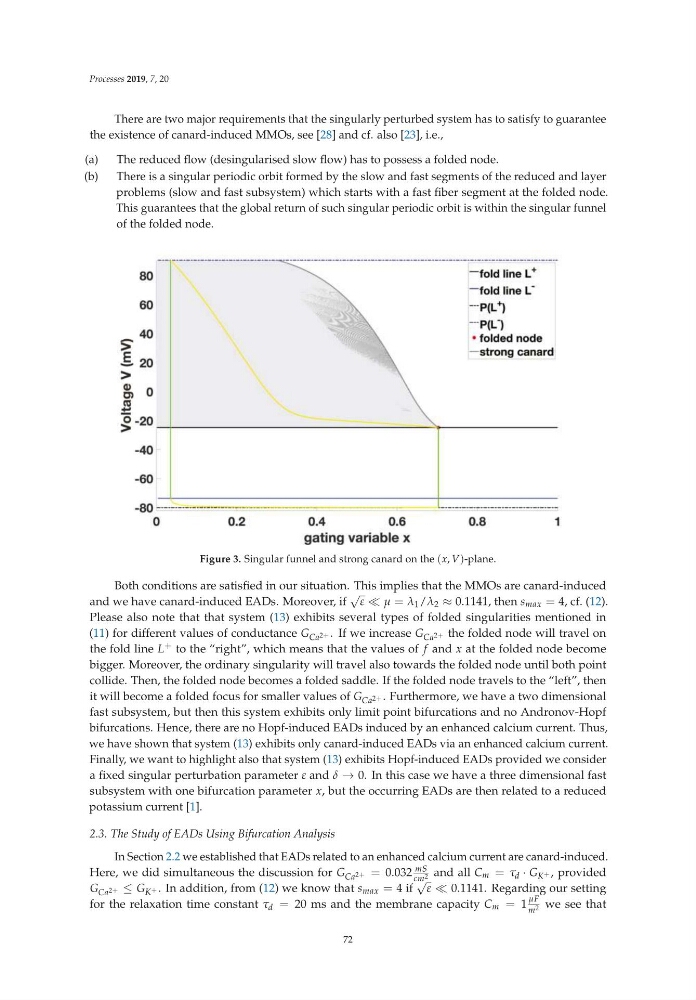
There are two major requirements that the singularly perturbed system has to satisfy to guarantee
the existence of canard-induced MMOs, see [28] and cf. also [23], i.e.,
(a)
The reduced flow (desingularised slow flow) has to possess a folded node.
(b)
There is a singular periodic orbit formed by the slow and fast segments of the reduced and layer
problems (slow and fast subsystem) which starts with a fast fiber segment at the folded node.
This guarantees that the global return of such singular periodic orbit is within the singular funnel
of the folded node.
Figure 3. Singular funnel and strong canard on the (x, V)-plane.
Both conditions are satisfied in our situation. This implies that the MMOs are canard-induced
and we have canard-induced EADs. Moreover, if
√
ε ≪ μ = λ 1 /λ 2 ≈ 0.1141, then s max = 4, cf. (12).
Please also note that that system (13) exhibits several types of folded singularities mentioned in
(11) for different values of conductance G Ca 2+ . If we increase G Ca 2+ the folded node will travel on
the fold line L + to the “right”, which means that the values of f and x at the folded node become
bigger. Moreover, the ordinary singularity will travel also towards the folded node until both point
collide. Then, the folded node becomes a folded saddle. If the folded node travels to the “left”, then
it will become a folded focus for smaller values of G Ca 2+ . Furthermore, we have a two dimensional
fast subsystem, but then this system exhibits only limit point bifurcations and no Andronov-Hopf
bifurcations. Hence, there are no Hopf-induced EADs induced by an enhanced calcium current. Thus,
we have shown that system (13) exhibits only canard-induced EADs via an enhanced calcium current.
Finally, we want to highlight also that system (13) exhibits Hopf-induced EADs provided we consider
a fixed singular perturbation parameter ε and δ → 0. In this case we have a three dimensional fast
subsystem with one bifurcation parameter x, but the occurring EADs are then related to a reduced
potassium current [1].
2.3. The Study of EADs Using Bifurcation Analysis
In Section 2.2 we established that EADs related to an enhanced calcium current are canard-induced.
Here, we did simultaneous the discussion for G Ca 2+ = 0.032
mS
cm 2 and all C m = τ d · G K + , provided
G Ca 2+ ≤ G K + . In addition, from (12) we know that s max = 4if
√
ε ≪ 0.1141. Regarding our setting
for the relaxation time constant τ d = 20 ms and the membrane capacity C m = 1
μF
m 2 we see that
72
There are two major requirements that the singularly perturbed system has to satisfy to guarantee
the existence of canard-induced MMOs, see [28] and cf. also [23], i.e.,
(a)
The reduced flow (desingularised slow flow) has to possess a folded node.
(b)
There is a singular periodic orbit formed by the slow and fast segments of the reduced and layer
problems (slow and fast subsystem) which starts with a fast fiber segment at the folded node.
This guarantees that the global return of such singular periodic orbit is within the singular funnel
of the folded node.
Figure 3. Singular funnel and strong canard on the (x, V)-plane.
Both conditions are satisfied in our situation. This implies that the MMOs are canard-induced
and we have canard-induced EADs. Moreover, if
√
ε ≪ μ = λ 1 /λ 2 ≈ 0.1141, then s max = 4, cf. (12).
Please also note that that system (13) exhibits several types of folded singularities mentioned in
(11) for different values of conductance G Ca 2+ . If we increase G Ca 2+ the folded node will travel on
the fold line L + to the “right”, which means that the values of f and x at the folded node become
bigger. Moreover, the ordinary singularity will travel also towards the folded node until both point
collide. Then, the folded node becomes a folded saddle. If the folded node travels to the “left”, then
it will become a folded focus for smaller values of G Ca 2+ . Furthermore, we have a two dimensional
fast subsystem, but then this system exhibits only limit point bifurcations and no Andronov-Hopf
bifurcations. Hence, there are no Hopf-induced EADs induced by an enhanced calcium current. Thus,
we have shown that system (13) exhibits only canard-induced EADs via an enhanced calcium current.
Finally, we want to highlight also that system (13) exhibits Hopf-induced EADs provided we consider
a fixed singular perturbation parameter ε and δ → 0. In this case we have a three dimensional fast
subsystem with one bifurcation parameter x, but the occurring EADs are then related to a reduced
potassium current [1].
2.3. The Study of EADs Using Bifurcation Analysis
In Section 2.2 we established that EADs related to an enhanced calcium current are canard-induced.
Here, we did simultaneous the discussion for G Ca 2+ = 0.032
mS
cm 2 and all C m = τ d · G K + , provided
G Ca 2+ ≤ G K + . In addition, from (12) we know that s max = 4if
√
ε ≪ 0.1141. Regarding our setting
for the relaxation time constant τ d = 20 ms and the membrane capacity C m = 1
μF
m 2 we see that
72