

Processes 2018, 6,56
Autoprotection is described as resistance to toxicant re-exposure following acute, mild injury
with the same toxicant, such as acetaminophen [11,12]. It is an example of a phenomenon that can
be characterized as located on the far left of the spectrum 1b. Knowledge of the phenomenon is
sparse and imprecise. Although there is considerable information about particular molecular details,
only incomplete speculative explanations of the phenomenon are currently feasible, and it would be
difficult to distinguish causes from effects. Such explanations would fall short of the definition of
mechanism and so would be located considerably left of center on the spectrum 1c. As such, weak
Mechanistic Explanation is an accurate descriptor and any possible mechanism-based account would
be at best conjecture.
5. Three Groups of Models of Explanation
A huge variety of explanatory model types populates the Mechanism-oriented Models spectrum
in Figure 1a. Having characterizations and descriptors that make it easier to distinguish among classes
and types is essential to support clarity and credibility, aid in distinguishing among computational
model types and provide a foundation for an ontology. We identify and describe seven broad types
and cluster them into three groups. Group A includes the three characterizations illustrated in Figure 2.
One of those characterizations is an essential core component of each of the four computational
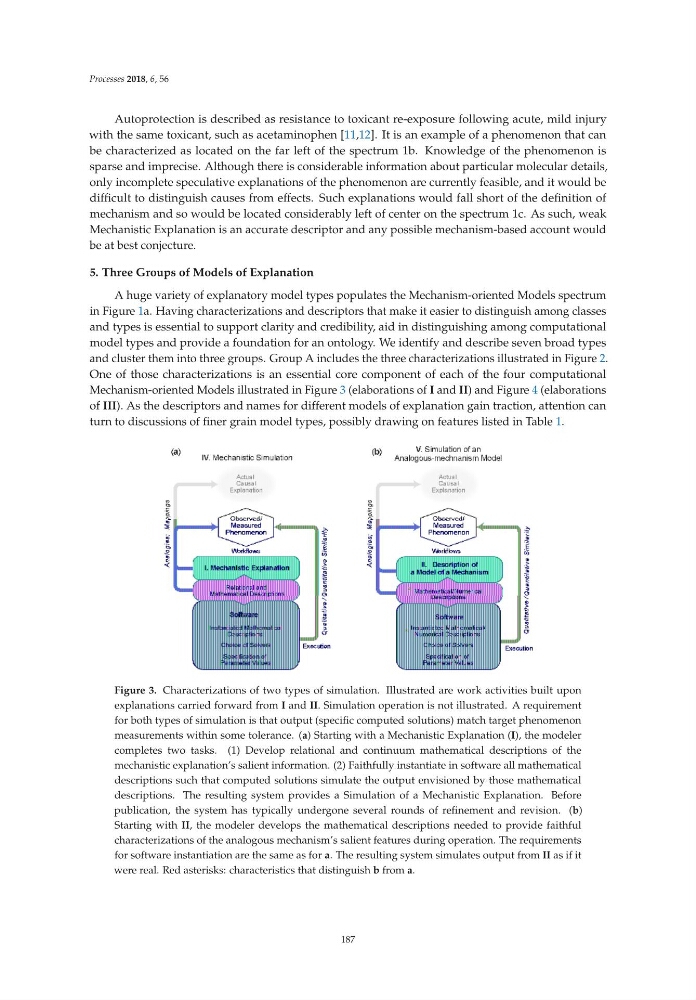
Mechanism-oriented Models illustrated in Figure 3 (elaborations of I and II) and Figure 4 (elaborations
of III). As the descriptors and names for different models of explanation gain traction, attention can
turn to discussions of finer grain model types, possibly drawing on features listed in Table 1.
Figure 3. Characterizations of two types of simulation. Illustrated are work activities built upon
explanations carried forward from I and II. Simulation operation is not illustrated. A requirement
for both types of simulation is that output (specific computed solutions) match target phenomenon
measurements within some tolerance. (a) Starting with a Mechanistic Explanation (I), the modeler
completes two tasks. (1) Develop relational and continuum mathematical descriptions of the
mechanistic explanation’s salient information. (2) Faithfully instantiate in software all mathematical
descriptions such that computed solutions simulate the output envisioned by those mathematical
descriptions. The resulting system provides a Simulation of a Mechanistic Explanation. Before
publication, the system has typically undergone several rounds of refinement and revision. (b)
Starting with II, the modeler develops the mathematical descriptions needed to provide faithful
characterizations of the analogous mechanism’s salient features during operation. The requirements
for software instantiation are the same as for a. The resulting system simulates output from II as if it
were real. Red asterisks: characteristics that distinguish b from a.
187
Autoprotection is described as resistance to toxicant re-exposure following acute, mild injury
with the same toxicant, such as acetaminophen [11,12]. It is an example of a phenomenon that can
be characterized as located on the far left of the spectrum 1b. Knowledge of the phenomenon is
sparse and imprecise. Although there is considerable information about particular molecular details,
only incomplete speculative explanations of the phenomenon are currently feasible, and it would be
difficult to distinguish causes from effects. Such explanations would fall short of the definition of
mechanism and so would be located considerably left of center on the spectrum 1c. As such, weak
Mechanistic Explanation is an accurate descriptor and any possible mechanism-based account would
be at best conjecture.
5. Three Groups of Models of Explanation
A huge variety of explanatory model types populates the Mechanism-oriented Models spectrum
in Figure 1a. Having characterizations and descriptors that make it easier to distinguish among classes
and types is essential to support clarity and credibility, aid in distinguishing among computational
model types and provide a foundation for an ontology. We identify and describe seven broad types
and cluster them into three groups. Group A includes the three characterizations illustrated in Figure 2.
One of those characterizations is an essential core component of each of the four computational
Mechanism-oriented Models illustrated in Figure 3 (elaborations of I and II) and Figure 4 (elaborations
of III). As the descriptors and names for different models of explanation gain traction, attention can
turn to discussions of finer grain model types, possibly drawing on features listed in Table 1.
Figure 3. Characterizations of two types of simulation. Illustrated are work activities built upon
explanations carried forward from I and II. Simulation operation is not illustrated. A requirement
for both types of simulation is that output (specific computed solutions) match target phenomenon
measurements within some tolerance. (a) Starting with a Mechanistic Explanation (I), the modeler
completes two tasks. (1) Develop relational and continuum mathematical descriptions of the
mechanistic explanation’s salient information. (2) Faithfully instantiate in software all mathematical
descriptions such that computed solutions simulate the output envisioned by those mathematical
descriptions. The resulting system provides a Simulation of a Mechanistic Explanation. Before
publication, the system has typically undergone several rounds of refinement and revision. (b)
Starting with II, the modeler develops the mathematical descriptions needed to provide faithful
characterizations of the analogous mechanism’s salient features during operation. The requirements
for software instantiation are the same as for a. The resulting system simulates output from II as if it
were real. Red asterisks: characteristics that distinguish b from a.
187