

Processes 2018, 6,56
and workflow clarity in wet-lab methods. Interest in independently reproducing results of simulation
experiments and in reusing and repurposing simulation components is expected to increase as the
healthcare implications and benefits of simulation experiments increase. Improved clarity at all
workflow stages will facilitate those developments, and in the sections that follow, we present specific
ways to improve and strengthen methodological and semantic clarity regarding mechanism-oriented
explanations of phenomena.
4. Mechanism-Oriented Models of Explanation
Based on our sampling of the research literature, all explanations of phenomena that draw on
features of mechanisms can be broadly described as being mechanism-oriented models of explanation.
They differ from other models of explanation in that they try to organize knowledge about both
phenomenon and its explanation around mechanisms [2]. The explanations are models because, even
when there is considerable knowledge about a phenomenon, there is still uncertainty about details of
the actual causal process and those details always exhibit biological variability. They range from being
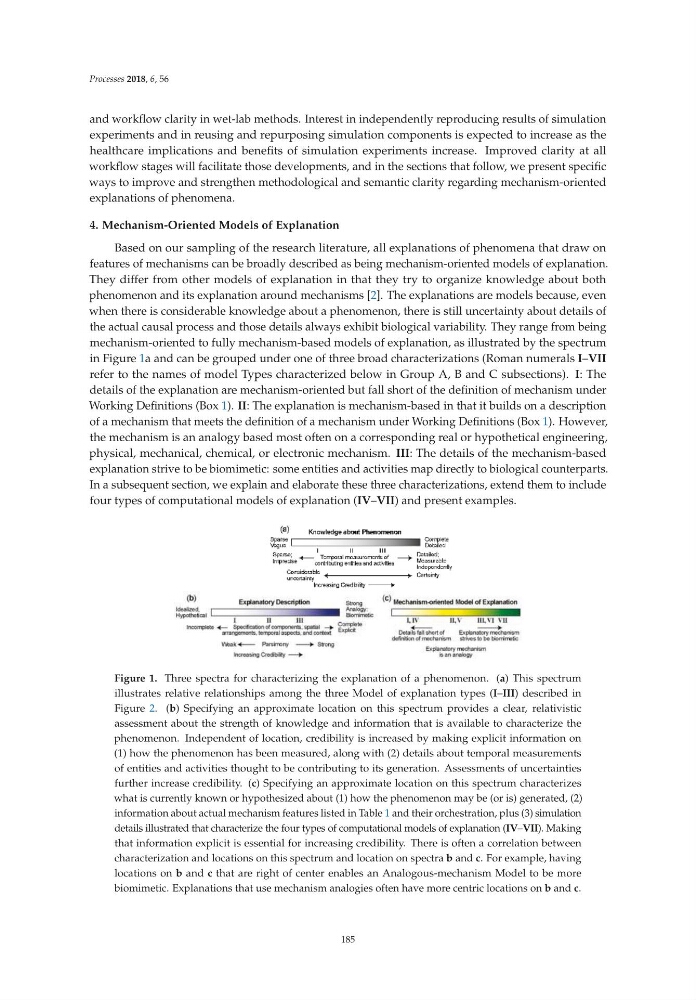
mechanism-oriented to fully mechanism-based models of explanation, as illustrated by the spectrum
in Figure 1a and can be grouped under one of three broad characterizations (Roman numerals I–VII
refer to the names of model Types characterized below in Group A, B and C subsections). I: The
details of the explanation are mechanism-oriented but fall short of the definition of mechanism under
Working Definitions (Box 1). II: The explanation is mechanism-based in that it builds on a description
of a mechanism that meets the definition of a mechanism under Working Definitions (Box 1). However,
the mechanism is an analogy based most often on a corresponding real or hypothetical engineering,
physical, mechanical, chemical, or electronic mechanism. III: The details of the mechanism-based
explanation strive to be biomimetic: some entities and activities map directly to biological counterparts.
In a subsequent section, we explain and elaborate these three characterizations, extend them to include
four types of computational models of explanation (IV–VII) and present examples.
Figure 1. Three spectra for characterizing the explanation of a phenomenon. (a) This spectrum
illustrates relative relationships among the three Model of explanation types (I–III) described in
Figure 2.( b) Specifying an approximate location on this spectrum provides a clear, relativistic
assessment about the strength of knowledge and information that is available to characterize the
phenomenon. Independent of location, credibility is increased by making explicit information on
(1) how the phenomenon has been measured, along with (2) details about temporal measurements
of entities and activities thought to be contributing to its generation. Assessments of uncertainties
further increase credibility. (c) Specifying an approximate location on this spectrum characterizes
what is currently known or hypothesized about (1) how the phenomenon may be (or is) generated, (2)
information about actual mechanism features listed in Table 1 and their orchestration, plus (3) simulation
details illustrated that characterize the four types of computational models of explanation (IV–VII). Making
that information explicit is essential for increasing credibility. There is often a correlation between
characterization and locations on this spectrum and location on spectra b and c. For example, having
locations on b and c that are right of center enables an Analogous-mechanism Model to be more
biomimetic. Explanations that use mechanism analogies often have more centric locations on b and c.
185
and workflow clarity in wet-lab methods. Interest in independently reproducing results of simulation
experiments and in reusing and repurposing simulation components is expected to increase as the
healthcare implications and benefits of simulation experiments increase. Improved clarity at all
workflow stages will facilitate those developments, and in the sections that follow, we present specific
ways to improve and strengthen methodological and semantic clarity regarding mechanism-oriented
explanations of phenomena.
4. Mechanism-Oriented Models of Explanation
Based on our sampling of the research literature, all explanations of phenomena that draw on
features of mechanisms can be broadly described as being mechanism-oriented models of explanation.
They differ from other models of explanation in that they try to organize knowledge about both
phenomenon and its explanation around mechanisms [2]. The explanations are models because, even
when there is considerable knowledge about a phenomenon, there is still uncertainty about details of
the actual causal process and those details always exhibit biological variability. They range from being
mechanism-oriented to fully mechanism-based models of explanation, as illustrated by the spectrum
in Figure 1a and can be grouped under one of three broad characterizations (Roman numerals I–VII
refer to the names of model Types characterized below in Group A, B and C subsections). I: The
details of the explanation are mechanism-oriented but fall short of the definition of mechanism under
Working Definitions (Box 1). II: The explanation is mechanism-based in that it builds on a description
of a mechanism that meets the definition of a mechanism under Working Definitions (Box 1). However,
the mechanism is an analogy based most often on a corresponding real or hypothetical engineering,
physical, mechanical, chemical, or electronic mechanism. III: The details of the mechanism-based
explanation strive to be biomimetic: some entities and activities map directly to biological counterparts.
In a subsequent section, we explain and elaborate these three characterizations, extend them to include
four types of computational models of explanation (IV–VII) and present examples.
Figure 1. Three spectra for characterizing the explanation of a phenomenon. (a) This spectrum
illustrates relative relationships among the three Model of explanation types (I–III) described in
Figure 2.( b) Specifying an approximate location on this spectrum provides a clear, relativistic
assessment about the strength of knowledge and information that is available to characterize the
phenomenon. Independent of location, credibility is increased by making explicit information on
(1) how the phenomenon has been measured, along with (2) details about temporal measurements
of entities and activities thought to be contributing to its generation. Assessments of uncertainties
further increase credibility. (c) Specifying an approximate location on this spectrum characterizes
what is currently known or hypothesized about (1) how the phenomenon may be (or is) generated, (2)
information about actual mechanism features listed in Table 1 and their orchestration, plus (3) simulation
details illustrated that characterize the four types of computational models of explanation (IV–VII). Making
that information explicit is essential for increasing credibility. There is often a correlation between
characterization and locations on this spectrum and location on spectra b and c. For example, having
locations on b and c that are right of center enables an Analogous-mechanism Model to be more
biomimetic. Explanations that use mechanism analogies often have more centric locations on b and c.
185