

Processes 2018, 6,56
the phenomenon of interest observed at coarser biological scale. The underlying finer details are the
entities and activities responsible for observable coarser behavior.
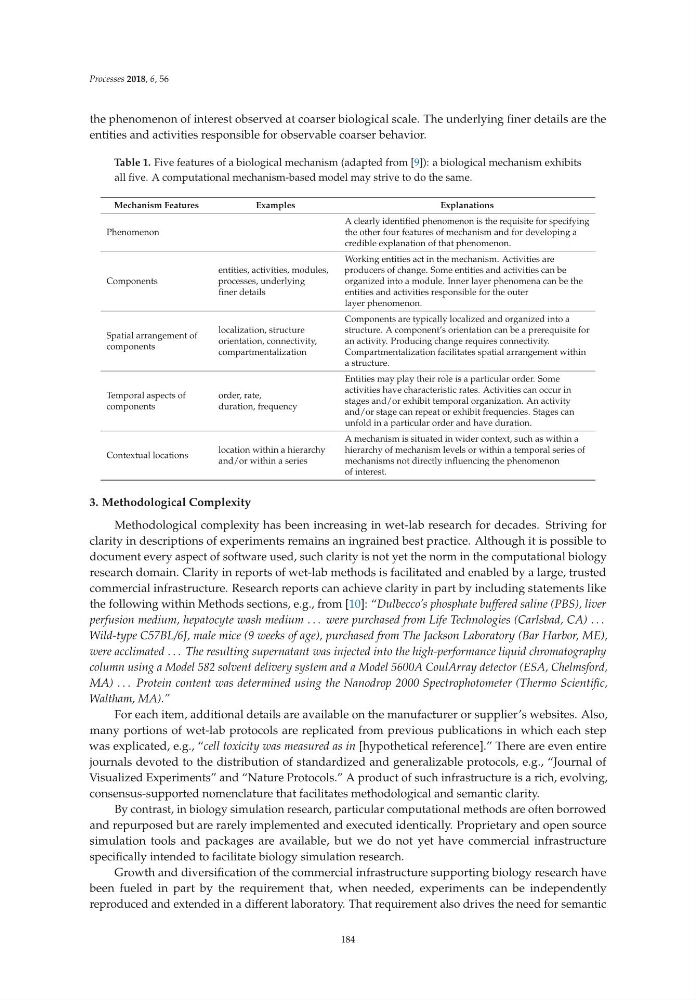
Table 1. Five features of a biological mechanism (adapted from [9]): a biological mechanism exhibits
all five. A computational mechanism-based model may strive to do the same.
Mechanism Features
Examples
Explanations
Phenomenon
A clearly identified phenomenon is the requisite for specifying
the other four features of mechanism and for developing a
credible explanation of that phenomenon.
Components
entities, activities, modules,
processes, underlying
finer details
Working entities act in the mechanism. Activities are
producers of change. Some entities and activities can be
organized into a module. Inner layer phenomena can be the
entities and activities responsible for the outer
layer phenomenon.
Spatial arrangement of
components
localization, structure
orientation, connectivity,
compartmentalization
Components are typically localized and organized into a
structure. A component’s orientation can be a prerequisite for
an activity. Producing change requires connectivity.
Compartmentalization facilitates spatial arrangement within
a structure.
Temporal aspects of
components
order, rate,
duration, frequency
Entities may play their role is a particular order. Some
activities have characteristic rates. Activities can occur in
stages and/or exhibit temporal organization. An activity
and/or stage can repeat or exhibit frequencies. Stages can
unfold in a particular order and have duration.
Contextual locations
location within a hierarchy
and/or within a series
A mechanism is situated in wider context, such as within a
hierarchy of mechanism levels or within a temporal series of
mechanisms not directly influencing the phenomenon
of interest.
3. Methodological Complexity
Methodological complexity has been increasing in wet-lab research for decades. Striving for
clarity in descriptions of experiments remains an ingrained best practice. Although it is possible to
document every aspect of software used, such clarity is not yet the norm in the computational biology
research domain. Clarity in reports of wet-lab methods is facilitated and enabled by a large, trusted
commercial infrastructure. Research reports can achieve clarity in part by including statements like
the following within Methods sections, e.g., from [10]: “Dulbecco’s phosphate buffered saline (PBS), liver
perfusion medium, hepatocyte wash medium ... were purchased from Life Technologies (Carlsbad, CA) ...
Wild-type C57BL/6J, male mice (9 weeks of age), purchased from The Jackson Laboratory (Bar Harbor, ME),
were acclimated ... The resulting supernatant was injected into the high-performance liquid chromatography
column using a Model 582 solvent delivery system and a Model 5600A CoulArray detector (ESA, Chelmsford,
MA) ... Protein content was determined using the Nanodrop 2000 Spectrophotometer (Thermo Scientific,
Waltham, MA).”
For each item, additional details are available on the manufacturer or supplier’s websites. Also,
many portions of wet-lab protocols are replicated from previous publications in which each step
was explicated, e.g., “cell toxicity was measured as in [hypothetical reference].” There are even entire
journals devoted to the distribution of standardized and generalizable protocols, e.g., “Journal of
Visualized Experiments” and “Nature Protocols.” A product of such infrastructure is a rich, evolving,
consensus-supported nomenclature that facilitates methodological and semantic clarity.
By contrast, in biology simulation research, particular computational methods are often borrowed
and repurposed but are rarely implemented and executed identically. Proprietary and open source
simulation tools and packages are available, but we do not yet have commercial infrastructure
specifically intended to facilitate biology simulation research.
Growth and diversification of the commercial infrastructure supporting biology research have
been fueled in part by the requirement that, when needed, experiments can be independently
reproduced and extended in a different laboratory. That requirement also drives the need for semantic
184
the phenomenon of interest observed at coarser biological scale. The underlying finer details are the
entities and activities responsible for observable coarser behavior.
Table 1. Five features of a biological mechanism (adapted from [9]): a biological mechanism exhibits
all five. A computational mechanism-based model may strive to do the same.
Mechanism Features
Examples
Explanations
Phenomenon
A clearly identified phenomenon is the requisite for specifying
the other four features of mechanism and for developing a
credible explanation of that phenomenon.
Components
entities, activities, modules,
processes, underlying
finer details
Working entities act in the mechanism. Activities are
producers of change. Some entities and activities can be
organized into a module. Inner layer phenomena can be the
entities and activities responsible for the outer
layer phenomenon.
Spatial arrangement of
components
localization, structure
orientation, connectivity,
compartmentalization
Components are typically localized and organized into a
structure. A component’s orientation can be a prerequisite for
an activity. Producing change requires connectivity.
Compartmentalization facilitates spatial arrangement within
a structure.
Temporal aspects of
components
order, rate,
duration, frequency
Entities may play their role is a particular order. Some
activities have characteristic rates. Activities can occur in
stages and/or exhibit temporal organization. An activity
and/or stage can repeat or exhibit frequencies. Stages can
unfold in a particular order and have duration.
Contextual locations
location within a hierarchy
and/or within a series
A mechanism is situated in wider context, such as within a
hierarchy of mechanism levels or within a temporal series of
mechanisms not directly influencing the phenomenon
of interest.
3. Methodological Complexity
Methodological complexity has been increasing in wet-lab research for decades. Striving for
clarity in descriptions of experiments remains an ingrained best practice. Although it is possible to
document every aspect of software used, such clarity is not yet the norm in the computational biology
research domain. Clarity in reports of wet-lab methods is facilitated and enabled by a large, trusted
commercial infrastructure. Research reports can achieve clarity in part by including statements like
the following within Methods sections, e.g., from [10]: “Dulbecco’s phosphate buffered saline (PBS), liver
perfusion medium, hepatocyte wash medium ... were purchased from Life Technologies (Carlsbad, CA) ...
Wild-type C57BL/6J, male mice (9 weeks of age), purchased from The Jackson Laboratory (Bar Harbor, ME),
were acclimated ... The resulting supernatant was injected into the high-performance liquid chromatography
column using a Model 582 solvent delivery system and a Model 5600A CoulArray detector (ESA, Chelmsford,
MA) ... Protein content was determined using the Nanodrop 2000 Spectrophotometer (Thermo Scientific,
Waltham, MA).”
For each item, additional details are available on the manufacturer or supplier’s websites. Also,
many portions of wet-lab protocols are replicated from previous publications in which each step
was explicated, e.g., “cell toxicity was measured as in [hypothetical reference].” There are even entire
journals devoted to the distribution of standardized and generalizable protocols, e.g., “Journal of
Visualized Experiments” and “Nature Protocols.” A product of such infrastructure is a rich, evolving,
consensus-supported nomenclature that facilitates methodological and semantic clarity.
By contrast, in biology simulation research, particular computational methods are often borrowed
and repurposed but are rarely implemented and executed identically. Proprietary and open source
simulation tools and packages are available, but we do not yet have commercial infrastructure
specifically intended to facilitate biology simulation research.
Growth and diversification of the commercial infrastructure supporting biology research have
been fueled in part by the requirement that, when needed, experiments can be independently
reproduced and extended in a different laboratory. That requirement also drives the need for semantic
184