

Processes 2018, 6,38
molar coefficients, thereby yielding the appropriate stoichiometries. The following steps convert
experimentally measured mass fractions of macromolecules to molar coefficients for use in the biomass
reaction:
(1) Record mass fractions as g macromolecule per g cell dry weight (see Table 4).
(2) Tabulate the molar mass of each macromolecule representation. Multiply the macromolecular
formula by the atomic mass of the respective elements, and sum over all elements to obtain
g/mol macromolecule.
(3) Divide the mass fraction of the macromolecule by its molar mass to obtain mol macromolecule/g
cell dry weight. The basis for cell dry weight normalization can be selected as desired; 1, 10,
or 100 kg cell dry weight typically results in reasonably scaled coefficients for elementary flux
mode and flux balance analyses. One kilogram cell dry weight often provides a convenient basis,
as when inputs are scaled to a mM basis in FBA, the resulting output biomass scales to grams.
(4) Incorporate the molar coefficients into the biomass reaction. The stoichiometries can be multiplied
by the macromolecular formulas and summed over all the macromolecules to obtain an overall
formula for biomass, which allows model output to be analyzed in terms of carbon moles of
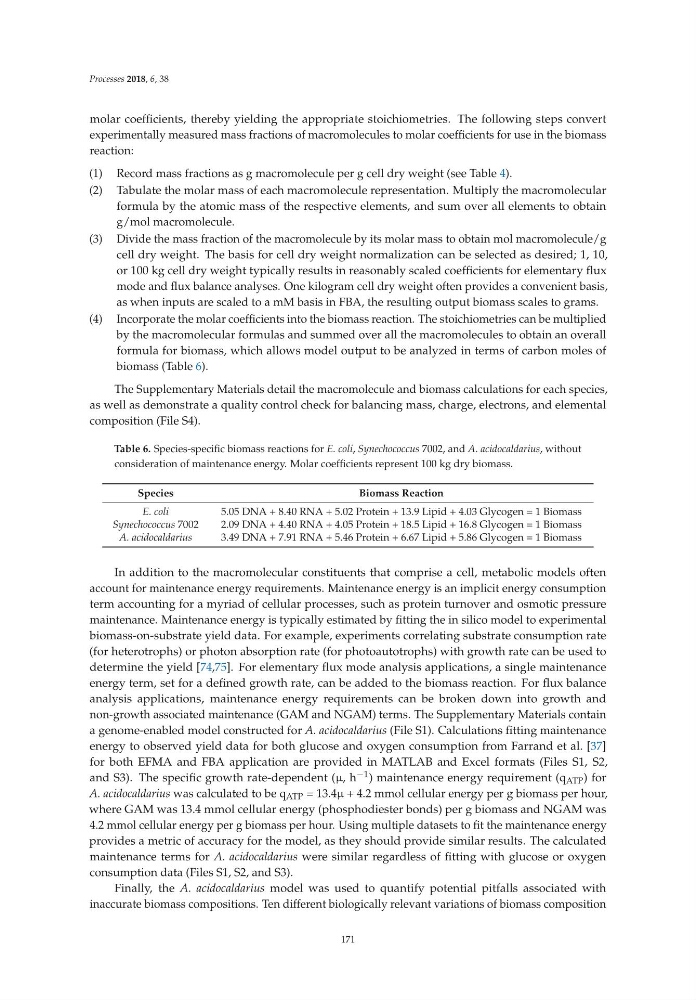
biomass (Table 6).
The Supplementary Materials detail the macromolecule and biomass calculations for each species,
as well as demonstrate a quality control check for balancing mass, charge, electrons, and elemental
composition (File S4).
Table 6. Species-specific biomass reactions for E. coli, Synechococcus 7002, and A. acidocaldarius, without
consideration of maintenance energy. Molar coefficients represent 100 kg dry biomass.
Species
Biomass Reaction
E. coli
5.05 DNA + 8.40 RNA + 5.02 Protein + 13.9 Lipid + 4.03 Glycogen = 1 Biomass
Synechococcus 7002
2.09 DNA + 4.40 RNA + 4.05 Protein + 18.5 Lipid + 16.8 Glycogen = 1 Biomass
A. acidocaldarius
3.49 DNA + 7.91 RNA + 5.46 Protein + 6.67 Lipid + 5.86 Glycogen = 1 Biomass
In addition to the macromolecular constituents that comprise a cell, metabolic models often
account for maintenance energy requirements. Maintenance energy is an implicit energy consumption
term accounting for a myriad of cellular processes, such as protein turnover and osmotic pressure
maintenance. Maintenance energy is typically estimated by fitting the in silico model to experimental
biomass-on-substrate yield data. For example, experiments correlating substrate consumption rate
(for heterotrophs) or photon absorption rate (for photoautotrophs) with growth rate can be used to
determine the yield [74,75]. For elementary flux mode analysis applications, a single maintenance
energy term, set for a defined growth rate, can be added to the biomass reaction. For flux balance
analysis applications, maintenance energy requirements can be broken down into growth and
non-growth associated maintenance (GAM and NGAM) terms. The Supplementary Materials contain
a genome-enabled model constructed for A. acidocaldarius (File S1). Calculations fitting maintenance
energy to observed yield data for both glucose and oxygen consumption from Farrand et al. [37]
for both EFMA and FBA application are provided in MATLAB and Excel formats (Files S1, S2,
and S3). The specific growth rate-dependent (µ,h −1 ) maintenance energy requirement (q ATP ) for
A. acidocaldarius was calculated to be q ATP = 13.4µ + 4.2 mmol cellular energy per g biomass per hour,
where GAM was 13.4 mmol cellular energy (phosphodiester bonds) per g biomass and NGAM was
4.2 mmol cellular energy per g biomass per hour. Using multiple datasets to fit the maintenance energy
provides a metric of accuracy for the model, as they should provide similar results. The calculated
maintenance terms for A. acidocaldarius were similar regardless of fitting with glucose or oxygen
consumption data (Files S1, S2, and S3).
Finally, the A. acidocaldarius model was used to quantify potential pitfalls associated with
inaccurate biomass compositions. Ten different biologically relevant variations of biomass composition
171
molar coefficients, thereby yielding the appropriate stoichiometries. The following steps convert
experimentally measured mass fractions of macromolecules to molar coefficients for use in the biomass
reaction:
(1) Record mass fractions as g macromolecule per g cell dry weight (see Table 4).
(2) Tabulate the molar mass of each macromolecule representation. Multiply the macromolecular
formula by the atomic mass of the respective elements, and sum over all elements to obtain
g/mol macromolecule.
(3) Divide the mass fraction of the macromolecule by its molar mass to obtain mol macromolecule/g
cell dry weight. The basis for cell dry weight normalization can be selected as desired; 1, 10,
or 100 kg cell dry weight typically results in reasonably scaled coefficients for elementary flux
mode and flux balance analyses. One kilogram cell dry weight often provides a convenient basis,
as when inputs are scaled to a mM basis in FBA, the resulting output biomass scales to grams.
(4) Incorporate the molar coefficients into the biomass reaction. The stoichiometries can be multiplied
by the macromolecular formulas and summed over all the macromolecules to obtain an overall
formula for biomass, which allows model output to be analyzed in terms of carbon moles of
biomass (Table 6).
The Supplementary Materials detail the macromolecule and biomass calculations for each species,
as well as demonstrate a quality control check for balancing mass, charge, electrons, and elemental
composition (File S4).
Table 6. Species-specific biomass reactions for E. coli, Synechococcus 7002, and A. acidocaldarius, without
consideration of maintenance energy. Molar coefficients represent 100 kg dry biomass.
Species
Biomass Reaction
E. coli
5.05 DNA + 8.40 RNA + 5.02 Protein + 13.9 Lipid + 4.03 Glycogen = 1 Biomass
Synechococcus 7002
2.09 DNA + 4.40 RNA + 4.05 Protein + 18.5 Lipid + 16.8 Glycogen = 1 Biomass
A. acidocaldarius
3.49 DNA + 7.91 RNA + 5.46 Protein + 6.67 Lipid + 5.86 Glycogen = 1 Biomass
In addition to the macromolecular constituents that comprise a cell, metabolic models often
account for maintenance energy requirements. Maintenance energy is an implicit energy consumption
term accounting for a myriad of cellular processes, such as protein turnover and osmotic pressure
maintenance. Maintenance energy is typically estimated by fitting the in silico model to experimental
biomass-on-substrate yield data. For example, experiments correlating substrate consumption rate
(for heterotrophs) or photon absorption rate (for photoautotrophs) with growth rate can be used to
determine the yield [74,75]. For elementary flux mode analysis applications, a single maintenance
energy term, set for a defined growth rate, can be added to the biomass reaction. For flux balance
analysis applications, maintenance energy requirements can be broken down into growth and
non-growth associated maintenance (GAM and NGAM) terms. The Supplementary Materials contain
a genome-enabled model constructed for A. acidocaldarius (File S1). Calculations fitting maintenance
energy to observed yield data for both glucose and oxygen consumption from Farrand et al. [37]
for both EFMA and FBA application are provided in MATLAB and Excel formats (Files S1, S2,
and S3). The specific growth rate-dependent (µ,h −1 ) maintenance energy requirement (q ATP ) for
A. acidocaldarius was calculated to be q ATP = 13.4µ + 4.2 mmol cellular energy per g biomass per hour,
where GAM was 13.4 mmol cellular energy (phosphodiester bonds) per g biomass and NGAM was
4.2 mmol cellular energy per g biomass per hour. Using multiple datasets to fit the maintenance energy
provides a metric of accuracy for the model, as they should provide similar results. The calculated
maintenance terms for A. acidocaldarius were similar regardless of fitting with glucose or oxygen
consumption data (Files S1, S2, and S3).
Finally, the A. acidocaldarius model was used to quantify potential pitfalls associated with
inaccurate biomass compositions. Ten different biologically relevant variations of biomass composition
171