

Marine lipids
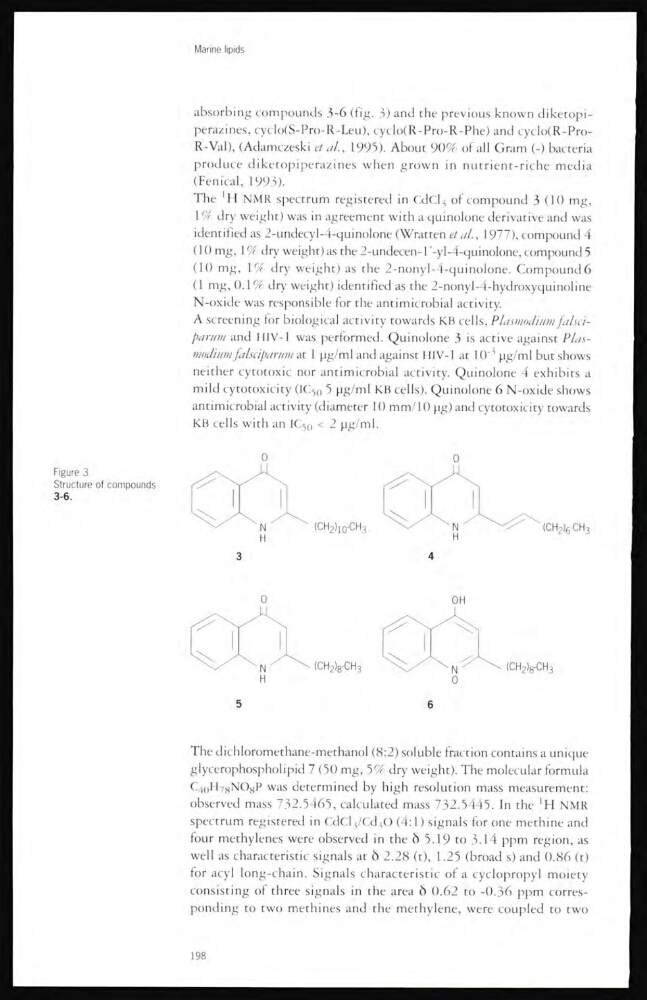
absorbing compounds 3-6 (fig. 3) and the previous known diketopiperazines, cyclo(S-Pro-R-Leu), cyclo(R-Pro-R-Phe) and cyclo(R-ProR-Val), (Adamczeski et al., 1995). About 90% of all Gram (-) bacteria
produce diketopiperazines when grown in nutrient-riche media
(Fenical, 1995).
The
1 H NMR spectrum registered in CdCl 3 ofcompound 3 (10 mg,
1% dry weight) was in agreement with a quinolone derivative and was
identified as 2-undecyl-4-quinolone (Wratten et al., 1977), compound 4
(10 mg, 1 % dry weight) as the 2-undecen-1'-yl-4-quinolone, compound 5
(10 mg, 1 % dry weight) as the 2-nonyl-4-quinolone. Compound 6
(1 mg, 0.1% dry weight) identified as the 2-nonyl-4-hydroxyquinoline
N-oxide was responsible for the antimicrobial activity.
A screening for biological activity towards KB cells, Plasmodium falsciparum and HIV-1 was performed. Quinolone 3 is active against Plasmodium falsciparum at 1 pg/ml and against HIV-1 at 10 - 3 µg/ml but shows
neither cytotoxic nor antimicrobial activity. Quinolone 4 exhibits a
mild cytotoxicity (IC 50 5 µg/ml KB cells). Quinolone 6 N-oxide shows
antimicrobial activity (diameter 10 mm/10 pg) and cytotoxicity towards
KB cells with an IC 50 < 2 µg/ml.
Figure 3
Structure of compounds
3-6.
The dichloromethane-methanol (8:2) soluble fraction contains a unique
glycerophospholipid 7 (50 mg, 5% dry weight). The molecular formula
C 40 H78
NO 8 P was determined by high resolution mass measurement:
observed mass 732.5465, calculated mass 732.5445. In the
1 H NMR
spectrum registered in CdCl 3 /Cd 3 0 (4:1) signals for one methine and
four methylenes were observed in the δ 5.19 to 3.14 ppm region, as
well as characteristic signals at ô 2.28 (t), 1.25 (broad s) and 0.86 (t)
for acyl long-chain. Signals characteristic of a cyclopropyl moiety
consisting of three signals in the area δ 0.62 to -0.36 ppm corresponding to two methines and the methylene, were coupled to two
198
absorbing compounds 3-6 (fig. 3) and the previous known diketopiperazines, cyclo(S-Pro-R-Leu), cyclo(R-Pro-R-Phe) and cyclo(R-ProR-Val), (Adamczeski et al., 1995). About 90% of all Gram (-) bacteria
produce diketopiperazines when grown in nutrient-riche media
(Fenical, 1995).
The
1 H NMR spectrum registered in CdCl 3 ofcompound 3 (10 mg,
1% dry weight) was in agreement with a quinolone derivative and was
identified as 2-undecyl-4-quinolone (Wratten et al., 1977), compound 4
(10 mg, 1 % dry weight) as the 2-undecen-1'-yl-4-quinolone, compound 5
(10 mg, 1 % dry weight) as the 2-nonyl-4-quinolone. Compound 6
(1 mg, 0.1% dry weight) identified as the 2-nonyl-4-hydroxyquinoline
N-oxide was responsible for the antimicrobial activity.
A screening for biological activity towards KB cells, Plasmodium falsciparum and HIV-1 was performed. Quinolone 3 is active against Plasmodium falsciparum at 1 pg/ml and against HIV-1 at 10 - 3 µg/ml but shows
neither cytotoxic nor antimicrobial activity. Quinolone 4 exhibits a
mild cytotoxicity (IC 50 5 µg/ml KB cells). Quinolone 6 N-oxide shows
antimicrobial activity (diameter 10 mm/10 pg) and cytotoxicity towards
KB cells with an IC 50 < 2 µg/ml.
Figure 3
Structure of compounds
3-6.
The dichloromethane-methanol (8:2) soluble fraction contains a unique
glycerophospholipid 7 (50 mg, 5% dry weight). The molecular formula
C 40 H78
NO 8 P was determined by high resolution mass measurement:
observed mass 732.5465, calculated mass 732.5445. In the
1 H NMR
spectrum registered in CdCl 3 /Cd 3 0 (4:1) signals for one methine and
four methylenes were observed in the δ 5.19 to 3.14 ppm region, as
well as characteristic signals at ô 2.28 (t), 1.25 (broad s) and 0.86 (t)
for acyl long-chain. Signals characteristic of a cyclopropyl moiety
consisting of three signals in the area δ 0.62 to -0.36 ppm corresponding to two methines and the methylene, were coupled to two
198