

Biotechnology
was recognized as a metabolite produced by a symbiotic cyanobacteria
Oscillatoria spongeliae (Unson & Faulkner, 1993). Hence, presence of 1
in a sponge-associated bacteria matches with recent data of literature.
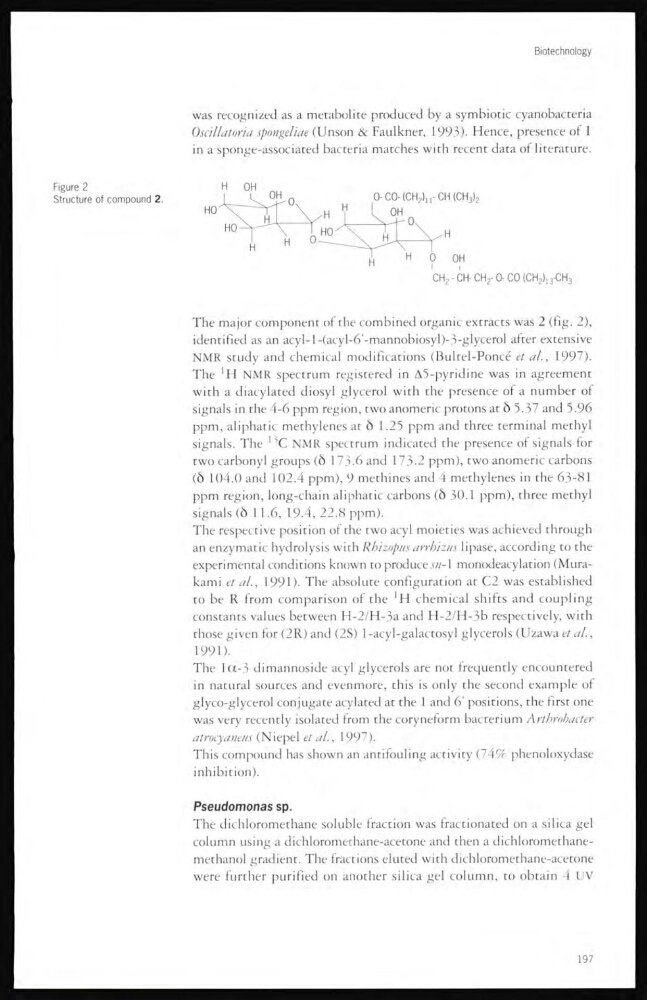
Figure 2
Structure of compound 2.
The major component of the combined organic extracts was 2 (fig. 2),
identified as an acyl-l-(acyl-6’-mannobiosyl)-3-glycerol after extensive
NMR study and chemical modifications (Bultel-Poncé et al., 1997).
The
1 H NMR spectrum registered in A5-pyridine was in agreement
with a diacylated diosyl glycerol with the presence of a number of
signals in the 4-6 ppm region, two anomeric protons at ô 5.37 and 5.96
ppm, aliphatic methylenes at δ 1.25 ppm and three terminal methyl
signals. The
1 ’C NMR spectrum indicated the presence of signals for
two carbonyl groups (δ 173.6 and 173-2 ppm), two anomeric carbons
(δ 104.0 and 102.4 ppm), 9 methines and 4 methylenes in the 63-81
ppm region, long-chain aliphatic carbons (δ 30.1 ppm), three methyl
signals (δ 1 1.6, 19.4, 22.8 ppm).
The respective position of the two acyl moieties was achieved through
an enzymatic hydrolysis with Rhizopus arrhizus lipase, according to the
experimental conditions known to produce sn-1 monodeacylation (Murakami et al., 1991). The absolute configuration at C2 was established
to be R from comparison of the
1 H chemical shilts and coupling
constants values between H-2/H-3a and H-2/H-3b respectively, with
those given for (2R) and (2S) 1-acyl-galactosyl glycerols (Uzawa et al.,
1991).
The la-3 dimannoside acyl glycerols are not frequently encountered
in natural sources and evenmore, this is only the second example ol
glyco-glycerol conjugate acylated at the 1 and 6' positions, the first one
was very recently isolated from the coryneform bacterium Arthrohacter
atrocyaneus (Niepel et al., 1997).
This compound has shown an antifouling activity (74% phenoloxydase
inhibition).
Pseudomonas sp.
The dichloromethane soluble fraction was fractionated on a silica gel
column using a dichloromethane-acetone and then a dichloromethanemethanol gradient. The fractions eluted with dichloromethane-acetone
were further purified on another silica gel column, to obtain 4 UV
197
was recognized as a metabolite produced by a symbiotic cyanobacteria
Oscillatoria spongeliae (Unson & Faulkner, 1993). Hence, presence of 1
in a sponge-associated bacteria matches with recent data of literature.
Figure 2
Structure of compound 2.
The major component of the combined organic extracts was 2 (fig. 2),
identified as an acyl-l-(acyl-6’-mannobiosyl)-3-glycerol after extensive
NMR study and chemical modifications (Bultel-Poncé et al., 1997).
The
1 H NMR spectrum registered in A5-pyridine was in agreement
with a diacylated diosyl glycerol with the presence of a number of
signals in the 4-6 ppm region, two anomeric protons at ô 5.37 and 5.96
ppm, aliphatic methylenes at δ 1.25 ppm and three terminal methyl
signals. The
1 ’C NMR spectrum indicated the presence of signals for
two carbonyl groups (δ 173.6 and 173-2 ppm), two anomeric carbons
(δ 104.0 and 102.4 ppm), 9 methines and 4 methylenes in the 63-81
ppm region, long-chain aliphatic carbons (δ 30.1 ppm), three methyl
signals (δ 1 1.6, 19.4, 22.8 ppm).
The respective position of the two acyl moieties was achieved through
an enzymatic hydrolysis with Rhizopus arrhizus lipase, according to the
experimental conditions known to produce sn-1 monodeacylation (Murakami et al., 1991). The absolute configuration at C2 was established
to be R from comparison of the
1 H chemical shilts and coupling
constants values between H-2/H-3a and H-2/H-3b respectively, with
those given for (2R) and (2S) 1-acyl-galactosyl glycerols (Uzawa et al.,
1991).
The la-3 dimannoside acyl glycerols are not frequently encountered
in natural sources and evenmore, this is only the second example ol
glyco-glycerol conjugate acylated at the 1 and 6' positions, the first one
was very recently isolated from the coryneform bacterium Arthrohacter
atrocyaneus (Niepel et al., 1997).
This compound has shown an antifouling activity (74% phenoloxydase
inhibition).
Pseudomonas sp.
The dichloromethane soluble fraction was fractionated on a silica gel
column using a dichloromethane-acetone and then a dichloromethanemethanol gradient. The fractions eluted with dichloromethane-acetone
were further purified on another silica gel column, to obtain 4 UV
197