

Marine lipids
The dichloromethane-mechanol (8:2, v/v) extract (1.1 g) of Pseudomonas sp. was successively extracted with dichloromethane and a 8:2, v/v
dichloromethane-methanol mixture. The dichloromethane soluble
fraction was chromatographied on a silica gel column using a dichloromethane-acetone and then a dichloromethane-methanol gradient.
The fractions eluted with dichoromethane-acetone (9:1, v/v to 8:2, v/v)
were further purifîecl on another silica gel column to obtain compounds
3-6 and the previous known diketopiperazines, cyclo(S-Pro-R-Leu),
cyclo(R-Pro-R-Phe) and cyclo(R-Pro-R-Val). The dichloromethanemethanol (8:2, v/v) fraction (0.5 g) was repeatedly chromatographed on
a silica gel column to give 50 mg of a unique glycerophospholipid 7.
Results and discussion
Micrococcus luteus
This bacterial strain is an ubiquitous Gram ( + ) bacterial strain. The
presence of this strain in marine habitats lias not yet been reported, but
unspecified micrococci were described from clifferent sea water locations
(Sieburth, 1979) and a Micrococcm sp. was recently reported as a commensal of the sponge Tedania ignis (Stierle et al., 1988) producing diketopiperazines, previously ascribed to the sponge.
The extract of Microccoats luteus was found to exhibit potent antimicrobial
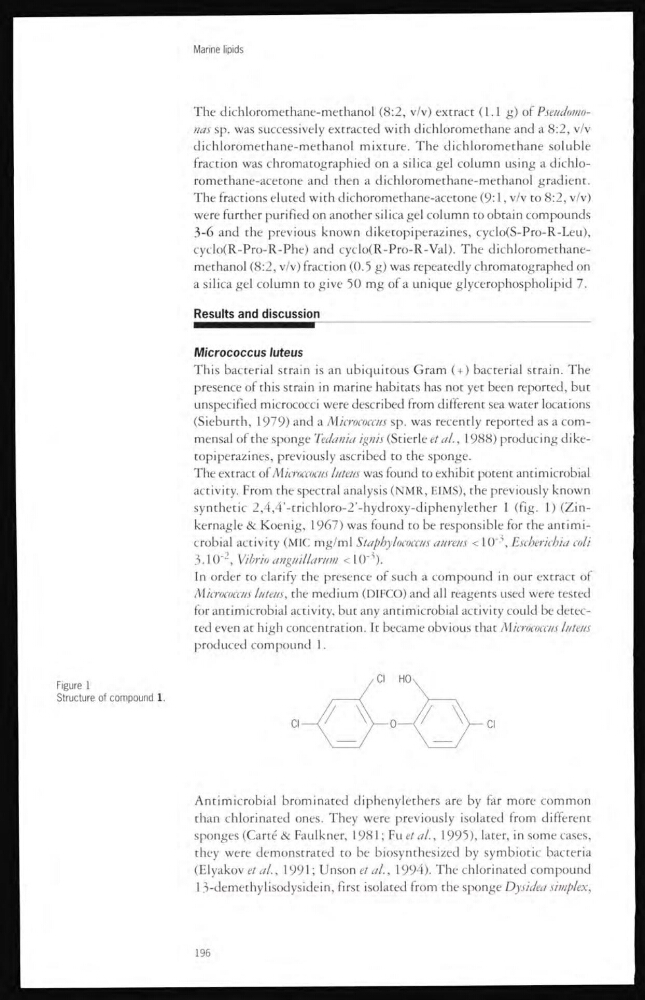
activity. From the spectral analysis (NMR, EIMS), the previously known
synthetic 2,4,4'-trichloro-2’-hydroxy-diphenylether 1 (fig. 1 ) (Zinkernagle & Koenig, 1967) was found to be responsible for the antimicrobial activity (MIC mg/ml Staphylococcus aureus < 10°, Eschericbia coli
3.10"
2 , Vibrio anguillarum < 10 -3 ).
In order to clarify the presence of such a compound in our extract of
Micrococcus luteits, the medium (DIFCO) and all reagents used were tested
for antimicrobial activity, but any antimicrobial activity could be detectecl even at high concentration. It became obvious that Micrococats lnteus
produced compound 1.
Figure 1
Structure of compound 1.
Antimicrobial brominated diphenylethers are by far more common
than chlorinated ones. They were previously isolated from different
sponges (Carté & Faulkner, 198 1 ; Fu et al., 1 995 ), later, in some cases,
they were demonstrated to be biosynthesized by symbiotic bacteria
(Elyakov et al., 1991; Unson etal., 1994). The chlorinated compound
1 3-demethylisodysidein, first isolated from the sponge Dysidea simplex,
196
The dichloromethane-mechanol (8:2, v/v) extract (1.1 g) of Pseudomonas sp. was successively extracted with dichloromethane and a 8:2, v/v
dichloromethane-methanol mixture. The dichloromethane soluble
fraction was chromatographied on a silica gel column using a dichloromethane-acetone and then a dichloromethane-methanol gradient.
The fractions eluted with dichoromethane-acetone (9:1, v/v to 8:2, v/v)
were further purifîecl on another silica gel column to obtain compounds
3-6 and the previous known diketopiperazines, cyclo(S-Pro-R-Leu),
cyclo(R-Pro-R-Phe) and cyclo(R-Pro-R-Val). The dichloromethanemethanol (8:2, v/v) fraction (0.5 g) was repeatedly chromatographed on
a silica gel column to give 50 mg of a unique glycerophospholipid 7.
Results and discussion
Micrococcus luteus
This bacterial strain is an ubiquitous Gram ( + ) bacterial strain. The
presence of this strain in marine habitats lias not yet been reported, but
unspecified micrococci were described from clifferent sea water locations
(Sieburth, 1979) and a Micrococcm sp. was recently reported as a commensal of the sponge Tedania ignis (Stierle et al., 1988) producing diketopiperazines, previously ascribed to the sponge.
The extract of Microccoats luteus was found to exhibit potent antimicrobial
activity. From the spectral analysis (NMR, EIMS), the previously known
synthetic 2,4,4'-trichloro-2’-hydroxy-diphenylether 1 (fig. 1 ) (Zinkernagle & Koenig, 1967) was found to be responsible for the antimicrobial activity (MIC mg/ml Staphylococcus aureus < 10°, Eschericbia coli
3.10"
2 , Vibrio anguillarum < 10 -3 ).
In order to clarify the presence of such a compound in our extract of
Micrococcus luteits, the medium (DIFCO) and all reagents used were tested
for antimicrobial activity, but any antimicrobial activity could be detectecl even at high concentration. It became obvious that Micrococats lnteus
produced compound 1.
Figure 1
Structure of compound 1.
Antimicrobial brominated diphenylethers are by far more common
than chlorinated ones. They were previously isolated from different
sponges (Carté & Faulkner, 198 1 ; Fu et al., 1 995 ), later, in some cases,
they were demonstrated to be biosynthesized by symbiotic bacteria
(Elyakov et al., 1991; Unson etal., 1994). The chlorinated compound
1 3-demethylisodysidein, first isolated from the sponge Dysidea simplex,
196