

Marine lipids
Thrombosis models
Since our dietary conditions enabled us to demonstrate that MaxEPA
oil is the only efficient product in reducing the platelet reactivity to
collagen in rat and that the three (n-3) fatty acid-rich diets are efficient
in decreasing plasma coagulability, we have explored the antithrombotic effects of the three same (n-3) fatty acid enriched diets in an
arterial and a venous models.
Thrombosis events are known to occur both in arterial and venous systems. While arterial thrombosis is mainly associated with the adhesion
and aggregation of platelets in damaged vessels with moderate to high
shear stress, venous thrombosis is mainly associated with blood coagulation leading to deposits of fibrin and erythrocytes in region of stasis
or low shear stress. If some studies suggest a beneficial effect of dietary
fish oil on vascular thrombus formation in primates (Harker et ai,
1993) or m rat models (Rand et al., 1986; Hornstra, 1989), few reports
have been devoted to the effects of purified (n-3) fatty acids (Mizota et
al., 1988; Umemura et al., 1994, 1995). Hence, the aim ol our studv
was to use rat models of arterial and venous thrombosis to evaluate the
potential antithrombotic effects of the four diets involved previously
in our platelet and coagulation studies.
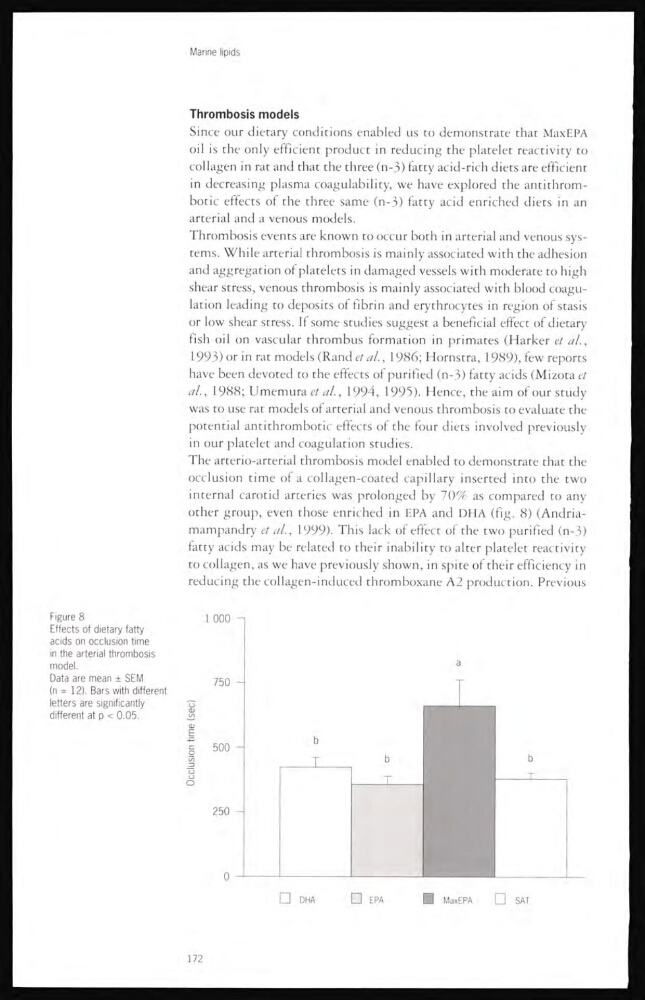
The arterio-arterial thrombosis model enabled to demonstrate that the
occlusion time of a collagen-coated capillary inserted into the two
internal carotid arteries was prolonged by 70% as compared to any
other group, even those enriched in EPA and DHA (fig. 8) (Andriamampandry et al., 1999). This lack of effect of the two purified (n-3)
fatty acids may be related to their inability to alter platelet reactivity
to collagen, as we have previously shown, in spite of their efficiency in
reducing the collagen-induced thromboxane A2 production. Previous
Figure 8
Effects of dietary fatty
acids on occlusion time
in the arterial thrombosis
model.
Data are mean ± SEM
(n = 12). Bars with different
letters are significantly
different at p < 0.05.
□ DHA
□ EPA
□ MaxEPA
□ SAT
172
Thrombosis models
Since our dietary conditions enabled us to demonstrate that MaxEPA
oil is the only efficient product in reducing the platelet reactivity to
collagen in rat and that the three (n-3) fatty acid-rich diets are efficient
in decreasing plasma coagulability, we have explored the antithrombotic effects of the three same (n-3) fatty acid enriched diets in an
arterial and a venous models.
Thrombosis events are known to occur both in arterial and venous systems. While arterial thrombosis is mainly associated with the adhesion
and aggregation of platelets in damaged vessels with moderate to high
shear stress, venous thrombosis is mainly associated with blood coagulation leading to deposits of fibrin and erythrocytes in region of stasis
or low shear stress. If some studies suggest a beneficial effect of dietary
fish oil on vascular thrombus formation in primates (Harker et ai,
1993) or m rat models (Rand et al., 1986; Hornstra, 1989), few reports
have been devoted to the effects of purified (n-3) fatty acids (Mizota et
al., 1988; Umemura et al., 1994, 1995). Hence, the aim ol our studv
was to use rat models of arterial and venous thrombosis to evaluate the
potential antithrombotic effects of the four diets involved previously
in our platelet and coagulation studies.
The arterio-arterial thrombosis model enabled to demonstrate that the
occlusion time of a collagen-coated capillary inserted into the two
internal carotid arteries was prolonged by 70% as compared to any
other group, even those enriched in EPA and DHA (fig. 8) (Andriamampandry et al., 1999). This lack of effect of the two purified (n-3)
fatty acids may be related to their inability to alter platelet reactivity
to collagen, as we have previously shown, in spite of their efficiency in
reducing the collagen-induced thromboxane A2 production. Previous
Figure 8
Effects of dietary fatty
acids on occlusion time
in the arterial thrombosis
model.
Data are mean ± SEM
(n = 12). Bars with different
letters are significantly
different at p < 0.05.
□ DHA
□ EPA
□ MaxEPA
□ SAT
172