

Function and metabolism
studies in another model have also demonstrated a lowering of the
tendency to thrombosis using a chronic aorta loop in rats fed a crude
marine oil (Rand et al., 1986; Hornstra, 1989). Some inhibitory effects
of EPA or DHA were recorded, but in different animal models (Mizota
et al., 1988; Umemura et al., 1994, 1995), thus precluding any comparisons.
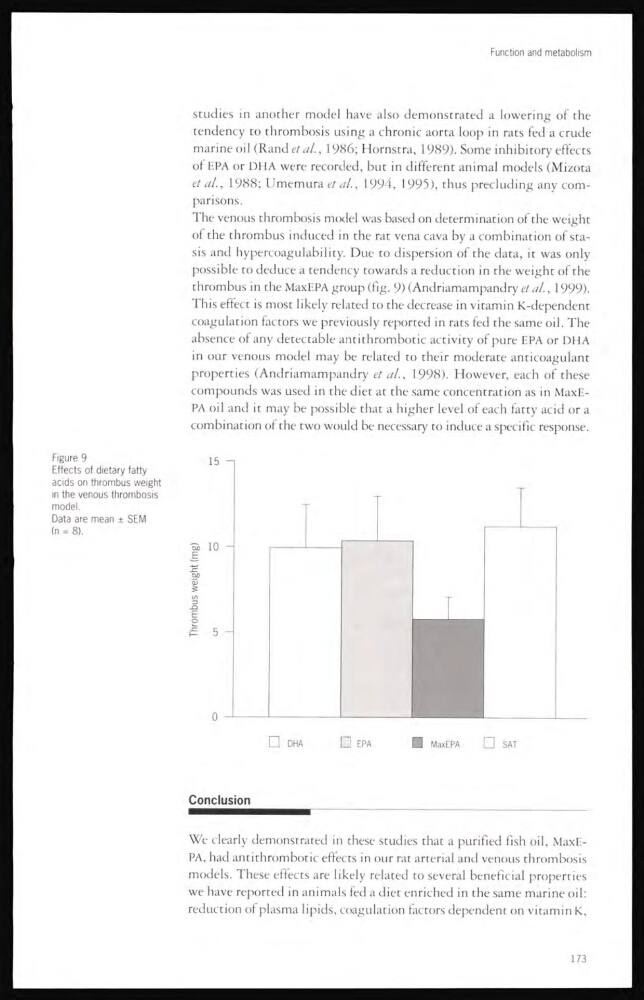
The venous thrombosis model was based on determination of the weight
of the thrombus induced in the rat vena cava by a combination of stasis and hypercoagulability. Due to dispersion of the data, ît was only
possible to deduce a tendency towards a reduction in the weight of the
thrombus in the MaxEPA group (fig. 9) (Andriamampandry et al., 1999).
This effect is most likely related to the decrease in vitamin K-dependent
coagulation factors we previously reported in rats fed the same oil. The
absence of any detectable antithrombotic activity of pure EPA or DHA
in our venous model may be related to their moderate anticoagulant
properties (Andriamampandry et al., 1998). However, each of these
compounds was used in the diet at the same concentration as in MaxEPA oil and it may be possible that a higher level of each fatty acid or a
combination of the two would be necessary to induce a specific response.
Figure 9
Effects of dietary fatty
acids on thrombus weight
in the uenous thrombosis
model.
Data are mean ± SEM
(n = 8).
□ DHA
□ EPA
□ MaxEPA
□ SAT
Conclusion
We clearly demonstrated in these studies that a purified fish oil, MaxEPA, had antithrombotic effec ts in our rat arterial and venous thrombosis
models. These effects are likely related to several beneficial properties
we have reported in animals fed a cliet enriched in the same marine oil:
reduction of plasma lipids, coagulation factors dependent on vitamin K,
173
studies in another model have also demonstrated a lowering of the
tendency to thrombosis using a chronic aorta loop in rats fed a crude
marine oil (Rand et al., 1986; Hornstra, 1989). Some inhibitory effects
of EPA or DHA were recorded, but in different animal models (Mizota
et al., 1988; Umemura et al., 1994, 1995), thus precluding any comparisons.
The venous thrombosis model was based on determination of the weight
of the thrombus induced in the rat vena cava by a combination of stasis and hypercoagulability. Due to dispersion of the data, ît was only
possible to deduce a tendency towards a reduction in the weight of the
thrombus in the MaxEPA group (fig. 9) (Andriamampandry et al., 1999).
This effect is most likely related to the decrease in vitamin K-dependent
coagulation factors we previously reported in rats fed the same oil. The
absence of any detectable antithrombotic activity of pure EPA or DHA
in our venous model may be related to their moderate anticoagulant
properties (Andriamampandry et al., 1998). However, each of these
compounds was used in the diet at the same concentration as in MaxEPA oil and it may be possible that a higher level of each fatty acid or a
combination of the two would be necessary to induce a specific response.
Figure 9
Effects of dietary fatty
acids on thrombus weight
in the uenous thrombosis
model.
Data are mean ± SEM
(n = 8).
□ DHA
□ EPA
□ MaxEPA
□ SAT
Conclusion
We clearly demonstrated in these studies that a purified fish oil, MaxEPA, had antithrombotic effec ts in our rat arterial and venous thrombosis
models. These effects are likely related to several beneficial properties
we have reported in animals fed a cliet enriched in the same marine oil:
reduction of plasma lipids, coagulation factors dependent on vitamin K,
173