

Marine lipids
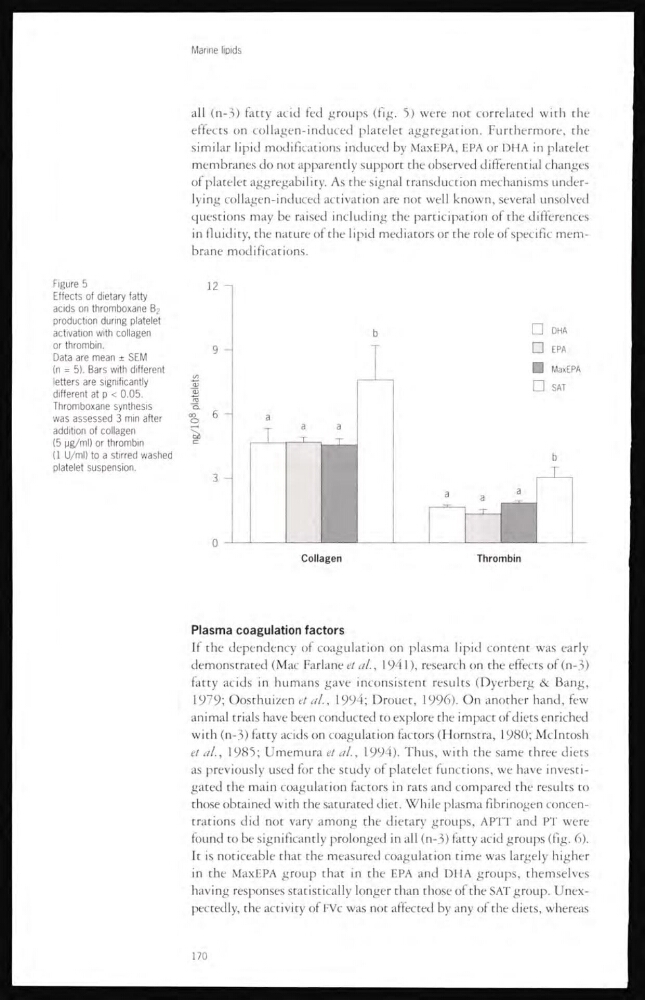
all (n-3) fatty acid fed groups (fig. 5) were not correlated with the
effects on collagen-induced platelet aggregation. Furthermore, the
similar lipid modifications induced by MaxEPA, EPA or DHA in platelet
membranes do not apparently support the observed differential changes
of platelet aggregability. As the signal transduction mechanisms underlying collagen-induced activation are not well known, several unsolved
questions may be raised including the participation of the differences
in fluidity, the nature of the lipid mediators or the role of specific membrane modifications.
Figure 5
Effects of dietary fatty
acids on thromboxane B2
production during platelet
activation with collagen
or thrombin.
Data are mean ± SEM
(n = 5). Bars with different
letters are significantly
different at p < 0.05.
Thromboxane synthesis
was assessed 3 min after
addition of collagen
(5 µg/ml) or thrombin
(1 U/ml) to a stirred washed
platelet suspension.
□ DHA
□ EPA
□ MaxEPA
□ SAT
Plasma coagulation factors
If the dependency of coagulation on plasma lipid content was early
demonsrrated (Mac Farlane et al., 1941), research on the effects of (n-3)
fatty acids in humans gave inconsistent results (Dyerberg & Bang,
1979; Oosthuizen et al., 1994; Drouet, 1996). On another hand, few
animal trials have been conducted to explore the impact of diets enriched
with (n-3) fatty acids on coagulation factors (Hornstra, 1980; Mclntosh
et al., 1985; Umemura et al., 1994). Thus, with the same three diets
as previously used for the study of platelet functions, we have investigated the main coagulation factors in rats and compared the results to
those obtained with the saturated diet. While plasma fibrinogen concentrations did not vary among the dietary groups, APTT and PT were
found to be significantly prolonged in all (n-3) fatty acid groups (fig. 6).
It is noticeable that the measured coagulation time was largely higher
in the MaxEPA group that in the EPA and DHA groups, themselves
having responses statistically longer than those of the SAT group. Unexpectedly, the activity of FVc was not affected by any of the diets, whereas
170
all (n-3) fatty acid fed groups (fig. 5) were not correlated with the
effects on collagen-induced platelet aggregation. Furthermore, the
similar lipid modifications induced by MaxEPA, EPA or DHA in platelet
membranes do not apparently support the observed differential changes
of platelet aggregability. As the signal transduction mechanisms underlying collagen-induced activation are not well known, several unsolved
questions may be raised including the participation of the differences
in fluidity, the nature of the lipid mediators or the role of specific membrane modifications.
Figure 5
Effects of dietary fatty
acids on thromboxane B2
production during platelet
activation with collagen
or thrombin.
Data are mean ± SEM
(n = 5). Bars with different
letters are significantly
different at p < 0.05.
Thromboxane synthesis
was assessed 3 min after
addition of collagen
(5 µg/ml) or thrombin
(1 U/ml) to a stirred washed
platelet suspension.
□ DHA
□ EPA
□ MaxEPA
□ SAT
Plasma coagulation factors
If the dependency of coagulation on plasma lipid content was early
demonsrrated (Mac Farlane et al., 1941), research on the effects of (n-3)
fatty acids in humans gave inconsistent results (Dyerberg & Bang,
1979; Oosthuizen et al., 1994; Drouet, 1996). On another hand, few
animal trials have been conducted to explore the impact of diets enriched
with (n-3) fatty acids on coagulation factors (Hornstra, 1980; Mclntosh
et al., 1985; Umemura et al., 1994). Thus, with the same three diets
as previously used for the study of platelet functions, we have investigated the main coagulation factors in rats and compared the results to
those obtained with the saturated diet. While plasma fibrinogen concentrations did not vary among the dietary groups, APTT and PT were
found to be significantly prolonged in all (n-3) fatty acid groups (fig. 6).
It is noticeable that the measured coagulation time was largely higher
in the MaxEPA group that in the EPA and DHA groups, themselves
having responses statistically longer than those of the SAT group. Unexpectedly, the activity of FVc was not affected by any of the diets, whereas
170