

Function and metabolism
These results demonstrate that EPA, which was previously shown to be
formed in the liver by retroconversion of DHA (Schlenck et al., 1969),
is efficiently acylated in circulating platelets, this fate preventing unfortunately any conclusion for a specific effect of DHA at the cellular level.
Further analyses enabled us to demonstrate that, despite these composition changes, the distribution of arachidonic acid among individual phospholipids was unaffected (Andriamampandry et al., 1996).
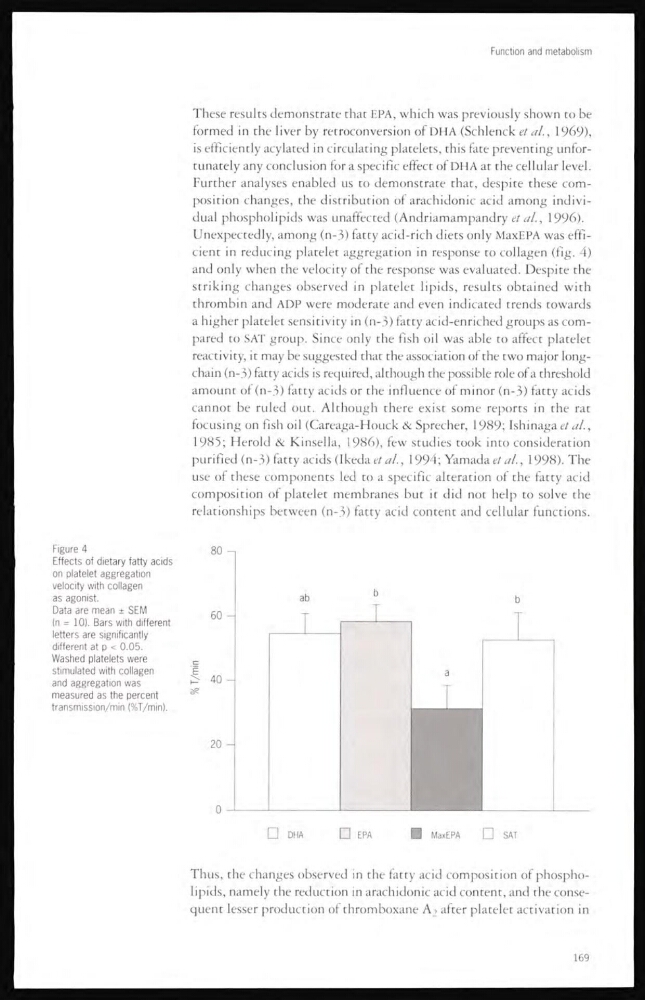
Unexpectedly, among (n-3) fatty acid-rich diets only MaxEPA was efficient in reducing platelet aggregation in response to collagen (fig. 4)
and only when the velocity of the response was evaluated. Despite the
striking changes observed m platelet lipids, results obtained with
thrombin and ADP were moderate and even indicated trends towards
a higher platelet sensitivity in (n-3) fatty acid-enriched groups as compared to SAT group. Since only the fish oil was able to affect platelet
reactivity, it may be suggested that the association of the two major longchain (n-3) fatty acids is required, although the possible role of a threshold
amount of (n-3) fatty acids or the influence of minor (n-3) fatty acids
cannot be ruled out. Although there exist some reports in the rat
focusing on fish oil (Careaga-Houck & Sprecher, 1989; Ishinaga et al.,
1985; Herold & Kinsella, 1986), few studies took into consideration
purified (n-3) fatty acids (Ikeda et al., 1994; Yamada et al., 1998). The
use of these components led to a specific alteration of the fatty acid
composition of platelet membranes but it did not help to solve the
relationships between (n-3) fatty acid content and cellular functions.
Figure 4
Effects of dietary fatty acids
on platelet aggregation
velocity with collagen
as agonist.
Data are mean ± SEM
(n = 10). Bars with different
letters are significantly
different at p < 0.05.
Washed platelets were
stimulated with collagen
and aggregation was
measured as the percent
transmisslon/min (%T/min).
□ DHA
□ EPA
□ MaxEPA
□ SAT
Thus, the changes observed in the fatty acid composition of phospholipids, namely the reduction m arachidonic acid content, and the consequent lesser production of thromboxane A 2 after platelet activation in
169
These results demonstrate that EPA, which was previously shown to be
formed in the liver by retroconversion of DHA (Schlenck et al., 1969),
is efficiently acylated in circulating platelets, this fate preventing unfortunately any conclusion for a specific effect of DHA at the cellular level.
Further analyses enabled us to demonstrate that, despite these composition changes, the distribution of arachidonic acid among individual phospholipids was unaffected (Andriamampandry et al., 1996).
Unexpectedly, among (n-3) fatty acid-rich diets only MaxEPA was efficient in reducing platelet aggregation in response to collagen (fig. 4)
and only when the velocity of the response was evaluated. Despite the
striking changes observed m platelet lipids, results obtained with
thrombin and ADP were moderate and even indicated trends towards
a higher platelet sensitivity in (n-3) fatty acid-enriched groups as compared to SAT group. Since only the fish oil was able to affect platelet
reactivity, it may be suggested that the association of the two major longchain (n-3) fatty acids is required, although the possible role of a threshold
amount of (n-3) fatty acids or the influence of minor (n-3) fatty acids
cannot be ruled out. Although there exist some reports in the rat
focusing on fish oil (Careaga-Houck & Sprecher, 1989; Ishinaga et al.,
1985; Herold & Kinsella, 1986), few studies took into consideration
purified (n-3) fatty acids (Ikeda et al., 1994; Yamada et al., 1998). The
use of these components led to a specific alteration of the fatty acid
composition of platelet membranes but it did not help to solve the
relationships between (n-3) fatty acid content and cellular functions.
Figure 4
Effects of dietary fatty acids
on platelet aggregation
velocity with collagen
as agonist.
Data are mean ± SEM
(n = 10). Bars with different
letters are significantly
different at p < 0.05.
Washed platelets were
stimulated with collagen
and aggregation was
measured as the percent
transmisslon/min (%T/min).
□ DHA
□ EPA
□ MaxEPA
□ SAT
Thus, the changes observed in the fatty acid composition of phospholipids, namely the reduction m arachidonic acid content, and the consequent lesser production of thromboxane A 2 after platelet activation in
169