

Marine lipids
Platelet composition and functions
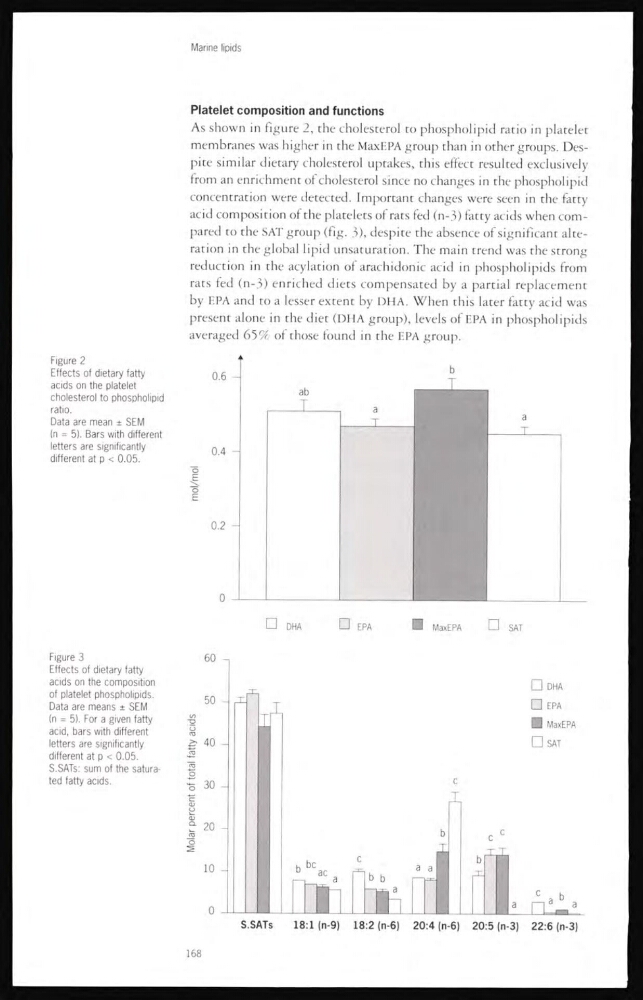
As shown in figure 2, the cholesterol to phospholipid ratio in platelet
membranes was higher in the MaxEPA group than in other groups. Despite similar dietary cholesterol uptakes, this effect resulted exclusively
from an enrichment of cholesterol since no changes in the phospholipid
concentration were detected. Important changes were seen in the fatty
acid composition of the platelets ofrats fed (n-3) fatty acids when compared to the SAT group (fig. 3), despite the absence of significant alteration in the global lipid unsaturation. The main trend was the strong
reduction in the acylation of arachidonic acid in phospholipids from
rats fed (n-3) enriched diets compensated by a partial replacement
by EPA and to a lesser extent by DHA. When this later fatty acid was
present alone in the diet (DHA group), levels of EPA in phospholipids
averageci 65% of those found in the EPA group.
Figure 2
Effects of dietary fatty
acids on the platelet
cholesterol to phospholipid
ratio.
Data are mean ± SEM
(n = 5). Bars with different
letters are significantly
different at p < 0.05.
□ DHA
□ EPA
□ MaxEPA □ SAT
Figure 3
Effects of dietary fatty
acids on the composition
of platelet phospholipids.
Data are means ± SEM
(n = 5). For a given fatty
acid, bars with different
letters are significantly
different at p < 0.05.
S.SATs: sum of the saturated fatty acids.
□ DHA
□ FFA
□ MaxEPA
□ SAT
168
Platelet composition and functions
As shown in figure 2, the cholesterol to phospholipid ratio in platelet
membranes was higher in the MaxEPA group than in other groups. Despite similar dietary cholesterol uptakes, this effect resulted exclusively
from an enrichment of cholesterol since no changes in the phospholipid
concentration were detected. Important changes were seen in the fatty
acid composition of the platelets ofrats fed (n-3) fatty acids when compared to the SAT group (fig. 3), despite the absence of significant alteration in the global lipid unsaturation. The main trend was the strong
reduction in the acylation of arachidonic acid in phospholipids from
rats fed (n-3) enriched diets compensated by a partial replacement
by EPA and to a lesser extent by DHA. When this later fatty acid was
present alone in the diet (DHA group), levels of EPA in phospholipids
averageci 65% of those found in the EPA group.
Figure 2
Effects of dietary fatty
acids on the platelet
cholesterol to phospholipid
ratio.
Data are mean ± SEM
(n = 5). Bars with different
letters are significantly
different at p < 0.05.
□ DHA
□ EPA
□ MaxEPA □ SAT
Figure 3
Effects of dietary fatty
acids on the composition
of platelet phospholipids.
Data are means ± SEM
(n = 5). For a given fatty
acid, bars with different
letters are significantly
different at p < 0.05.
S.SATs: sum of the saturated fatty acids.
□ DHA
□ FFA
□ MaxEPA
□ SAT
168