

Function and metabolism
The experimental arterial thrombosis model (Freund et al., 1993)
enabled the measurement of the occlusion time of an extracorporal
shunt equipped with a glass capillary coated with collagen which was
inserted into the two internal carotids. The occlusion time was determined by means of thermic probes (Andriamampandry et al., 1999).
The experimental venous thrombosis model involved a combination ol
stasis and hypercoagulability as previously described (Wessler, 1962).
Dilute thromboplastin solution was injected systemically and after ten
seconds a stasis was established by tightening a portion of the vena
cava. Ten minutes later, the resultant thrombus was removed, rinsed
and weighed (Andriamampandry et al., 1 999).
Results and discussion
Plasma lipid composition
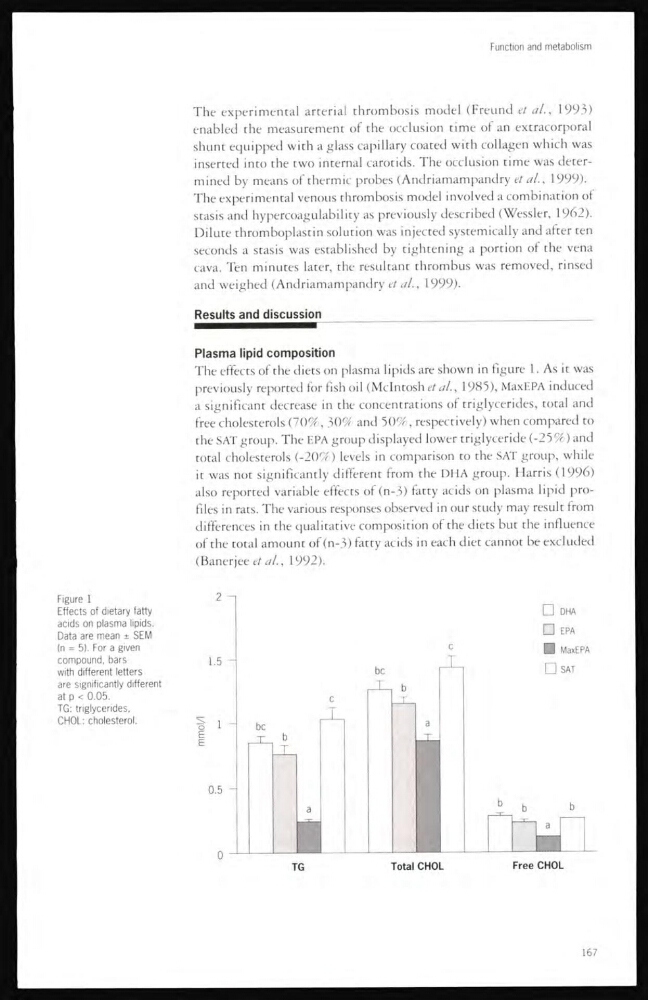
The effects of the diets on plasma lipids are shown in figure 1. As it was
previously reported for fish oil (Mclntosh et al., 1985), MaxEPA induced
a significant decrease in the concentrations of triglycerides, total and
free cholesterols (70%, 30% and 50%, respectively) when compared to
the SAT group. The EPA group displayed lower triglyceride (-25%) and
total cholesterols (-20%) levels in comparison to the SAT group, while
it was not significantly different from the DHA group. Harris (1996)
also reported variable effects of (n-3) fatty acids on plasma lipid profiles in rats. The various responses observed in our study may result from
differences in the qualitative composition of the diets but the influence
of the total amount of (n-3) fatty acids in each diet cannot be excluded
(Banerjee et al., 1992).
Figure 1
Effects of dietary fatty
acids on plasma lipids.
Data are mean ± SEM
(n = 5). For a given
compound, bars
with different letters
are significantly different
at p < 0.05.
TG: triglycerides,
CHOL: cholesterol.
□ DHA
□ EPA
□ MaxEPA
□ SAT
167
The experimental arterial thrombosis model (Freund et al., 1993)
enabled the measurement of the occlusion time of an extracorporal
shunt equipped with a glass capillary coated with collagen which was
inserted into the two internal carotids. The occlusion time was determined by means of thermic probes (Andriamampandry et al., 1999).
The experimental venous thrombosis model involved a combination ol
stasis and hypercoagulability as previously described (Wessler, 1962).
Dilute thromboplastin solution was injected systemically and after ten
seconds a stasis was established by tightening a portion of the vena
cava. Ten minutes later, the resultant thrombus was removed, rinsed
and weighed (Andriamampandry et al., 1 999).
Results and discussion
Plasma lipid composition
The effects of the diets on plasma lipids are shown in figure 1. As it was
previously reported for fish oil (Mclntosh et al., 1985), MaxEPA induced
a significant decrease in the concentrations of triglycerides, total and
free cholesterols (70%, 30% and 50%, respectively) when compared to
the SAT group. The EPA group displayed lower triglyceride (-25%) and
total cholesterols (-20%) levels in comparison to the SAT group, while
it was not significantly different from the DHA group. Harris (1996)
also reported variable effects of (n-3) fatty acids on plasma lipid profiles in rats. The various responses observed in our study may result from
differences in the qualitative composition of the diets but the influence
of the total amount of (n-3) fatty acids in each diet cannot be excluded
(Banerjee et al., 1992).
Figure 1
Effects of dietary fatty
acids on plasma lipids.
Data are mean ± SEM
(n = 5). For a given
compound, bars
with different letters
are significantly different
at p < 0.05.
TG: triglycerides,
CHOL: cholesterol.
□ DHA
□ EPA
□ MaxEPA
□ SAT
167