

87
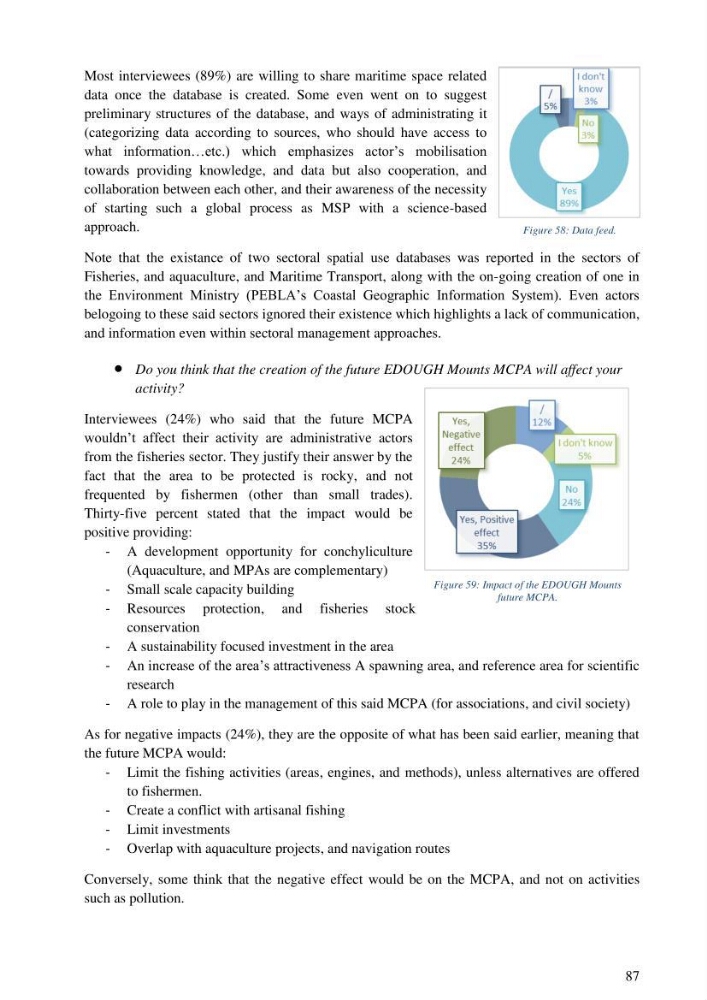
Most interviewees (89%) are willing to share maritime space related
data once the database is created. Some even went on to suggest
preliminary structures of the database, and ways of administrating it
(categorizing data according to sources, who should have access to
what information…etc.) which emphasizes actor‟s mobilisation
towards providing knowledge, and data but also cooperation, and
collaboration between each other, and their awareness of the necessity
of starting such a global process as MSP with a science-based
approach.
Note that the existance of two sectoral spatial use databases was reported in the sectors of
Fisheries, and aquaculture, and Maritime Transport, along with the on-going creation of one in
the Environment Ministry (PEBLA‟s Coastal Geographic Information System). Even actors
belogoing to these said sectors ignored their existence which highlights a lack of communication,
and information even within sectoral management approaches.
Do you think that the creation of the future EDOUGH Mounts MCPA will affect your
activity?
Interviewees (24%) who said that the future MCPA
wouldn‟t affect their activity are administrative actors
from the fisheries sector. They justify their answer by the
fact that the area to be protected is rocky, and not
frequented by fishermen (other than small trades).
Thirty-five percent stated that the impact would be
positive providing:
- A development opportunity for conchyliculture
(Aquaculture, and MPAs are complementary)
- Small scale capacity building
- Resources protection, and fisheries stock
conservation
- A sustainability focused investment in the area
- An increase of the area‟s attractiveness A spawning area, and reference area for scientific
research
- A role to play in the management of this said MCPA (for associations, and civil society)
As for negative impacts (24%), they are the opposite of what has been said earlier, meaning that
the future MCPA would:
- Limit the fishing activities (areas, engines, and methods), unless alternatives are offered
to fishermen.
- Create a conflict with artisanal fishing
- Limit investments
- Overlap with aquaculture projects, and navigation routes
Conversely, some think that the negative effect would be on the MCPA, and not on activities
such as pollution.
Figure 58: Data feed.
Figure 59: Impact of the EDOUGH Mounts
future MCPA.
Most interviewees (89%) are willing to share maritime space related
data once the database is created. Some even went on to suggest
preliminary structures of the database, and ways of administrating it
(categorizing data according to sources, who should have access to
what information…etc.) which emphasizes actor‟s mobilisation
towards providing knowledge, and data but also cooperation, and
collaboration between each other, and their awareness of the necessity
of starting such a global process as MSP with a science-based
approach.
Note that the existance of two sectoral spatial use databases was reported in the sectors of
Fisheries, and aquaculture, and Maritime Transport, along with the on-going creation of one in
the Environment Ministry (PEBLA‟s Coastal Geographic Information System). Even actors
belogoing to these said sectors ignored their existence which highlights a lack of communication,
and information even within sectoral management approaches.
Do you think that the creation of the future EDOUGH Mounts MCPA will affect your
activity?
Interviewees (24%) who said that the future MCPA
wouldn‟t affect their activity are administrative actors
from the fisheries sector. They justify their answer by the
fact that the area to be protected is rocky, and not
frequented by fishermen (other than small trades).
Thirty-five percent stated that the impact would be
positive providing:
- A development opportunity for conchyliculture
(Aquaculture, and MPAs are complementary)
- Small scale capacity building
- Resources protection, and fisheries stock
conservation
- A sustainability focused investment in the area
- An increase of the area‟s attractiveness A spawning area, and reference area for scientific
research
- A role to play in the management of this said MCPA (for associations, and civil society)
As for negative impacts (24%), they are the opposite of what has been said earlier, meaning that
the future MCPA would:
- Limit the fishing activities (areas, engines, and methods), unless alternatives are offered
to fishermen.
- Create a conflict with artisanal fishing
- Limit investments
- Overlap with aquaculture projects, and navigation routes
Conversely, some think that the negative effect would be on the MCPA, and not on activities
such as pollution.
Figure 58: Data feed.
Figure 59: Impact of the EDOUGH Mounts
future MCPA.