

86
knowledge on the MSP concept (6%), the current sectoral management (5%), the lack of
communication (4%), and competences (4%) along with other issues as shown in the upper
figure. Other (41%) problems were reported such as:
- Absence of a state of reference
- Absence of application texts in
legislation
- Adaptation to the social aspect of the
country
- The current flow of decisions
- Algeria's unclear weight in the
Mediterranean basin
- First users' lack of trust in foreign
concepts
- Heavy, and not sufficient laws, and
regulations (not flexible)
- Lack of ambition, and political will, and
interest in maritime space (MSP is not
currently a strategic priority)
- Lack of coordination, and short-term
planning
- Lack of respect for decentralized
decisions, and sectoral monopole of
spaces.
- Slow reactions to spatial use
emergencies
- Time gap (we're far behind international
standards because we turned our back to
the sea)
In your opinion, would a database on the use of maritime space in Algeria be useful for
managing conflicts between activities? If so, where do you think it would be located?
Who would administer/manage it? Could you participate in its data feed in the
perspective of collaboration, and cooperation?
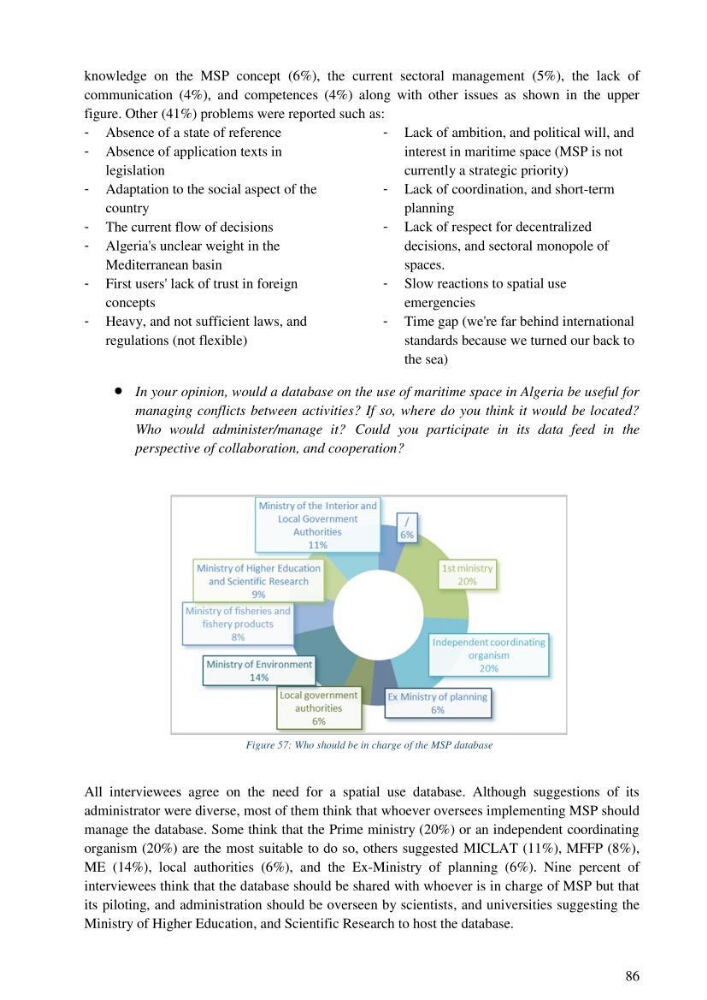
All interviewees agree on the need for a spatial use database. Although suggestions of its
administrator were diverse, most of them think that whoever oversees implementing MSP should
manage the database. Some think that the Prime ministry (20%) or an independent coordinating
organism (20%) are the most suitable to do so, others suggested MICLAT (11%), MFFP (8%),
ME (14%), local authorities (6%), and the Ex-Ministry of planning (6%). Nine percent of
interviewees think that the database should be shared with whoever is in charge of MSP but that
its piloting, and administration should be overseen by scientists, and universities suggesting the
Ministry of Higher Education, and Scientific Research to host the database.
Figure 57: Who should be in charge of the MSP database
knowledge on the MSP concept (6%), the current sectoral management (5%), the lack of
communication (4%), and competences (4%) along with other issues as shown in the upper
figure. Other (41%) problems were reported such as:
- Absence of a state of reference
- Absence of application texts in
legislation
- Adaptation to the social aspect of the
country
- The current flow of decisions
- Algeria's unclear weight in the
Mediterranean basin
- First users' lack of trust in foreign
concepts
- Heavy, and not sufficient laws, and
regulations (not flexible)
- Lack of ambition, and political will, and
interest in maritime space (MSP is not
currently a strategic priority)
- Lack of coordination, and short-term
planning
- Lack of respect for decentralized
decisions, and sectoral monopole of
spaces.
- Slow reactions to spatial use
emergencies
- Time gap (we're far behind international
standards because we turned our back to
the sea)
In your opinion, would a database on the use of maritime space in Algeria be useful for
managing conflicts between activities? If so, where do you think it would be located?
Who would administer/manage it? Could you participate in its data feed in the
perspective of collaboration, and cooperation?
All interviewees agree on the need for a spatial use database. Although suggestions of its
administrator were diverse, most of them think that whoever oversees implementing MSP should
manage the database. Some think that the Prime ministry (20%) or an independent coordinating
organism (20%) are the most suitable to do so, others suggested MICLAT (11%), MFFP (8%),
ME (14%), local authorities (6%), and the Ex-Ministry of planning (6%). Nine percent of
interviewees think that the database should be shared with whoever is in charge of MSP but that
its piloting, and administration should be overseen by scientists, and universities suggesting the
Ministry of Higher Education, and Scientific Research to host the database.
Figure 57: Who should be in charge of the MSP database