

88
How do you plan to deal with this use conflict?
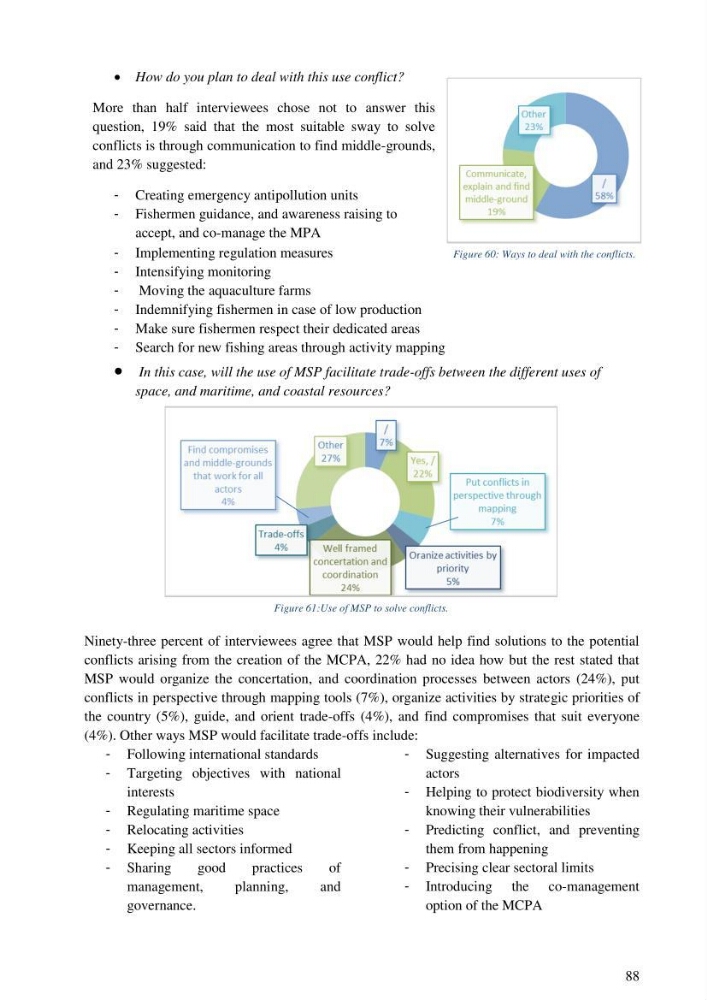
More than half interviewees chose not to answer this
question, 19% said that the most suitable sway to solve
conflicts is through communication to find middle-grounds,
and 23% suggested:
- Creating emergency antipollution units
- Fishermen guidance, and awareness raising to
accept, and co-manage the MPA
- Implementing regulation measures
- Intensifying monitoring
- Moving the aquaculture farms
- Indemnifying fishermen in case of low production
- Make sure fishermen respect their dedicated areas
- Search for new fishing areas through activity mapping
In this case, will the use of MSP facilitate trade-offs between the different uses of
space, and maritime, and coastal resources?
Ninety-three percent of interviewees agree that MSP would help find solutions to the potential
conflicts arising from the creation of the MCPA, 22% had no idea how but the rest stated that
MSP would organize the concertation, and coordination processes between actors (24%), put
conflicts in perspective through mapping tools (7%), organize activities by strategic priorities of
the country (5%), guide, and orient trade-offs (4%), and find compromises that suit everyone
(4%). Other ways MSP would facilitate trade-offs include:
- Following international standards
- Targeting objectives with national
interests
- Regulating maritime space
- Relocating activities
- Keeping all sectors informed
- Sharing
good
practices
of
management,
planning,
and
governance.
- Suggesting alternatives for impacted
actors
- Helping to protect biodiversity when
knowing their vulnerabilities
- Predicting conflict, and preventing
them from happening
- Precising clear sectoral limits
- Introducing the co-management
option of the MCPA
Figure 60: Ways to deal with the conflicts.
Figure 61:Use of MSP to solve conflicts.
How do you plan to deal with this use conflict?
More than half interviewees chose not to answer this
question, 19% said that the most suitable sway to solve
conflicts is through communication to find middle-grounds,
and 23% suggested:
- Creating emergency antipollution units
- Fishermen guidance, and awareness raising to
accept, and co-manage the MPA
- Implementing regulation measures
- Intensifying monitoring
- Moving the aquaculture farms
- Indemnifying fishermen in case of low production
- Make sure fishermen respect their dedicated areas
- Search for new fishing areas through activity mapping
In this case, will the use of MSP facilitate trade-offs between the different uses of
space, and maritime, and coastal resources?
Ninety-three percent of interviewees agree that MSP would help find solutions to the potential
conflicts arising from the creation of the MCPA, 22% had no idea how but the rest stated that
MSP would organize the concertation, and coordination processes between actors (24%), put
conflicts in perspective through mapping tools (7%), organize activities by strategic priorities of
the country (5%), guide, and orient trade-offs (4%), and find compromises that suit everyone
(4%). Other ways MSP would facilitate trade-offs include:
- Following international standards
- Targeting objectives with national
interests
- Regulating maritime space
- Relocating activities
- Keeping all sectors informed
- Sharing
good
practices
of
management,
planning,
and
governance.
- Suggesting alternatives for impacted
actors
- Helping to protect biodiversity when
knowing their vulnerabilities
- Predicting conflict, and preventing
them from happening
- Precising clear sectoral limits
- Introducing the co-management
option of the MCPA
Figure 60: Ways to deal with the conflicts.
Figure 61:Use of MSP to solve conflicts.