

67
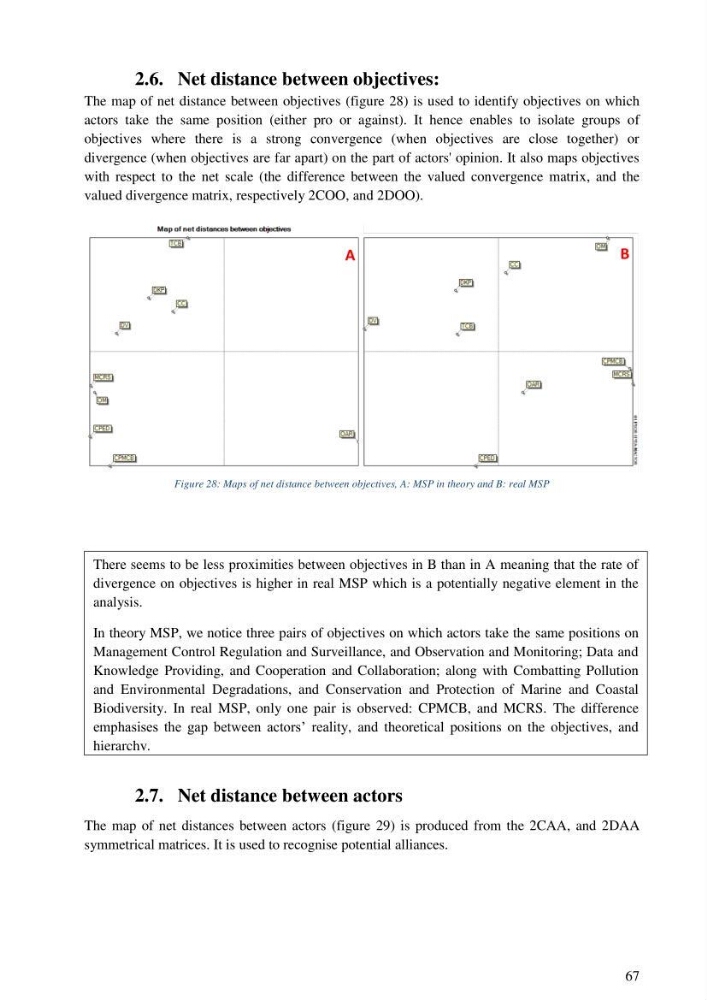
There seems to be less proximities between objectives in B than in A meaning that the rate of
divergence on objectives is higher in real MSP which is a potentially negative element in the
analysis.
In theory MSP, we notice three pairs of objectives on which actors take the same positions on
Management Control Regulation and Surveillance, and Observation and Monitoring; Data and
Knowledge Providing, and Cooperation and Collaboration; along with Combatting Pollution
and Environmental Degradations, and Conservation and Protection of Marine and Coastal
Biodiversity. In real MSP, only one pair is observed: CPMCB, and MCRS. The difference
emphasises the gap between actors‟ reality, and theoretical positions on the objectives, and
hierarchy.
2.6. Net distance between objectives:
The map of net distance between objectives (figure 28) is used to identify objectives on which
actors take the same position (either pro or against). It hence enables to isolate groups of
objectives where there is a strong convergence (when objectives are close together) or
divergence (when objectives are far apart) on the part of actors' opinion. It also maps objectives
with respect to the net scale (the difference between the valued convergence matrix, and the
valued divergence matrix, respectively 2COO, and 2DOO).
2.7. Net distance between actors
The map of net distances between actors (figure 29) is produced from the 2CAA, and 2DAA
symmetrical matrices. It is used to recognise potential alliances.
Figure 28: Maps of net distance between objectives, A: MSP in theory and B: real MSP
There seems to be less proximities between objectives in B than in A meaning that the rate of
divergence on objectives is higher in real MSP which is a potentially negative element in the
analysis.
In theory MSP, we notice three pairs of objectives on which actors take the same positions on
Management Control Regulation and Surveillance, and Observation and Monitoring; Data and
Knowledge Providing, and Cooperation and Collaboration; along with Combatting Pollution
and Environmental Degradations, and Conservation and Protection of Marine and Coastal
Biodiversity. In real MSP, only one pair is observed: CPMCB, and MCRS. The difference
emphasises the gap between actors‟ reality, and theoretical positions on the objectives, and
hierarchy.
2.6. Net distance between objectives:
The map of net distance between objectives (figure 28) is used to identify objectives on which
actors take the same position (either pro or against). It hence enables to isolate groups of
objectives where there is a strong convergence (when objectives are close together) or
divergence (when objectives are far apart) on the part of actors' opinion. It also maps objectives
with respect to the net scale (the difference between the valued convergence matrix, and the
valued divergence matrix, respectively 2COO, and 2DOO).
2.7. Net distance between actors
The map of net distances between actors (figure 29) is produced from the 2CAA, and 2DAA
symmetrical matrices. It is used to recognise potential alliances.
Figure 28: Maps of net distance between objectives, A: MSP in theory and B: real MSP