

68
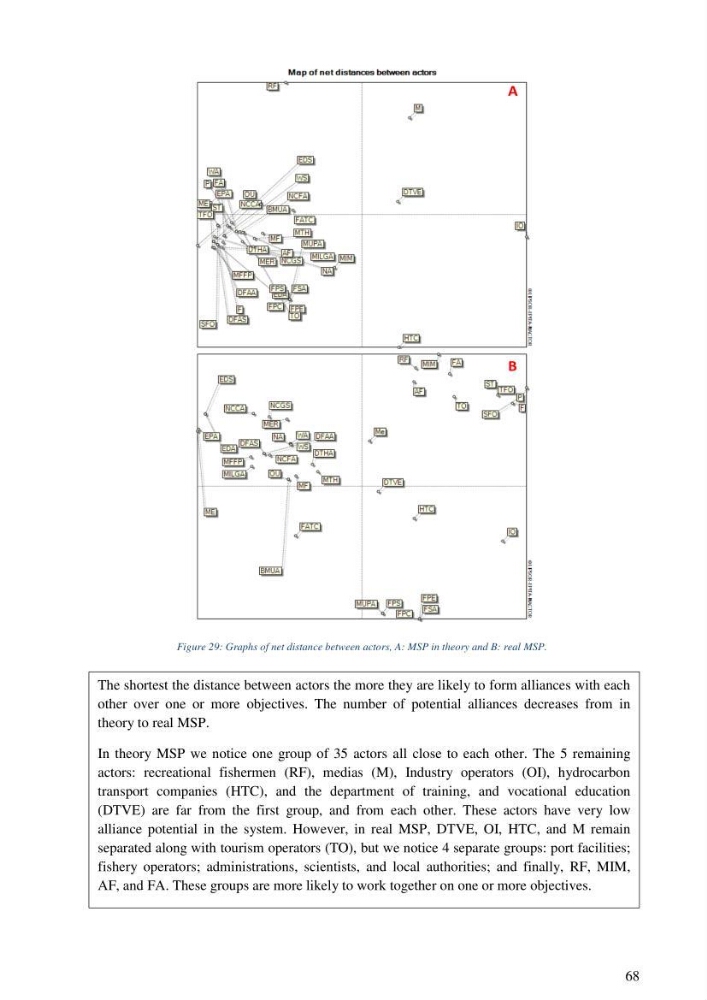
Figure 29: Graphs of net distance between actors, A: MSP in theory and B: real MSP.
The shortest the distance between actors the more they are likely to form alliances with each
other over one or more objectives. The number of potential alliances decreases from in
theory to real MSP.
In theory MSP we notice one group of 35 actors all close to each other. The 5 remaining
actors: recreational fishermen (RF), medias (M), Industry operators (OI), hydrocarbon
transport companies (HTC), and the department of training, and vocational education
(DTVE) are far from the first group, and from each other. These actors have very low
alliance potential in the system. However, in real MSP, DTVE, OI, HTC, and M remain
separated along with tourism operators (TO), but we notice 4 separate groups: port facilities;
fishery operators; administrations, scientists, and local authorities; and finally, RF, MIM,
AF, and FA. These groups are more likely to work together on one or more objectives.
Figure 29: Graphs of net distance between actors, A: MSP in theory and B: real MSP.
The shortest the distance between actors the more they are likely to form alliances with each
other over one or more objectives. The number of potential alliances decreases from in
theory to real MSP.
In theory MSP we notice one group of 35 actors all close to each other. The 5 remaining
actors: recreational fishermen (RF), medias (M), Industry operators (OI), hydrocarbon
transport companies (HTC), and the department of training, and vocational education
(DTVE) are far from the first group, and from each other. These actors have very low
alliance potential in the system. However, in real MSP, DTVE, OI, HTC, and M remain
separated along with tourism operators (TO), but we notice 4 separate groups: port facilities;
fishery operators; administrations, scientists, and local authorities; and finally, RF, MIM,
AF, and FA. These groups are more likely to work together on one or more objectives.