

66
Table 22 : 3EQi calculating, and interpretation elements.
Calculating elements
Elements of
interpretation
3EQ i
The weighted valued ambivalences is calculated in the
following way:
3EQ i = 1 - (| k | (3CAA) ik | - | 3DAA) ik |) / (| k | (3CAA) ik | + |
(3DAA) ik |)
This indicator varies from
1
(very
ambivalent
actors)
to
0
(not
ambivalent actors).
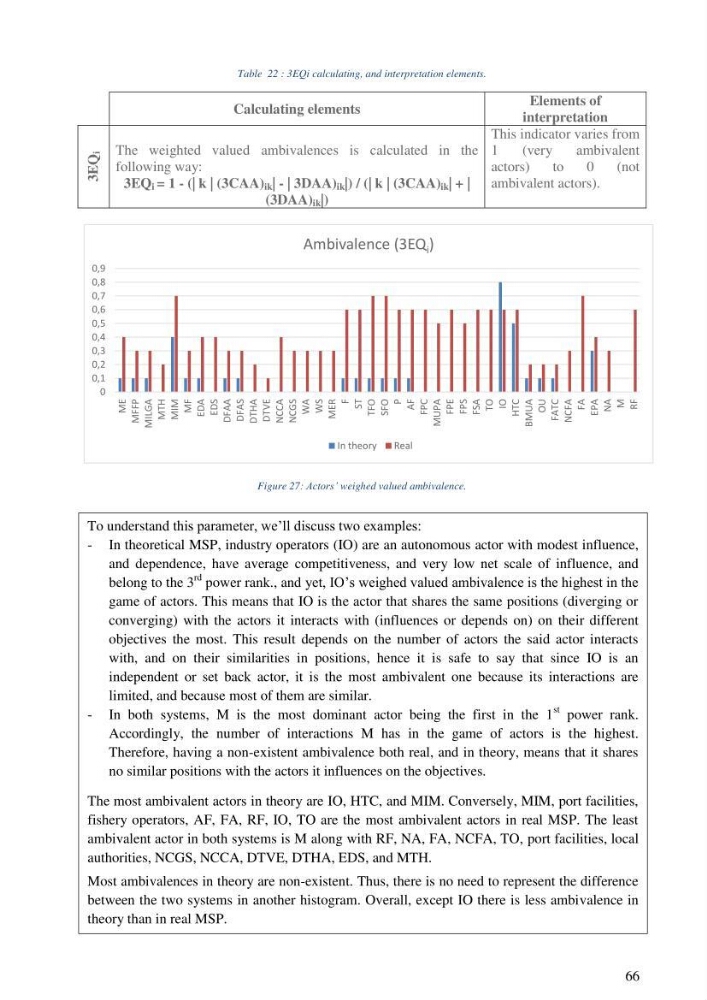
Figure 27: Actors‟ weighed valued ambivalence.
0
0,1
0,2
0,3
0,4
0,5
0,6
0,7
0,8
0,9
ME
MFFP MILGA MTH
MIM
MF EDA
EDS
DFAA
DFAS
DTHA DTVE
NCCA NCGS WA WS
MER F
ST TFO SFO P AF FPC MUPA FPE FPS FSA TO IO HTC BMUA OU FATC NCFA FA EPA NA M RF
Ambivalence (3EQ i )
In theory
Real
To understand this parameter, we‟ll discuss two examples:
- In theoretical MSP, industry operators (IO) are an autonomous actor with modest influence,
and dependence, have average competitiveness, and very low net scale of influence, and
belong to the 3
rd power rank., and yet, IO‟s weighed valued ambivalence is the highest in the
game of actors. This means that IO is the actor that shares the same positions (diverging or
converging) with the actors it interacts with (influences or depends on) on their different
objectives the most. This result depends on the number of actors the said actor interacts
with, and on their similarities in positions, hence it is safe to say that since IO is an
independent or set back actor, it is the most ambivalent one because its interactions are
limited, and because most of them are similar.
- In both systems, M is the most dominant actor being the first in the 1
st power rank.
Accordingly, the number of interactions M has in the game of actors is the highest.
Therefore, having a non-existent ambivalence both real, and in theory, means that it shares
no similar positions with the actors it influences on the objectives.
The most ambivalent actors in theory are IO, HTC, and MIM. Conversely, MIM, port facilities,
fishery operators, AF, FA, RF, IO, TO are the most ambivalent actors in real MSP. The least
ambivalent actor in both systems is M along with RF, NA, FA, NCFA, TO, port facilities, local
authorities, NCGS, NCCA, DTVE, DTHA, EDS, and MTH.
Most ambivalences in theory are non-existent. Thus, there is no need to represent the difference
between the two systems in another histogram. Overall, except IO there is less ambivalence in
theory than in real MSP.
Table 22 : 3EQi calculating, and interpretation elements.
Calculating elements
Elements of
interpretation
3EQ i
The weighted valued ambivalences is calculated in the
following way:
3EQ i = 1 - (| k | (3CAA) ik | - | 3DAA) ik |) / (| k | (3CAA) ik | + |
(3DAA) ik |)
This indicator varies from
1
(very
ambivalent
actors)
to
0
(not
ambivalent actors).
Figure 27: Actors‟ weighed valued ambivalence.
0
0,1
0,2
0,3
0,4
0,5
0,6
0,7
0,8
0,9
ME
MFFP MILGA MTH
MIM
MF EDA
EDS
DFAA
DFAS
DTHA DTVE
NCCA NCGS WA WS
MER F
ST TFO SFO P AF FPC MUPA FPE FPS FSA TO IO HTC BMUA OU FATC NCFA FA EPA NA M RF
Ambivalence (3EQ i )
In theory
Real
To understand this parameter, we‟ll discuss two examples:
- In theoretical MSP, industry operators (IO) are an autonomous actor with modest influence,
and dependence, have average competitiveness, and very low net scale of influence, and
belong to the 3
rd power rank., and yet, IO‟s weighed valued ambivalence is the highest in the
game of actors. This means that IO is the actor that shares the same positions (diverging or
converging) with the actors it interacts with (influences or depends on) on their different
objectives the most. This result depends on the number of actors the said actor interacts
with, and on their similarities in positions, hence it is safe to say that since IO is an
independent or set back actor, it is the most ambivalent one because its interactions are
limited, and because most of them are similar.
- In both systems, M is the most dominant actor being the first in the 1
st power rank.
Accordingly, the number of interactions M has in the game of actors is the highest.
Therefore, having a non-existent ambivalence both real, and in theory, means that it shares
no similar positions with the actors it influences on the objectives.
The most ambivalent actors in theory are IO, HTC, and MIM. Conversely, MIM, port facilities,
fishery operators, AF, FA, RF, IO, TO are the most ambivalent actors in real MSP. The least
ambivalent actor in both systems is M along with RF, NA, FA, NCFA, TO, port facilities, local
authorities, NCGS, NCCA, DTVE, DTHA, EDS, and MTH.
Most ambivalences in theory are non-existent. Thus, there is no need to represent the difference
between the two systems in another histogram. Overall, except IO there is less ambivalence in
theory than in real MSP.