

14
2.2.1. Maritime sectors and activities:
Maritime and coastal spaces are shared by multiple sectors, and activities. “Multi-use” refers to
the intentional joint use of the same maritime space and/or of resources in close geographic
proximity by either a single user or multiple users. Indeed, the term covers different situations in
which maritime uses are (or may be) combined in at least one of the temporal, and spatial
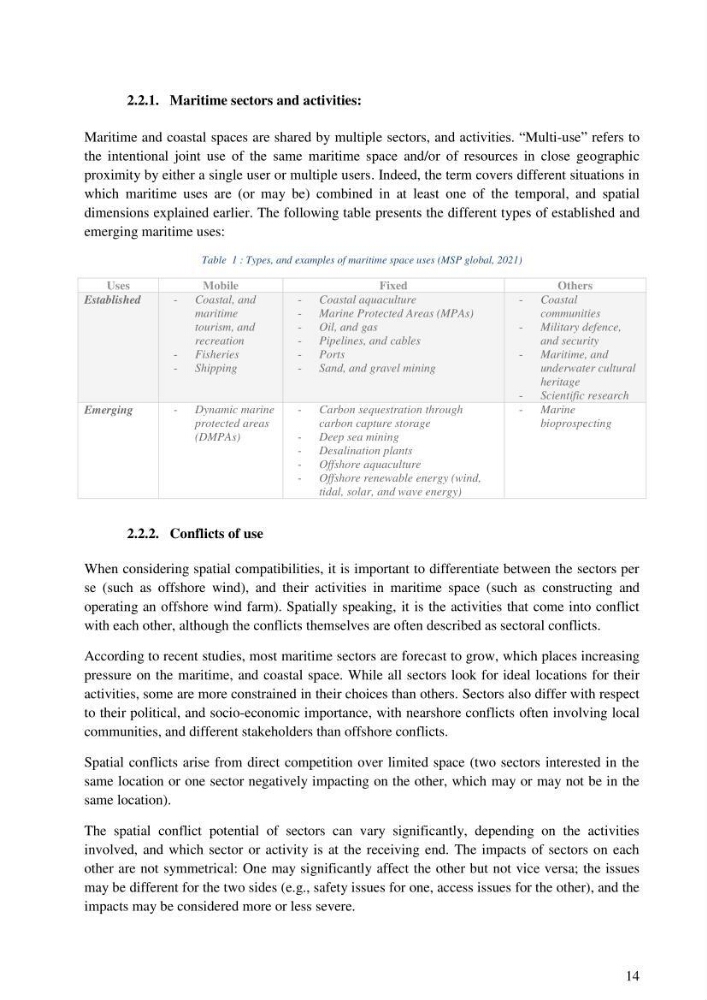
dimensions explained earlier. The following table presents the different types of established and
emerging maritime uses:
Table 1 : Types, and examples of maritime space uses (MSP global, 2021)
Uses
Mobile
Fixed
Others
Established
- Coastal, and
maritime
tourism, and
recreation
- Fisheries
- Shipping
- Coastal aquaculture
- Marine Protected Areas (MPAs)
- Oil, and gas
- Pipelines, and cables
- Ports
- Sand, and gravel mining
- Coastal
communities
- Military defence,
and security
- Maritime, and
underwater cultural
heritage
- Scientific research
Emerging
- Dynamic marine
protected areas
(DMPAs)
- Carbon sequestration through
carbon capture storage
- Deep sea mining
- Desalination plants
- Offshore aquaculture
- Offshore renewable energy (wind,
tidal, solar, and wave energy)
- Marine
bioprospecting
2.2.2. Conflicts of use
When considering spatial compatibilities, it is important to differentiate between the sectors per
se (such as offshore wind), and their activities in maritime space (such as constructing and
operating an offshore wind farm). Spatially speaking, it is the activities that come into conflict
with each other, although the conflicts themselves are often described as sectoral conflicts.
According to recent studies, most maritime sectors are forecast to grow, which places increasing
pressure on the maritime, and coastal space. While all sectors look for ideal locations for their
activities, some are more constrained in their choices than others. Sectors also differ with respect
to their political, and socio-economic importance, with nearshore conflicts often involving local
communities, and different stakeholders than offshore conflicts.
Spatial conflicts arise from direct competition over limited space (two sectors interested in the
same location or one sector negatively impacting on the other, which may or may not be in the
same location).
The spatial conflict potential of sectors can vary significantly, depending on the activities
involved, and which sector or activity is at the receiving end. The impacts of sectors on each
other are not symmetrical: One may significantly affect the other but not vice versa; the issues
may be different for the two sides (e.g., safety issues for one, access issues for the other), and the
impacts may be considered more or less severe.
2.2.1. Maritime sectors and activities:
Maritime and coastal spaces are shared by multiple sectors, and activities. “Multi-use” refers to
the intentional joint use of the same maritime space and/or of resources in close geographic
proximity by either a single user or multiple users. Indeed, the term covers different situations in
which maritime uses are (or may be) combined in at least one of the temporal, and spatial
dimensions explained earlier. The following table presents the different types of established and
emerging maritime uses:
Table 1 : Types, and examples of maritime space uses (MSP global, 2021)
Uses
Mobile
Fixed
Others
Established
- Coastal, and
maritime
tourism, and
recreation
- Fisheries
- Shipping
- Coastal aquaculture
- Marine Protected Areas (MPAs)
- Oil, and gas
- Pipelines, and cables
- Ports
- Sand, and gravel mining
- Coastal
communities
- Military defence,
and security
- Maritime, and
underwater cultural
heritage
- Scientific research
Emerging
- Dynamic marine
protected areas
(DMPAs)
- Carbon sequestration through
carbon capture storage
- Deep sea mining
- Desalination plants
- Offshore aquaculture
- Offshore renewable energy (wind,
tidal, solar, and wave energy)
- Marine
bioprospecting
2.2.2. Conflicts of use
When considering spatial compatibilities, it is important to differentiate between the sectors per
se (such as offshore wind), and their activities in maritime space (such as constructing and
operating an offshore wind farm). Spatially speaking, it is the activities that come into conflict
with each other, although the conflicts themselves are often described as sectoral conflicts.
According to recent studies, most maritime sectors are forecast to grow, which places increasing
pressure on the maritime, and coastal space. While all sectors look for ideal locations for their
activities, some are more constrained in their choices than others. Sectors also differ with respect
to their political, and socio-economic importance, with nearshore conflicts often involving local
communities, and different stakeholders than offshore conflicts.
Spatial conflicts arise from direct competition over limited space (two sectors interested in the
same location or one sector negatively impacting on the other, which may or may not be in the
same location).
The spatial conflict potential of sectors can vary significantly, depending on the activities
involved, and which sector or activity is at the receiving end. The impacts of sectors on each
other are not symmetrical: One may significantly affect the other but not vice versa; the issues
may be different for the two sides (e.g., safety issues for one, access issues for the other), and the
impacts may be considered more or less severe.