

15
This means there are different levels of risk, and urgencies associated with conflicting issues
(e.g. one sector requiring immediate action). Suitable means must then be found to successfully
address each conflicting issue. These will also depend on the spatial scale of the conflict (local,
regional, national, or international) (EU, 2019).
3. Maritime spatial planning
Mostly called marine spatial planning, there are other designations to define the process, such as:
“maritime spatial planning”; “Ocean planning”, “maritime planning”, “marine spatial
management (Ehler & Douvere, 2009), “Marine function zoning” (in China) …. etc.
3.1. Definitions
The fact that there is no internationally agreed definition of MSP, reflects the different contexts
under which it could be developed, the scope it can take, and the diverse ranging of purposes it
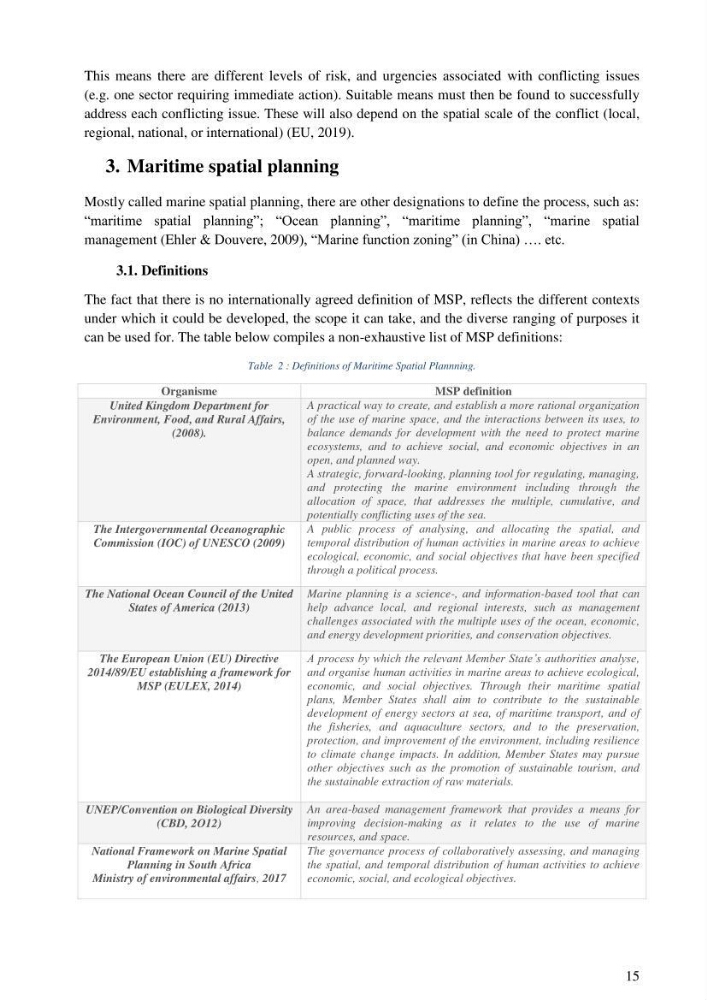
can be used for. The table below compiles a non-exhaustive list of MSP definitions:
Table 2 : Definitions of Maritime Spatial Plannning.
Organisme
MSP definition
United Kingdom Department for
Environment, Food, and Rural Affairs,
(2008).
A practical way to create, and establish a more rational organization
of the use of marine space, and the interactions between its uses, to
balance demands for development with the need to protect marine
ecosystems, and to achieve social, and economic objectives in an
open, and planned way.
A strategic, forward-looking, planning tool for regulating, managing,
and protecting the marine environment including through the
allocation of space, that addresses the multiple, cumulative, and
potentially conflicting uses of the sea.
The Intergovernmental Oceanographic
Commission (IOC) of UNESCO (2009)
A public process of analysing, and allocating the spatial, and
temporal distribution of human activities in marine areas to achieve
ecological, economic, and social objectives that have been specified
through a political process.
The National Ocean Council of the United
States of America (2013)
Marine planning is a science-, and information-based tool that can
help advance local, and regional interests, such as management
challenges associated with the multiple uses of the ocean, economic,
and energy development priorities, and conservation objectives.
The European Union (EU) Directive
2014/89/EU establishing a framework for
MSP (EULEX, 2014)
A process by which the relevant Member State‟s authorities analyse,
and organise human activities in marine areas to achieve ecological,
economic, and social objectives. Through their maritime spatial
plans, Member States shall aim to contribute to the sustainable
development of energy sectors at sea, of maritime transport, and of
the fisheries, and aquaculture sectors, and to the preservation,
protection, and improvement of the environment, including resilience
to climate change impacts. In addition, Member States may pursue
other objectives such as the promotion of sustainable tourism, and
the sustainable extraction of raw materials.
UNEP/Convention on Biological Diversity
(CBD, 2O12)
An area-based management framework that provides a means for
improving decision-making as it relates to the use of marine
resources, and space.
National Framework on Marine Spatial
Planning in South Africa
Ministry of environmental affairs, 2017
The governance process of collaboratively assessing, and managing
the spatial, and temporal distribution of human activities to achieve
economic, social, and ecological objectives.
This means there are different levels of risk, and urgencies associated with conflicting issues
(e.g. one sector requiring immediate action). Suitable means must then be found to successfully
address each conflicting issue. These will also depend on the spatial scale of the conflict (local,
regional, national, or international) (EU, 2019).
3. Maritime spatial planning
Mostly called marine spatial planning, there are other designations to define the process, such as:
“maritime spatial planning”; “Ocean planning”, “maritime planning”, “marine spatial
management (Ehler & Douvere, 2009), “Marine function zoning” (in China) …. etc.
3.1. Definitions
The fact that there is no internationally agreed definition of MSP, reflects the different contexts
under which it could be developed, the scope it can take, and the diverse ranging of purposes it
can be used for. The table below compiles a non-exhaustive list of MSP definitions:
Table 2 : Definitions of Maritime Spatial Plannning.
Organisme
MSP definition
United Kingdom Department for
Environment, Food, and Rural Affairs,
(2008).
A practical way to create, and establish a more rational organization
of the use of marine space, and the interactions between its uses, to
balance demands for development with the need to protect marine
ecosystems, and to achieve social, and economic objectives in an
open, and planned way.
A strategic, forward-looking, planning tool for regulating, managing,
and protecting the marine environment including through the
allocation of space, that addresses the multiple, cumulative, and
potentially conflicting uses of the sea.
The Intergovernmental Oceanographic
Commission (IOC) of UNESCO (2009)
A public process of analysing, and allocating the spatial, and
temporal distribution of human activities in marine areas to achieve
ecological, economic, and social objectives that have been specified
through a political process.
The National Ocean Council of the United
States of America (2013)
Marine planning is a science-, and information-based tool that can
help advance local, and regional interests, such as management
challenges associated with the multiple uses of the ocean, economic,
and energy development priorities, and conservation objectives.
The European Union (EU) Directive
2014/89/EU establishing a framework for
MSP (EULEX, 2014)
A process by which the relevant Member State‟s authorities analyse,
and organise human activities in marine areas to achieve ecological,
economic, and social objectives. Through their maritime spatial
plans, Member States shall aim to contribute to the sustainable
development of energy sectors at sea, of maritime transport, and of
the fisheries, and aquaculture sectors, and to the preservation,
protection, and improvement of the environment, including resilience
to climate change impacts. In addition, Member States may pursue
other objectives such as the promotion of sustainable tourism, and
the sustainable extraction of raw materials.
UNEP/Convention on Biological Diversity
(CBD, 2O12)
An area-based management framework that provides a means for
improving decision-making as it relates to the use of marine
resources, and space.
National Framework on Marine Spatial
Planning in South Africa
Ministry of environmental affairs, 2017
The governance process of collaboratively assessing, and managing
the spatial, and temporal distribution of human activities to achieve
economic, social, and ecological objectives.