

I. LITERATURE REVIEW OF OFFSHORE OIL AND GAS DRILLING
28
Their composition varies according to the depth and nature of the formations crossed. It includes
a continuous or emulsified section which is water or diesel, in addition to a very large number of
chemical additives and auxiliaries which have a specific role and multiple actions.
In general, the first section of the well is drilled with water-based mud or Water-Based Mud
(WBM) which is composed of more than 95% water in addition to bentonite or other clay and
chemical additives of low percentage. The drilling mud used deeper in the other sections of the
well are oil-based, hence their name OBM or Oil-Based Mud. They are composed of up to 94%
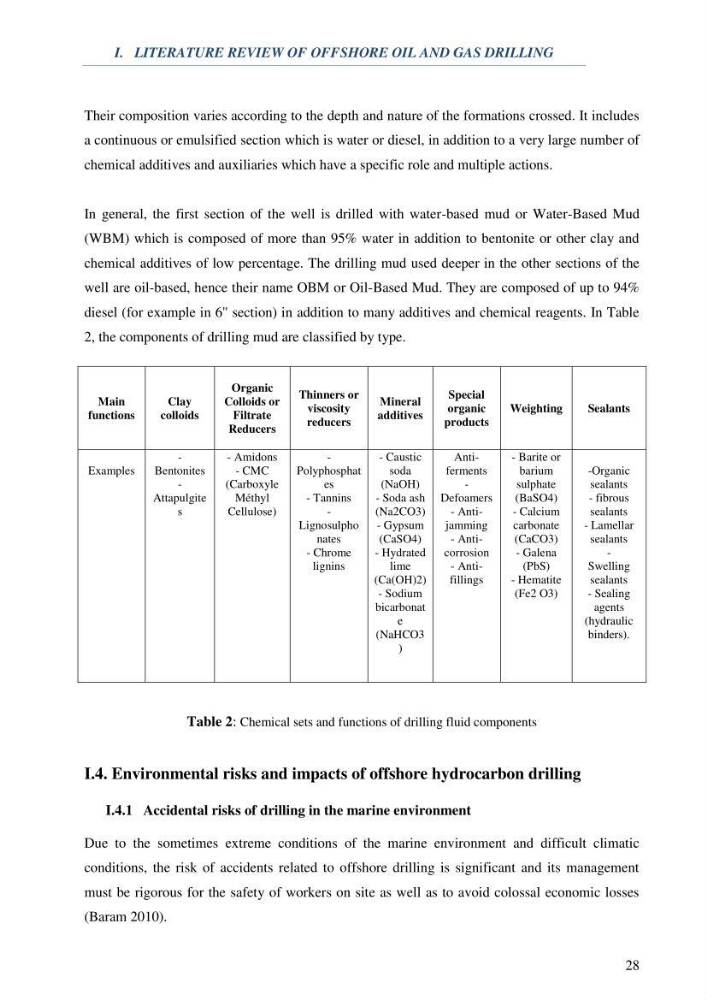
diesel (for example in 6'' section) in addition to many additives and chemical reagents. In Table
2, the components of drilling mud are classified by type.
Table 2: Chemical sets and functions of drilling fluid components
I.4. Environmental risks and impacts of offshore hydrocarbon drilling
I.4.1 Accidental risks of drilling in the marine environment
Due to the sometimes extreme conditions of the marine environment and difficult climatic
conditions, the risk of accidents related to offshore drilling is significant and its management
must be rigorous for the safety of workers on site as well as to avoid colossal economic losses
(Baram 2010).
Main
functions
Clay
colloids
Organic
Colloids or
Filtrate
Reducers
Thinners or
viscosity
reducers
Mineral
additives
Special
organic
products
Weighting
Sealants
Examples
-
Bentonites
-
Attapulgite
s
- Amidons
- CMC
(Carboxyle
Méthyl
Cellulose)
-
Polyphosphat
es
- Tannins
-
Lignosulpho
nates
- Chrome
lignins
- Caustic
soda
(NaOH)
- Soda ash
(Na2CO3)
- Gypsum
(CaSO4)
- Hydrated
lime
(Ca(OH)2)
- Sodium
bicarbonat
e
(NaHCO3
)
Antiferments
-
Defoamers
- Antijamming
- Anticorrosion
- Antifillings
- Barite or
barium
sulphate
(BaSO4)
- Calcium
carbonate
(CaCO3)
- Galena
(PbS)
- Hematite
(Fe2 O3)
-Organic
sealants
- fibrous
sealants
- Lamellar
sealants
-
Swelling
sealants
- Sealing
agents
(hydraulic
binders).
28
Their composition varies according to the depth and nature of the formations crossed. It includes
a continuous or emulsified section which is water or diesel, in addition to a very large number of
chemical additives and auxiliaries which have a specific role and multiple actions.
In general, the first section of the well is drilled with water-based mud or Water-Based Mud
(WBM) which is composed of more than 95% water in addition to bentonite or other clay and
chemical additives of low percentage. The drilling mud used deeper in the other sections of the
well are oil-based, hence their name OBM or Oil-Based Mud. They are composed of up to 94%
diesel (for example in 6'' section) in addition to many additives and chemical reagents. In Table
2, the components of drilling mud are classified by type.
Table 2: Chemical sets and functions of drilling fluid components
I.4. Environmental risks and impacts of offshore hydrocarbon drilling
I.4.1 Accidental risks of drilling in the marine environment
Due to the sometimes extreme conditions of the marine environment and difficult climatic
conditions, the risk of accidents related to offshore drilling is significant and its management
must be rigorous for the safety of workers on site as well as to avoid colossal economic losses
(Baram 2010).
Main
functions
Clay
colloids
Organic
Colloids or
Filtrate
Reducers
Thinners or
viscosity
reducers
Mineral
additives
Special
organic
products
Weighting
Sealants
Examples
-
Bentonites
-
Attapulgite
s
- Amidons
- CMC
(Carboxyle
Méthyl
Cellulose)
-
Polyphosphat
es
- Tannins
-
Lignosulpho
nates
- Chrome
lignins
- Caustic
soda
(NaOH)
- Soda ash
(Na2CO3)
- Gypsum
(CaSO4)
- Hydrated
lime
(Ca(OH)2)
- Sodium
bicarbonat
e
(NaHCO3
)
Antiferments
-
Defoamers
- Antijamming
- Anticorrosion
- Antifillings
- Barite or
barium
sulphate
(BaSO4)
- Calcium
carbonate
(CaCO3)
- Galena
(PbS)
- Hematite
(Fe2 O3)
-Organic
sealants
- fibrous
sealants
- Lamellar
sealants
-
Swelling
sealants
- Sealing
agents
(hydraulic
binders).