

I. LITERATURE REVIEW OF OFFSHORE OIL AND GAS DRILLING
29
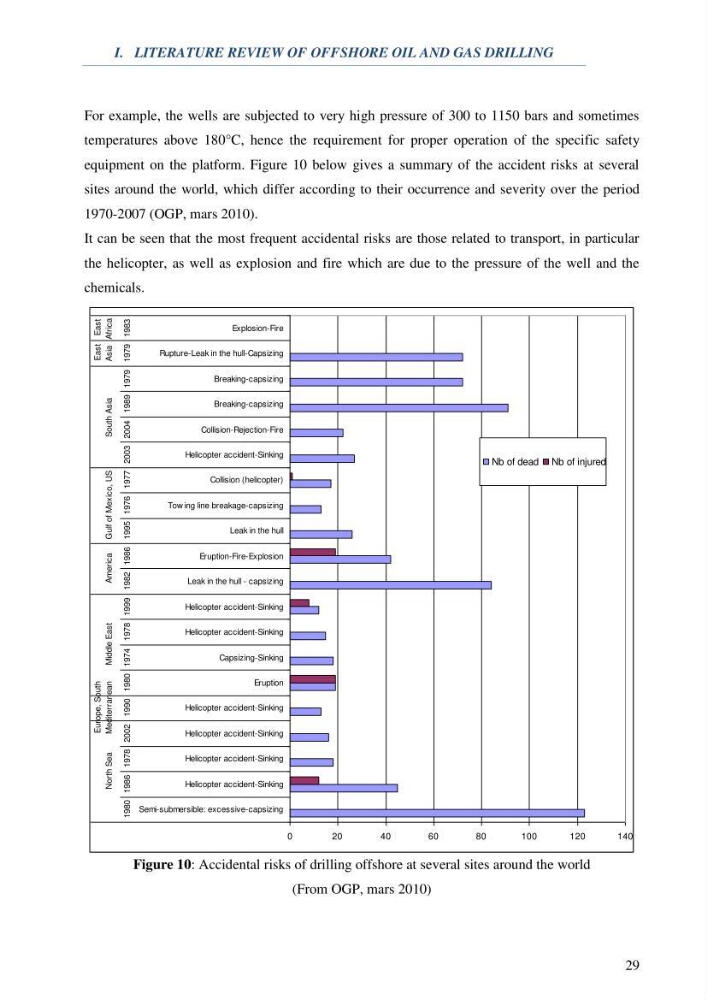
For example, the wells are subjected to very high pressure of 300 to 1150 bars and sometimes
temperatures above 180°C, hence the requirement for proper operation of the specific safety
equipment on the platform. Figure 10 below gives a summary of the accident risks at several
sites around the world, which differ according to their occurrence and severity over the period
1970-2007 (OGP, mars 2010).
It can be seen that the most frequent accidental risks are those related to transport, in particular
the helicopter, as well as explosion and fire which are due to the pressure of the well and the
chemicals.
0
20
40
60
80
100
120
140
Semi-submersible: excessive-capsizing
Helicopter accident-Sinking
Helicopter accident-Sinking
Helicopter accident-Sinking
Helicopter accident-Sinking
Eruption
Capsizing-Sinking
Helicopter accident-Sinking
Helicopter accident-Sinking
Leak in the hull - capsizing
Eruption-Fire-Explosion
Leak in the hull
Tow ing line breakage-capsizing
Collision (helicopter)
Helicopter accident-Sinking
Collision-Rejection-Fire
Breaking-capsizing
Breaking-capsizing
Rupture-Leak in the hull-Capsizing
Explosion-Fire
1980 1986 1978 2002 1990 1980 1974 1978 1999 1982 1986 1995 1976 1977 2003 2004 1989 1979 1979 1983
North
Sea
Europe,
South
Mediterranean Middle
East America Gulf
of
Mexico,
US South
Asia
East
Asia
East Africa
Nb of dead Nb of injured
Figure 10: Accidental risks of drilling offshore at several sites around the world
(From OGP, mars 2010)
29
For example, the wells are subjected to very high pressure of 300 to 1150 bars and sometimes
temperatures above 180°C, hence the requirement for proper operation of the specific safety
equipment on the platform. Figure 10 below gives a summary of the accident risks at several
sites around the world, which differ according to their occurrence and severity over the period
1970-2007 (OGP, mars 2010).
It can be seen that the most frequent accidental risks are those related to transport, in particular
the helicopter, as well as explosion and fire which are due to the pressure of the well and the
chemicals.
0
20
40
60
80
100
120
140
Semi-submersible: excessive-capsizing
Helicopter accident-Sinking
Helicopter accident-Sinking
Helicopter accident-Sinking
Helicopter accident-Sinking
Eruption
Capsizing-Sinking
Helicopter accident-Sinking
Helicopter accident-Sinking
Leak in the hull - capsizing
Eruption-Fire-Explosion
Leak in the hull
Tow ing line breakage-capsizing
Collision (helicopter)
Helicopter accident-Sinking
Collision-Rejection-Fire
Breaking-capsizing
Breaking-capsizing
Rupture-Leak in the hull-Capsizing
Explosion-Fire
1980 1986 1978 2002 1990 1980 1974 1978 1999 1982 1986 1995 1976 1977 2003 2004 1989 1979 1979 1983
North
Sea
Europe,
South
Mediterranean Middle
East America Gulf
of
Mexico,
US South
Asia
East
Asia
East Africa
Nb of dead Nb of injured
Figure 10: Accidental risks of drilling offshore at several sites around the world
(From OGP, mars 2010)