

Environ Monit Assess
(2021) 193:333
1 3
333
Page 6 of 12
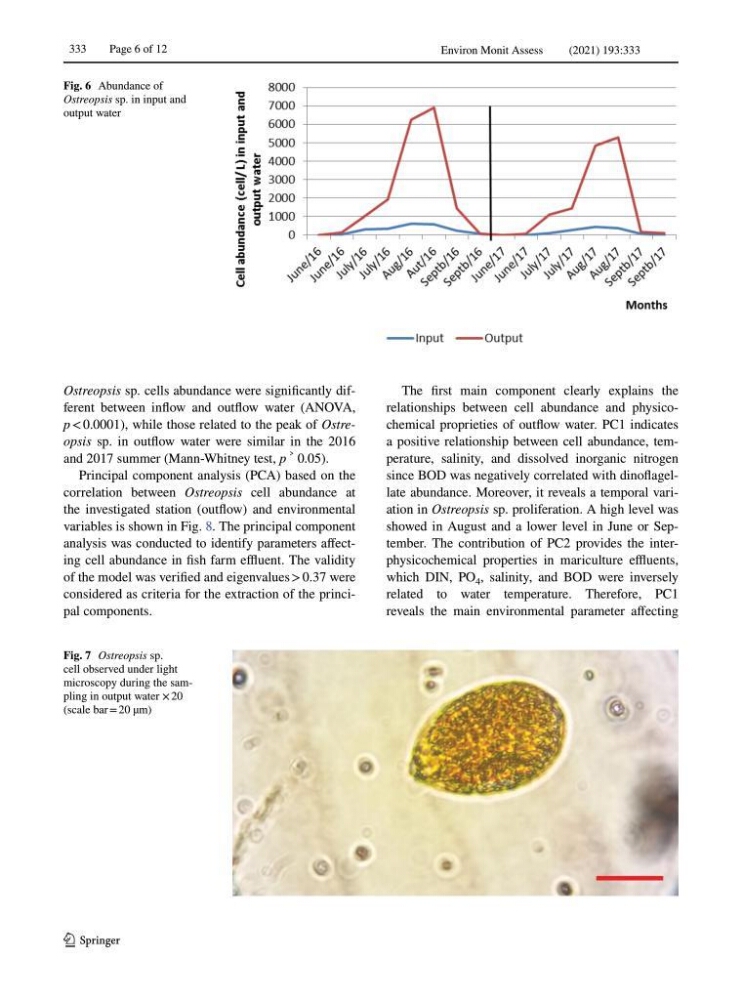
Ostreopsis sp. cells abundance were significantly different between inflow and outflow water (ANOVA,
p < 0.0001), while those related to the peak of Ostreopsis sp. in outflow water were similar in the 2016
and 2017 summer (Mann-Whitney test, p ˃ 0.05).
Principal component analysis (PCA) based on the
correlation between Ostreopsis cell abundance at
the investigated station (outflow) and environmental
variables is shown in Fig. 8. The principal component
analysis was conducted to identify parameters affecting cell abundance in fish farm effluent. The validity
of the model was verified and eigenvalues > 0.37 were
considered as criteria for the extraction of the principal components.
The first main component clearly explains the
relationships between cell abundance and physicochemical proprieties of outflow water. PC1 indicates
a positive relationship between cell abundance, temperature, salinity, and dissolved inorganic nitrogen
since BOD was negatively correlated with dinoflagellate abundance. Moreover, it reveals a temporal variation in Ostreopsis sp. proliferation. A high level was
showed in August and a lower level in June or September. The contribution of PC2 provides the interphysicochemical properties in mariculture effluents,
which DIN, PO 4 , salinity, and BOD were inversely
related to water temperature. Therefore, PC1
reveals the main environmental parameter affecting
Fig. 6 Abundance of
Ostreopsis sp. in input and
output water
Fig. 7 Ostreopsis sp.
cell observed under light
microscopy during the sampling in output water × 20
(scale bar = 20 µm)
(2021) 193:333
1 3
333
Page 6 of 12
Ostreopsis sp. cells abundance were significantly different between inflow and outflow water (ANOVA,
p < 0.0001), while those related to the peak of Ostreopsis sp. in outflow water were similar in the 2016
and 2017 summer (Mann-Whitney test, p ˃ 0.05).
Principal component analysis (PCA) based on the
correlation between Ostreopsis cell abundance at
the investigated station (outflow) and environmental
variables is shown in Fig. 8. The principal component
analysis was conducted to identify parameters affecting cell abundance in fish farm effluent. The validity
of the model was verified and eigenvalues > 0.37 were
considered as criteria for the extraction of the principal components.
The first main component clearly explains the
relationships between cell abundance and physicochemical proprieties of outflow water. PC1 indicates
a positive relationship between cell abundance, temperature, salinity, and dissolved inorganic nitrogen
since BOD was negatively correlated with dinoflagellate abundance. Moreover, it reveals a temporal variation in Ostreopsis sp. proliferation. A high level was
showed in August and a lower level in June or September. The contribution of PC2 provides the interphysicochemical properties in mariculture effluents,
which DIN, PO 4 , salinity, and BOD were inversely
related to water temperature. Therefore, PC1
reveals the main environmental parameter affecting
Fig. 6 Abundance of
Ostreopsis sp. in input and
output water
Fig. 7 Ostreopsis sp.
cell observed under light
microscopy during the sampling in output water × 20
(scale bar = 20 µm)