

Environ Monit Assess
(2021) 193:333
1 3
Page 7 of 12 333
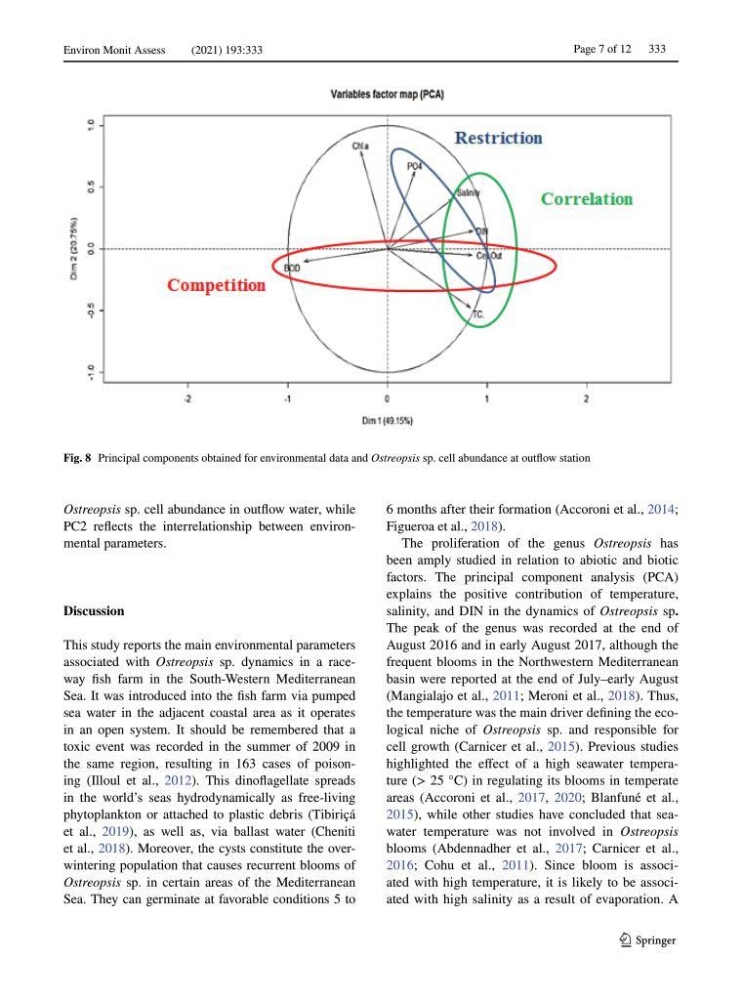
Ostreopsis sp. cell abundance in outflow water, while
PC2 reflects the interrelationship between environmental parameters.
Discussion
This study reports the main environmental parameters
associated with Ostreopsis sp. dynamics in a raceway fish farm in the South-Western Mediterranean
Sea. It was introduced into the fish farm via pumped
sea water in the adjacent coastal area as it operates
in an open system. It should be remembered that a
toxic event was recorded in the summer of 2009 in
the same region, resulting in 163 cases of poisoning (Illoul et al., 2012). This dinoflagellate spreads
in the world’s seas hydrodynamically as free-living
phytoplankton or attached to plastic debris (Tibiriçá
et al., 2019), as well as, via ballast water (Cheniti
et al., 2018). Moreover, the cysts constitute the overwintering population that causes recurrent blooms of
Ostreopsis sp. in certain areas of the Mediterranean
Sea. They can germinate at favorable conditions 5 to
6 months after their formation (Accoroni et al., 2014;
Figueroa et al., 2018).
The proliferation of the genus Ostreopsis has
been amply studied in relation to abiotic and biotic
factors. The principal component analysis (PCA)
explains the positive contribution of temperature,
salinity, and DIN in the dynamics of Ostreopsis sp.
The peak of the genus was recorded at the end of
August 2016 and in early August 2017, although the
frequent blooms in the Northwestern Mediterranean
basin were reported at the end of July–early August
(Mangialajo et al., 2011; Meroni et al., 2018). Thus,
the temperature was the main driver defining the ecological niche of Ostreopsis sp. and responsible for
cell growth (Carnicer et al., 2015). Previous studies
highlighted the effect of a high seawater temperature (> 25 °C) in regulating its blooms in temperate
areas (Accoroni et al., 2017, 2020; Blanfuné et al.,
2015), while other studies have concluded that seawater temperature was not involved in Ostreopsis
blooms (Abdennadher et al., 2017; Carnicer et al.,
2016; Cohu et al., 2011). Since bloom is associated with high temperature, it is likely to be associated with high salinity as a result of evaporation. A
Fig. 8 Principal components obtained for environmental data and Ostreopsis sp. cell abundance at outflow station
(2021) 193:333
1 3
Page 7 of 12 333
Ostreopsis sp. cell abundance in outflow water, while
PC2 reflects the interrelationship between environmental parameters.
Discussion
This study reports the main environmental parameters
associated with Ostreopsis sp. dynamics in a raceway fish farm in the South-Western Mediterranean
Sea. It was introduced into the fish farm via pumped
sea water in the adjacent coastal area as it operates
in an open system. It should be remembered that a
toxic event was recorded in the summer of 2009 in
the same region, resulting in 163 cases of poisoning (Illoul et al., 2012). This dinoflagellate spreads
in the world’s seas hydrodynamically as free-living
phytoplankton or attached to plastic debris (Tibiriçá
et al., 2019), as well as, via ballast water (Cheniti
et al., 2018). Moreover, the cysts constitute the overwintering population that causes recurrent blooms of
Ostreopsis sp. in certain areas of the Mediterranean
Sea. They can germinate at favorable conditions 5 to
6 months after their formation (Accoroni et al., 2014;
Figueroa et al., 2018).
The proliferation of the genus Ostreopsis has
been amply studied in relation to abiotic and biotic
factors. The principal component analysis (PCA)
explains the positive contribution of temperature,
salinity, and DIN in the dynamics of Ostreopsis sp.
The peak of the genus was recorded at the end of
August 2016 and in early August 2017, although the
frequent blooms in the Northwestern Mediterranean
basin were reported at the end of July–early August
(Mangialajo et al., 2011; Meroni et al., 2018). Thus,
the temperature was the main driver defining the ecological niche of Ostreopsis sp. and responsible for
cell growth (Carnicer et al., 2015). Previous studies
highlighted the effect of a high seawater temperature (> 25 °C) in regulating its blooms in temperate
areas (Accoroni et al., 2017, 2020; Blanfuné et al.,
2015), while other studies have concluded that seawater temperature was not involved in Ostreopsis
blooms (Abdennadher et al., 2017; Carnicer et al.,
2016; Cohu et al., 2011). Since bloom is associated with high temperature, it is likely to be associated with high salinity as a result of evaporation. A
Fig. 8 Principal components obtained for environmental data and Ostreopsis sp. cell abundance at outflow station