

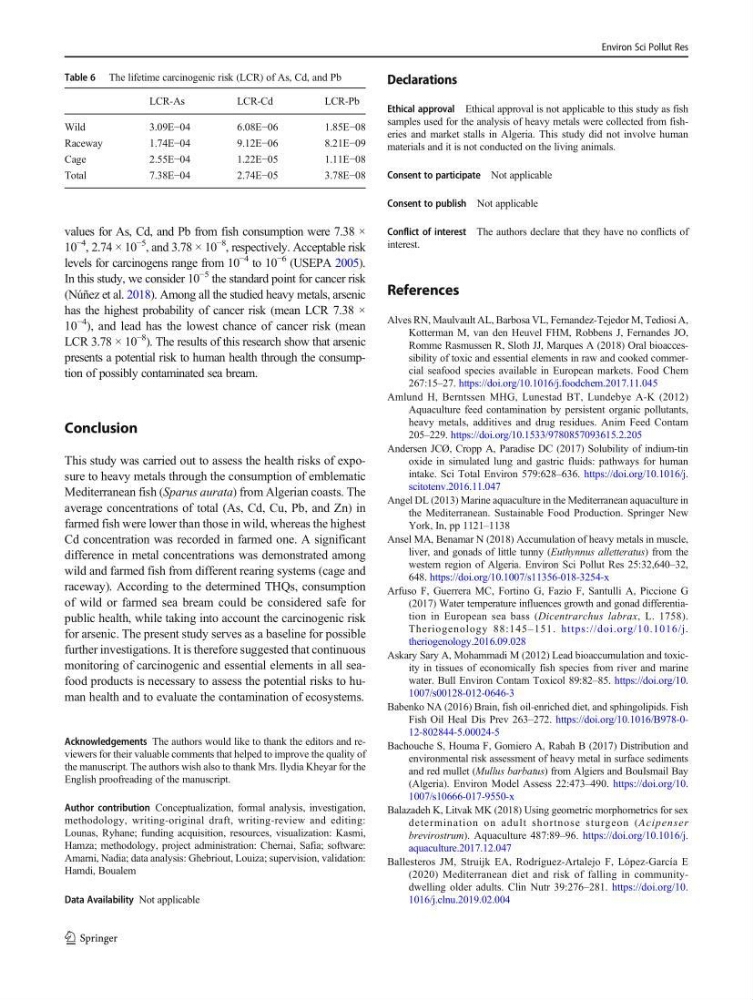
values for As, Cd, and Pb from fish consumption were 7.38 ×
10
−4
, 2.74 × 10
−5
, and 3.78 × 10
−8
, respectively. Acceptable risk
levels for carcinogens range from 10
−4 to 10
−6 (USEPA 2005).
In this study, we consider 10
−5 the standard point for cancer risk
(Núñez et al. 2018). Among all the studied heavy metals, arsenic
has the highest probability of cancer risk (mean LCR 7.38 ×
10
−4
), and lead has the lowest chance of cancer risk (mean
LCR 3.78 × 10
−8
). The results of this research show that arsenic
presents a potential risk to human health through the consumption of possibly contaminated sea bream.
Conclusion
This study was carried out to assess the health risks of exposure to heavy metals through the consumption of emblematic
Mediterranean fish (Sparus aurata) from Algerian coasts. The
average concentrations of total (As, Cd, Cu, Pb, and Zn) in
farmed fish were lower than those in wild, whereas the highest
Cd concentration was recorded in farmed one. A significant
difference in metal concentrations was demonstrated among
wild and farmed fish from different rearing systems (cage and
raceway). According to the determined THQs, consumption
of wild or farmed sea bream could be considered safe for
public health, while taking into account the carcinogenic risk
for arsenic. The present study serves as a baseline for possible
further investigations. It is therefore suggested that continuous
monitoring of carcinogenic and essential elements in all seafood products is necessary to assess the potential risks to human health and to evaluate the contamination of ecosystems.
Acknowledgements The authors would like to thank the editors and reviewers for their valuable comments that helped to improve the quality of
the manuscript. The authors wish also to thank Mrs. Ilydia Kheyar for the
English proofreading of the manuscript.
Author contribution Conceptualization, formal analysis, investigation,
methodology, writing-original draft, writing-review and editing:
Lounas, Ryhane; funding acquisition, resources, visualization: Kasmi,
Hamza; methodology, project administration: Chernai, Safia; software:
Amarni, Nadia; data analysis: Ghebriout, Louiza; supervision, validation:
Hamdi, Boualem
Data Availability Not applicable
Declarations
Ethical approval Ethical approval is not applicable to this study as fish
samples used for the analysis of heavy metals were collected from fisheries and market stalls in Algeria. This study did not involve human
materials and it is not conducted on the living animals.
Consent to participate Not applicable
Consent to publish Not applicable
Conflict of interest The authors declare that they have no conflicts of
interest.
References
Alves RN, Maulvault AL, Barbosa VL, Fernandez-Tejedor M, Tediosi A,
Kotterman M, van den Heuvel FHM, Robbens J, Fernandes JO,
Romme Rasmussen R, Sloth JJ, Marques A (2018) Oral bioaccessibility of toxic and essential elements in raw and cooked commercial seafood species available in European markets. Food Chem
267:15–27. https://doi.org/10.1016/j.foodchem.2017.11.045
Amlund H, Berntssen MHG, Lunestad BT, Lundebye A-K (2012)
Aquaculture feed contamination by persistent organic pollutants,
heavy metals, additives and drug residues. Anim Feed Contam
205–229. https://doi.org/10.1533/9780857093615.2.205
Andersen JCØ, Cropp A, Paradise DC (2017) Solubility of indium-tin
oxide in simulated lung and gastric fluids: pathways for human
intake. Sci Total Environ 579:628–636. https://doi.org/10.1016/j.
scitotenv.2016.11.047
Angel DL (2013) Marine aquaculture in the Mediterranean aquaculture in
the Mediterranean. Sustainable Food Production. Springer New
York, In, pp 1121–1138
Ansel MA, Benamar N (2018) Accumulation of heavy metals in muscle,
liver, and gonads of little tunny (Euthynnus alletteratus) from the
western region of Algeria. Environ Sci Pollut Res 25:32,640–32,
648. https://doi.org/10.1007/s11356-018-3254-x
Arfuso F, Guerrera MC, Fortino G, Fazio F, Santulli A, Piccione G
(2017) Water temperature influences growth and gonad differentiation in European sea bass (Dicentrarchus labrax, L. 1758).
Theriogenology 88:145–151. https://doi.org/10.1016/j.
theriogenology.2016.09.028
Askary Sary A, Mohammadi M (2012) Lead bioaccumulation and toxicity in tissues of economically fish species from river and marine
water. Bull Environ Contam Toxicol 89:82–85. https://doi.org/10.
1007/s00128-012-0646-3
Babenko NA (2016) Brain, fish oil-enriched diet, and sphingolipids. Fish
Fish Oil Heal Dis Prev 263–272. https://doi.org/10.1016/B978-012-802844-5.00024-5
Bachouche S, Houma F, Gomiero A, Rabah B (2017) Distribution and
environmental risk assessment of heavy metal in surface sediments
and red mullet (Mullus barbatus) from Algiers and BouIsmail Bay
(Algeria). Environ Model Assess 22:473–490. https://doi.org/10.
1007/s10666-017-9550-x
Balazadeh K, Litvak MK (2018) Using geometric morphometrics for sex
determination on adult shortnose sturgeon (Acipenser
brevirostrum). Aquaculture 487:89–96. https://doi.org/10.1016/j.
aquaculture.2017.12.047
Ballesteros JM, Struijk EA, Rodríguez-Artalejo F, López-García E
(2020) Mediterranean diet and risk of falling in communitydwelling older adults. Clin Nutr 39:276–281. https://doi.org/10.
1016/j.clnu.2019.02.004
Table 6 The lifetime carcinogenic risk (LCR) of As, Cd, and Pb
LCR-As
LCR-Cd
LCR-Pb
Wild
3.09E−04
6.08E−06
1.85E−08
Raceway
1.74E−04
9.12E−06
8.21E−09
Cage
2.55E−04
1.22E−05
1.11E−08
Total
7.38E−04
2.74E−05
3.78E−08
Environ Sci Pollut Res
10
−4
, 2.74 × 10
−5
, and 3.78 × 10
−8
, respectively. Acceptable risk
levels for carcinogens range from 10
−4 to 10
−6 (USEPA 2005).
In this study, we consider 10
−5 the standard point for cancer risk
(Núñez et al. 2018). Among all the studied heavy metals, arsenic
has the highest probability of cancer risk (mean LCR 7.38 ×
10
−4
), and lead has the lowest chance of cancer risk (mean
LCR 3.78 × 10
−8
). The results of this research show that arsenic
presents a potential risk to human health through the consumption of possibly contaminated sea bream.
Conclusion
This study was carried out to assess the health risks of exposure to heavy metals through the consumption of emblematic
Mediterranean fish (Sparus aurata) from Algerian coasts. The
average concentrations of total (As, Cd, Cu, Pb, and Zn) in
farmed fish were lower than those in wild, whereas the highest
Cd concentration was recorded in farmed one. A significant
difference in metal concentrations was demonstrated among
wild and farmed fish from different rearing systems (cage and
raceway). According to the determined THQs, consumption
of wild or farmed sea bream could be considered safe for
public health, while taking into account the carcinogenic risk
for arsenic. The present study serves as a baseline for possible
further investigations. It is therefore suggested that continuous
monitoring of carcinogenic and essential elements in all seafood products is necessary to assess the potential risks to human health and to evaluate the contamination of ecosystems.
Acknowledgements The authors would like to thank the editors and reviewers for their valuable comments that helped to improve the quality of
the manuscript. The authors wish also to thank Mrs. Ilydia Kheyar for the
English proofreading of the manuscript.
Author contribution Conceptualization, formal analysis, investigation,
methodology, writing-original draft, writing-review and editing:
Lounas, Ryhane; funding acquisition, resources, visualization: Kasmi,
Hamza; methodology, project administration: Chernai, Safia; software:
Amarni, Nadia; data analysis: Ghebriout, Louiza; supervision, validation:
Hamdi, Boualem
Data Availability Not applicable
Declarations
Ethical approval Ethical approval is not applicable to this study as fish
samples used for the analysis of heavy metals were collected from fisheries and market stalls in Algeria. This study did not involve human
materials and it is not conducted on the living animals.
Consent to participate Not applicable
Consent to publish Not applicable
Conflict of interest The authors declare that they have no conflicts of
interest.
References
Alves RN, Maulvault AL, Barbosa VL, Fernandez-Tejedor M, Tediosi A,
Kotterman M, van den Heuvel FHM, Robbens J, Fernandes JO,
Romme Rasmussen R, Sloth JJ, Marques A (2018) Oral bioaccessibility of toxic and essential elements in raw and cooked commercial seafood species available in European markets. Food Chem
267:15–27. https://doi.org/10.1016/j.foodchem.2017.11.045
Amlund H, Berntssen MHG, Lunestad BT, Lundebye A-K (2012)
Aquaculture feed contamination by persistent organic pollutants,
heavy metals, additives and drug residues. Anim Feed Contam
205–229. https://doi.org/10.1533/9780857093615.2.205
Andersen JCØ, Cropp A, Paradise DC (2017) Solubility of indium-tin
oxide in simulated lung and gastric fluids: pathways for human
intake. Sci Total Environ 579:628–636. https://doi.org/10.1016/j.
scitotenv.2016.11.047
Angel DL (2013) Marine aquaculture in the Mediterranean aquaculture in
the Mediterranean. Sustainable Food Production. Springer New
York, In, pp 1121–1138
Ansel MA, Benamar N (2018) Accumulation of heavy metals in muscle,
liver, and gonads of little tunny (Euthynnus alletteratus) from the
western region of Algeria. Environ Sci Pollut Res 25:32,640–32,
648. https://doi.org/10.1007/s11356-018-3254-x
Arfuso F, Guerrera MC, Fortino G, Fazio F, Santulli A, Piccione G
(2017) Water temperature influences growth and gonad differentiation in European sea bass (Dicentrarchus labrax, L. 1758).
Theriogenology 88:145–151. https://doi.org/10.1016/j.
theriogenology.2016.09.028
Askary Sary A, Mohammadi M (2012) Lead bioaccumulation and toxicity in tissues of economically fish species from river and marine
water. Bull Environ Contam Toxicol 89:82–85. https://doi.org/10.
1007/s00128-012-0646-3
Babenko NA (2016) Brain, fish oil-enriched diet, and sphingolipids. Fish
Fish Oil Heal Dis Prev 263–272. https://doi.org/10.1016/B978-012-802844-5.00024-5
Bachouche S, Houma F, Gomiero A, Rabah B (2017) Distribution and
environmental risk assessment of heavy metal in surface sediments
and red mullet (Mullus barbatus) from Algiers and BouIsmail Bay
(Algeria). Environ Model Assess 22:473–490. https://doi.org/10.
1007/s10666-017-9550-x
Balazadeh K, Litvak MK (2018) Using geometric morphometrics for sex
determination on adult shortnose sturgeon (Acipenser
brevirostrum). Aquaculture 487:89–96. https://doi.org/10.1016/j.
aquaculture.2017.12.047
Ballesteros JM, Struijk EA, Rodríguez-Artalejo F, López-García E
(2020) Mediterranean diet and risk of falling in communitydwelling older adults. Clin Nutr 39:276–281. https://doi.org/10.
1016/j.clnu.2019.02.004
Table 6 The lifetime carcinogenic risk (LCR) of As, Cd, and Pb
LCR-As
LCR-Cd
LCR-Pb
Wild
3.09E−04
6.08E−06
1.85E−08
Raceway
1.74E−04
9.12E−06
8.21E−09
Cage
2.55E−04
1.22E−05
1.11E−08
Total
7.38E−04
2.74E−05
3.78E−08
Environ Sci Pollut Res