

Therefore, PC1 reveals the anthropogenic contribution components,
mainly from mariculture: Uneaten feed and feces are the most important
source of nutrient input in caged aquaculture. PC2 reflects both natural and
anthropogenic input of Fe.
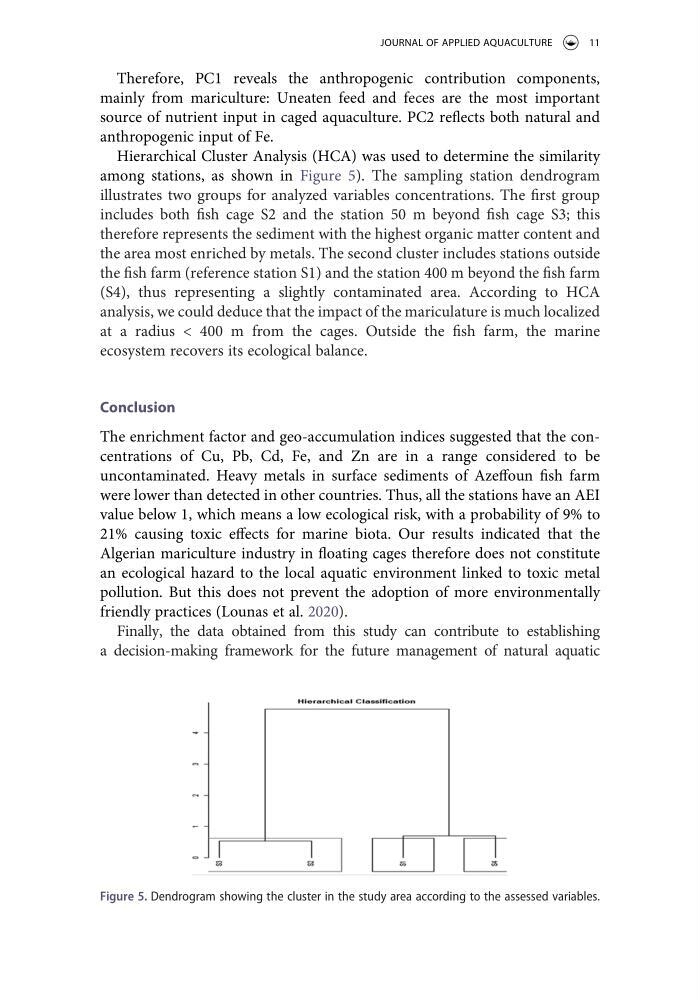
Hierarchical Cluster Analysis (HCA) was used to determine the similarity
among stations, as shown in Figure 5). The sampling station dendrogram
illustrates two groups for analyzed variables concentrations. The first group
includes both fish cage S2 and the station 50 m beyond fish cage S3; this
therefore represents the sediment with the highest organic matter content and
the area most enriched by metals. The second cluster includes stations outside
the fish farm (reference station S1) and the station 400 m beyond the fish farm
(S4), thus representing a slightly contaminated area. According to HCA
analysis, we could deduce that the impact of the mariculature is much localized
at a radius < 400 m from the cages. Outside the fish farm, the marine
ecosystem recovers its ecological balance.
Conclusion
The enrichment factor and geo-accumulation indices suggested that the concentrations of Cu, Pb, Cd, Fe, and Zn are in a range considered to be
uncontaminated. Heavy metals in surface sediments of Azeffoun fish farm
were lower than detected in other countries. Thus, all the stations have an AEI
value below 1, which means a low ecological risk, with a probability of 9% to
21% causing toxic effects for marine biota. Our results indicated that the
Algerian mariculture industry in floating cages therefore does not constitute
an ecological hazard to the local aquatic environment linked to toxic metal
pollution. But this does not prevent the adoption of more environmentally
friendly practices (Lounas et al. 2020).
Finally, the data obtained from this study can contribute to establishing
a decision-making framework for the future management of natural aquatic
Figure 5. Dendrogram showing the cluster in the study area according to the assessed variables.
JOURNAL OF APPLIED AQUACULTURE
11
mainly from mariculture: Uneaten feed and feces are the most important
source of nutrient input in caged aquaculture. PC2 reflects both natural and
anthropogenic input of Fe.
Hierarchical Cluster Analysis (HCA) was used to determine the similarity
among stations, as shown in Figure 5). The sampling station dendrogram
illustrates two groups for analyzed variables concentrations. The first group
includes both fish cage S2 and the station 50 m beyond fish cage S3; this
therefore represents the sediment with the highest organic matter content and
the area most enriched by metals. The second cluster includes stations outside
the fish farm (reference station S1) and the station 400 m beyond the fish farm
(S4), thus representing a slightly contaminated area. According to HCA
analysis, we could deduce that the impact of the mariculature is much localized
at a radius < 400 m from the cages. Outside the fish farm, the marine
ecosystem recovers its ecological balance.
Conclusion
The enrichment factor and geo-accumulation indices suggested that the concentrations of Cu, Pb, Cd, Fe, and Zn are in a range considered to be
uncontaminated. Heavy metals in surface sediments of Azeffoun fish farm
were lower than detected in other countries. Thus, all the stations have an AEI
value below 1, which means a low ecological risk, with a probability of 9% to
21% causing toxic effects for marine biota. Our results indicated that the
Algerian mariculture industry in floating cages therefore does not constitute
an ecological hazard to the local aquatic environment linked to toxic metal
pollution. But this does not prevent the adoption of more environmentally
friendly practices (Lounas et al. 2020).
Finally, the data obtained from this study can contribute to establishing
a decision-making framework for the future management of natural aquatic
Figure 5. Dendrogram showing the cluster in the study area according to the assessed variables.
JOURNAL OF APPLIED AQUACULTURE
11