

for cages and are also present in fish feed as preservative additives and as an
alternative for antibiotics (Ashfaq, Verma, and Khan 2016; Poole 2017). They
have been mentioned as tracers for animal feed pellets (Sutherland et al. 2007).
Generally, these metals are derived from the uneaten feed and excreta (feces)
(Riera et al. 2017). Cd was associated with agricultural activities (Song et al.
2017). Qiu (2015) suggested that particular attention must be focused on the
production of fish feed in relation to the contamination with Pb metal because
of its high transfer factor from food. Also, shipping operations within the
harbor (Pourabadehei and Mulligan 2016) were possible sources of these
metals. External sources consist of the periodic receipt of municipal wastewater from tourist centers and fishing boats (Nour et al. 2018).
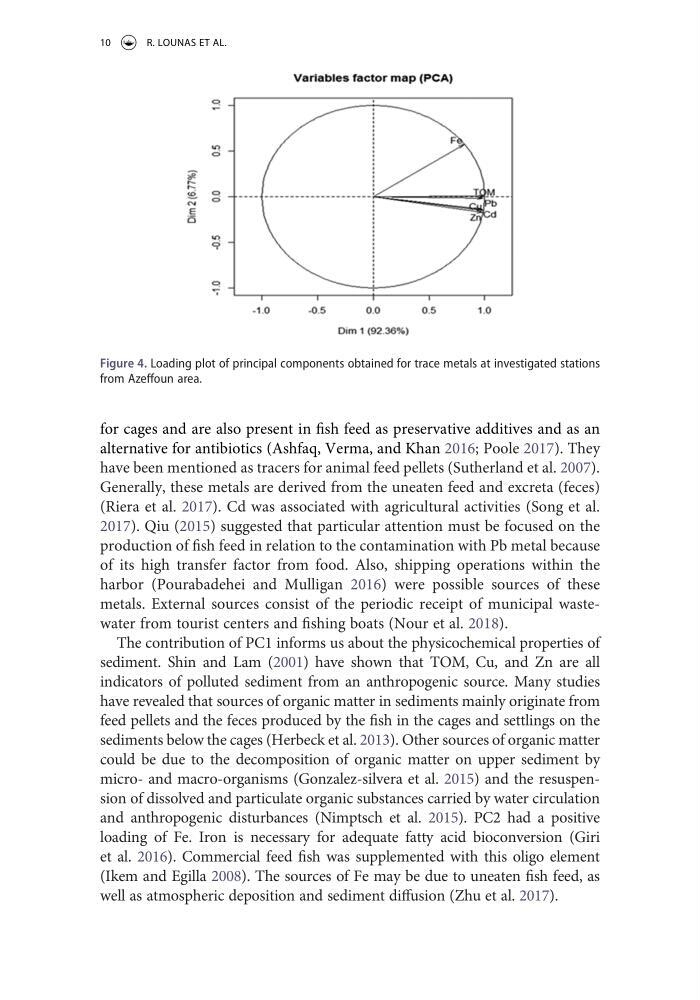
The contribution of PC1 informs us about the physicochemical properties of
sediment. Shin and Lam (2001) have shown that TOM, Cu, and Zn are all
indicators of polluted sediment from an anthropogenic source. Many studies
have revealed that sources of organic matter in sediments mainly originate from
feed pellets and the feces produced by the fish in the cages and settlings on the
sediments below the cages (Herbeck et al. 2013). Other sources of organic matter
could be due to the decomposition of organic matter on upper sediment by
micro- and macro-organisms (Gonzalez-silvera et al. 2015) and the resuspension of dissolved and particulate organic substances carried by water circulation
and anthropogenic disturbances (Nimptsch et al. 2015). PC2 had a positive
loading of Fe. Iron is necessary for adequate fatty acid bioconversion (Giri
et al. 2016). Commercial feed fish was supplemented with this oligo element
(Ikem and Egilla 2008). The sources of Fe may be due to uneaten fish feed, as
well as atmospheric deposition and sediment diffusion (Zhu et al. 2017).
Figure 4. Loading plot of principal components obtained for trace metals at investigated stations
from Azeffoun area.
10
R. LOUNAS ET AL.
alternative for antibiotics (Ashfaq, Verma, and Khan 2016; Poole 2017). They
have been mentioned as tracers for animal feed pellets (Sutherland et al. 2007).
Generally, these metals are derived from the uneaten feed and excreta (feces)
(Riera et al. 2017). Cd was associated with agricultural activities (Song et al.
2017). Qiu (2015) suggested that particular attention must be focused on the
production of fish feed in relation to the contamination with Pb metal because
of its high transfer factor from food. Also, shipping operations within the
harbor (Pourabadehei and Mulligan 2016) were possible sources of these
metals. External sources consist of the periodic receipt of municipal wastewater from tourist centers and fishing boats (Nour et al. 2018).
The contribution of PC1 informs us about the physicochemical properties of
sediment. Shin and Lam (2001) have shown that TOM, Cu, and Zn are all
indicators of polluted sediment from an anthropogenic source. Many studies
have revealed that sources of organic matter in sediments mainly originate from
feed pellets and the feces produced by the fish in the cages and settlings on the
sediments below the cages (Herbeck et al. 2013). Other sources of organic matter
could be due to the decomposition of organic matter on upper sediment by
micro- and macro-organisms (Gonzalez-silvera et al. 2015) and the resuspension of dissolved and particulate organic substances carried by water circulation
and anthropogenic disturbances (Nimptsch et al. 2015). PC2 had a positive
loading of Fe. Iron is necessary for adequate fatty acid bioconversion (Giri
et al. 2016). Commercial feed fish was supplemented with this oligo element
(Ikem and Egilla 2008). The sources of Fe may be due to uneaten fish feed, as
well as atmospheric deposition and sediment diffusion (Zhu et al. 2017).
Figure 4. Loading plot of principal components obtained for trace metals at investigated stations
from Azeffoun area.
10
R. LOUNAS ET AL.